The storyWhy this reference matters
Seiko launched the calibre 6139 in the spring of 1969, in the middle of the race for the first automatic chronograph against Zenith and the Heuer-Breitling-Hamilton consortium. It brought two things that still mark out an expensive watch today: a column wheel and a vertical clutch, the first ever fitted to a chronograph. And one engineer's decision: since the rotor wound it more than well enough, it had no manual winding at all.
Astronaut William Pogue had not been issued his Speedmaster during training for the Skylab 4 mission, so in 1972 he bought a yellow-dialled 6139-6005 at the base exchange — the Seiko Museum puts the price at 71 dollars — and timed manoeuvres and engine burns with it. He flew with both watches: the regulation Omega and the Seiko he knew. The mission ran from 16 November 1973 to 8 February 1974, eighty-four days and 1,214 orbits of the Earth.
Nobody knew until photographs of Pogue in Skylab with the Seiko on his wrist surfaced online in 2006; until then the first automatic chronograph in space was assumed to have been a Sinn. Pogue auctioned the watch in 2008 for the astronauts' scholarship foundation, 6139 prices jumped overnight, and a market in spare parts and "new" dials sprang up behind them.
SpecificationsThe numbers, in one table
| Brand | Seiko |
|---|---|
| Family | 6139 |
| Reference | 6139-6005 / 6139-6002 |
| Years made | 1969–1978 |
| Calibre | Seiko 6139 |
| Movement | Automático (sin cuerda manual) |
| Frequency | 21.600 alt/h |
| Jewels | 17 |
| Complications | Cronógrafo de 30 minutos · Día y fecha con ajuste rápido · Bisel interior giratorio |
| Diameter | 41 mm |
| Lug to lug | 46 mm |
| Lug width | 19 mm |
| Case | Acero |
| Crystal | Hardlex |
| Water resistance | 70 m |
IdentificationHow to tell it apart
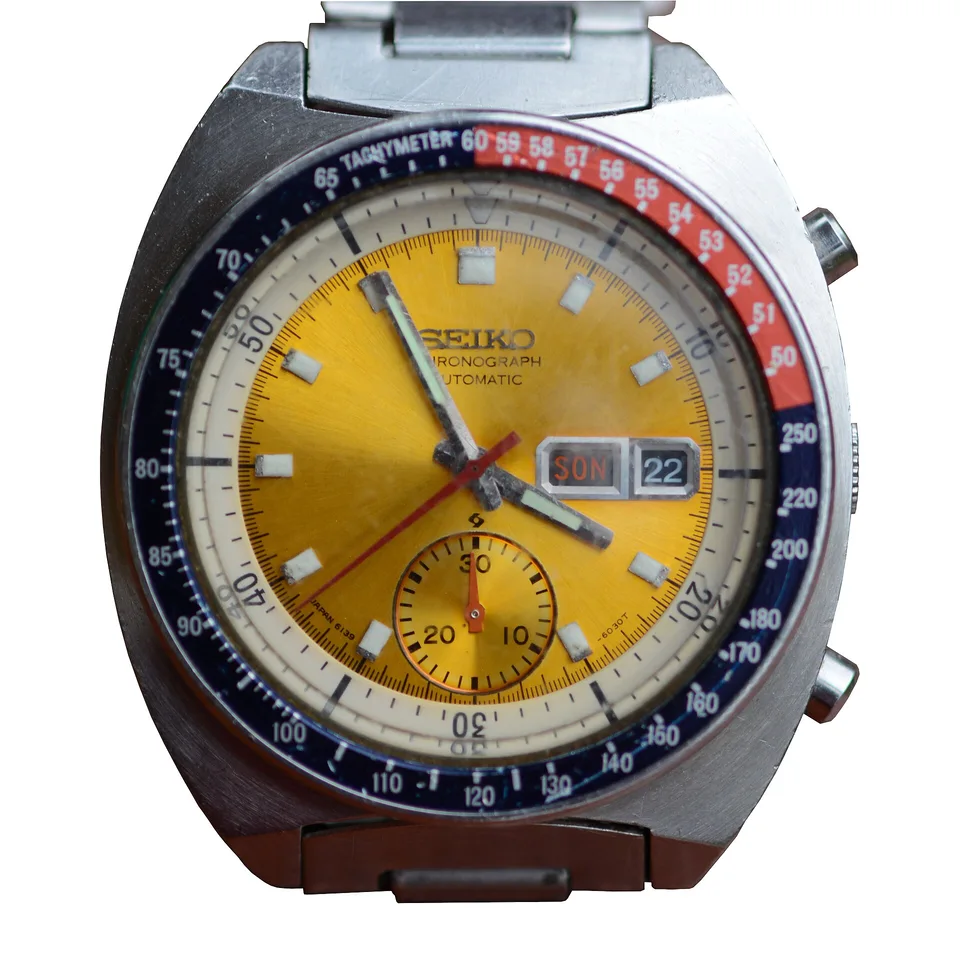
The "true Pogue" is a 6139-6005, the North American reference, with a yellow dial reading "WATER 70m RESIST". The 6139-6002 is its export twin for the rest of the world: same case, same calibre, same yellow dial, with only the print under the logo changing — "CHRONOGRAPH AUTOMATIC" on the -6002 against "AUTOMATIC" and "17J." on the -6005. The 6139-6000 is the Japanese version, the only one with a 21-jewel calibre.
The dial text dates the watch: "WATER 70m PROOF" from 1969 to mid-1970, "WATER 70m RESIST" from then until late 1972, and no water marking after that. The serial number on the case back gives month and year: the first digit is the year of the decade, the second the month. Pogue's, 190945, left the factory in September 1971.
The outer bezel with its blue and red tachymeter scale — the "Pepsi" — changed in mid-1976, when a white block appeared at the 60; the yellow inner bezel turns from the crown and sits loose between crystal and case, so it is the first thing to wear. Date and day are set by pushing the crown in, not by turning it.
CollectingWhat collectors check
Since 2006, dials, hands, bezels and even cases "just like the originals" have been made in industrial quantities, and many 6139s for sale are new parts assembled around an old calibre. A dial with print too clean, without the corrosion around the minute counter that original Hamazawa dials typically show, is suspect by definition.
Chronograph hands were routinely replaced during service, so the original two-piece hands are rarely seen; a minute-counter hand in a different colour from the rest is a replacement. And the calibre exists in two versions, 6139A until mid-1971 and 6139B after, with chronograph parts that do not interchange between them.
The mechanical weak point is the clutch: once worn, the central chronograph hand takes more than sixty seconds to complete a lap. Spare parts are getting scarce. Ask for a video of the chronograph running before you bid, and price in a service if nobody can document one.
Common questionsWhat people ask us about this reference
Which watch did William Pogue wear on Skylab?
A yellow-dialled Seiko 6139-6005, bought in 1972 at his base exchange, alongside the regulation Omega Speedmaster. It was the first automatic chronograph in space; the story only came out in 2006.
What is the difference between the 6139-6005 and the 6139-6002?
The market and the dial text. The -6005 was sold in North America and reads "AUTOMATIC" and "17J."; the -6002 is the export version for the rest of the world and reads "CHRONOGRAPH AUTOMATIC". Case, calibre and colours are the same.
Can the 6139 be wound by hand?
No. Seiko designed it with automatic winding only, because the rotor wound it more than well enough. If it stops, you shake it or swing it a few times to get it going.
Was it the world's first automatic chronograph?
Seiko claims so, and launched it in the spring of 1969, the same year as the Zenith El Primero and the Calibre 11 of Heuer, Breitling and Hamilton. Who reached the shops first is still argued; what is not argued is that it was the first with a vertical clutch.
Keep readingWhere to go from here
Close relativesThe ones it gets confused with
Every Monday we send seven vintage watches at auction, picked one by one and explained. One email a week, nothing else.
Confidence: alta — this page was checked against the sources below. If a detail looks wrong to you, write to us and we will fix it.