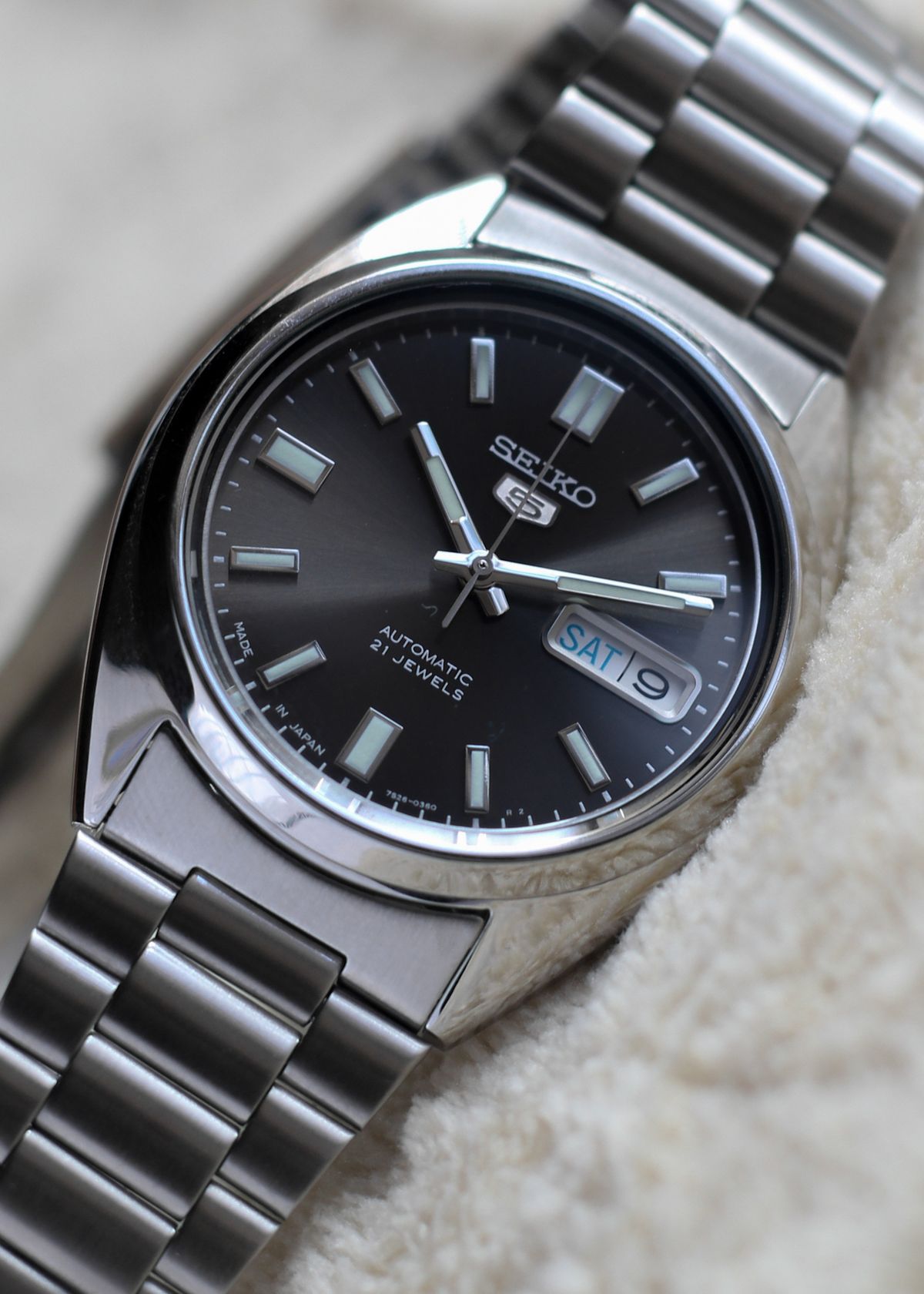
Seiko's calibre numbers run into the hundreds, and the family tree behind those four-digit codes is the most tangled in Japanese watchmaking, which is a fair part of the appeal. No attempt is made here to list them all. What follows are the movements that defined the brand, the ones a collector meets again and again on the vintage market, and the ones that make a real difference to price, rarity and demand. Click a calibre number for the full page.
| Calibre | Type | Jewels | Frequency | Years | Key note |
|---|---|---|---|---|---|
| 6217 | Automatic | 17 | 18,000 vph | 1965 – 1968 | The 62MAS: Seiko's first diver |
| 6105 | Automatic | 17 | 18,000 vph | 1968 – 1977 | The "Captain Willard" |
| 6309 | Automatic | 17 | 21,600 vph | 1976 – 1988 | The "Turtle" |
| 6139 | Automatic chronograph | 17–21 | 21,600 vph | 1969 – 1979 | The world's first automatic chronograph |
| 6138 | Automatic chronograph | 17–21 | 21,600 vph | 1969 – 1979 | The "Bullhead" and the "UFO" |
| 7S26 | Automatic | 21 | 21,600 vph | 1996 – 2020 | The engine of the SKX and the Seiko 5 |
| 4R36 | Automatic | 24 | 21,600 vph | 2010 – present | The 7S26, now with hacking and hand-winding |
| 8L35 | Automatic | 26 | 28,800 vph | 2000 – present | Top-tier mechanical; Marine Master 300 |
| 9S5x / 9S6x | Automatic / hand-wound | — | 28,800 – 36,000 vph | 1998 – present | The mechanical heart of Grand Seiko |
| 9R | Mechanical-quartz hybrid | — | — | 1999 – present | Spring Drive: the seconds hand that never ticks |
How to identify a vintage Seiko
Unlike most Swiss brands, Seiko almost always stamps the full case number — case reference plus serial — on the back: something like "6309-7040" followed by six digits. The first two digits of the serial give the year of manufacture (the scheme resets from one decade to the next, so cross-check it against the calibre), and the third digit gives the month.
The exact calibre hardly ever appears on the dial, but it is on the movement — visible through a display back, or once the case is open. Matching the case number against the calibre actually fitted is the surest way to date and verify a vintage Seiko, and far better than going by the dial design, which Seiko reused across different periods and different calibres.