
In one line
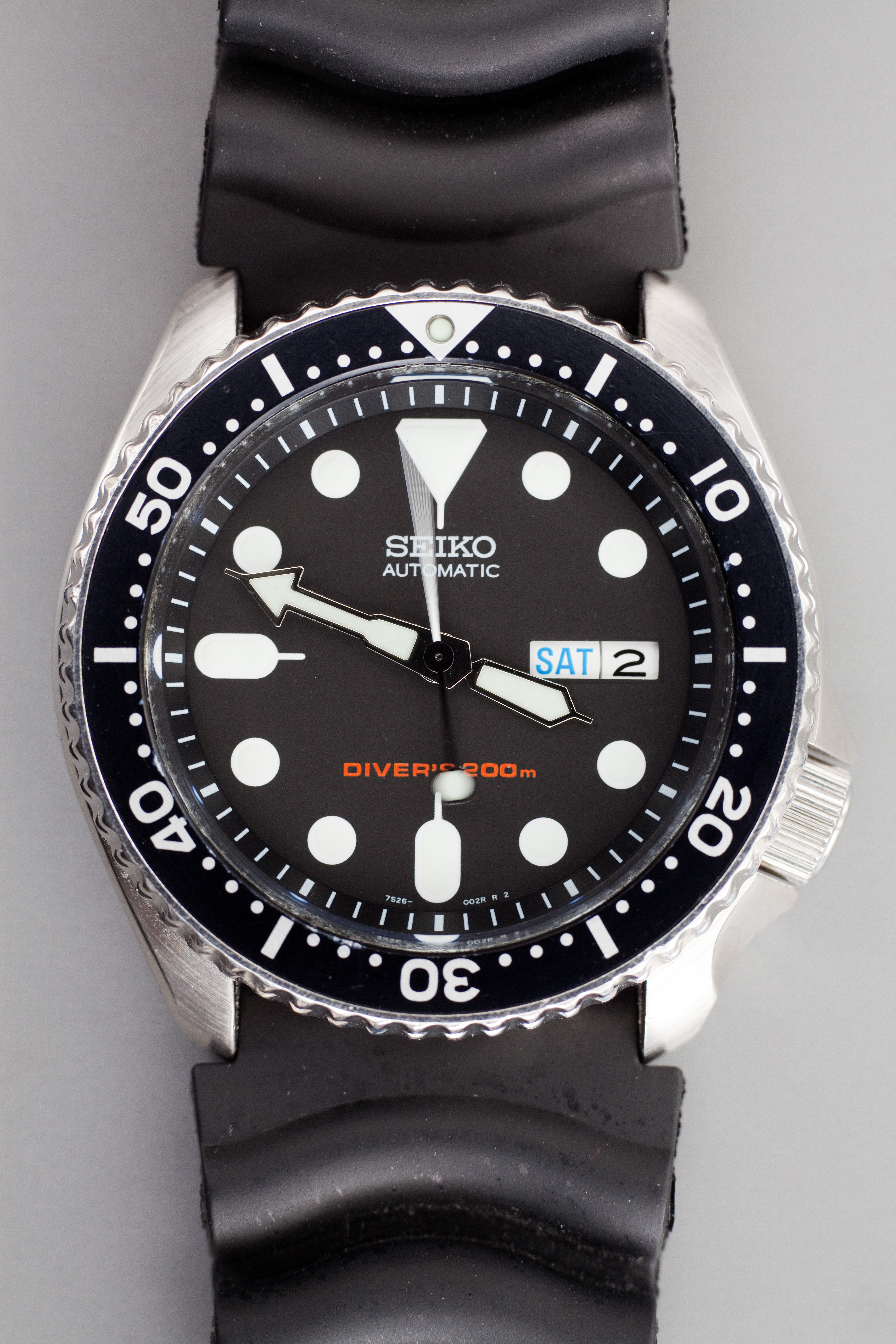
Twenty-three years inside almost every Seiko 5 and inside the SKX007. It will not hack, it will not take hand winding and it will survive whatever you throw at it: Seiko designed it to cost little and last long, in exactly that order.
First thing you want to know: is that Seiko a 7S26 or a 4R36?
This is what brings a lot of people here, because the two watches look much the same in a listing photograph. The answer is not on the dial. It is in the reference.
SRPD, the "5KX" — calibre 4R36. It hacks and it hand-winds, but it drops to 100 m and is not ISO rated.
So the replacement improved the movement and made the watch worse. The 4R36 does the two things the 7S26 always lacked; in exchange, the SRPD stopped being a certified diver. Nobody hunting an SKX is hunting hacking seconds — they are after the 200 metres and the case.
And if you open one to find an NH36 where you expected the 7S26, that is not bad news either. The NH36 is the same 4R36 that Seiko Instruments sells to third parties, and it drops into the original's place with nothing to adapt: same dimensions, same stem, same dial feet. It is the swap almost every watchmaker makes when a 7S26 dies.
7S26 against 4R36: where you actually feel it
Seiko swapped one for the other when it withdrew the SKX. They run at the same frequency and hold the same charge; the change is in what the crown will do.
| Calibre 7S26 | Calibre 4R36 | |
|---|---|---|
| Hacking seconds | No | Yes |
| Hand winding | No | Yes |
| Jewels | 21 | 24 |
| Frequency | 21,600 vph | 21,600 vph |
| Power reserve | ~41 hours | ~41 hours |
| Stated accuracy | −20/+40 s/day | −35/+45 s/day |
| Years | 1996 – 2019 | 2011 onwards |
Yes, you read the second-to-last row correctly: Seiko quotes a wider spread for the successor than for the calibre it replaces. That does not mean the 4R36 runs worse. It means those figures are warranty commitments, not measurements of performance. Nobody buys either one for its accuracy.
Underneath, it is the same architecture of 1996, with the same Magic Lever. The 4R36 has gained a hand-winding clutch and a stop lever, and little else.
Why it exists
The 7S26 was not designed to be good. It was designed, in 1996, to be built in industrial quantities for next to nothing, and it replaced the 7009 across the Seiko 5 range. Stamped parts where others machine them, no hand-winding clutch, no stop lever, and the Magic Lever — a pawl with two claws — feeding the mainspring from both directions of rotor travel.
There were three versions, and hardly anybody can tell them apart. The 7S26A is the original. The 7S26B followed in 2006 with an Etachron-type regulator, which finally made the hairspring stud adjustable. The 7S26C appeared around 2011 with a redesigned balance assembly, partly so it could share parts with the 4R and 6R families. There is also a 23-jewel brother, the 7S36, with two extra stones split between the third wheel and the escape wheel.
It was assembled in Japan, in Malaysia and in Singapore, and went out of production when Seiko withdrew the SKX in the second half of 2019. Twenty-three years doing exactly the same job.
Three things almost nobody knows
- The 5 in Seiko 5 is a shopping list. Five specific promises: automatic winding, day and date in a single window, water resistance, a recessed crown at four o'clock, and a case and bracelet built to last. It began with the Sportmatic 5 of 1963, the first Japanese automatic with day and date. The 7S26 delivers the first two on its own.
- The day wheel comes in two languages because Seiko sold everywhere. Rather than make a separate disc for every market, Seiko fitted bilingual wheels and let the buyer choose by turning the crown. A watch sold in Spain will alternate the days in Spanish and English on the same disc. That is not a fault or an import oddity: it is the standard part.
- The early ones could not be fully regulated. The 7S26A left the factory with a fixed hairspring stud: a watchmaker could move the index, but could not put the balance in beat — what the timing machine reads as beat error. That was corrected in 2006 with the 7S26B. If you take a 1990s SKX in for regulation and are told that is as far as it goes, you are not being fobbed off.
Technical data
| Type | Automatic with day and date, no hacking and no hand winding |
|---|---|
| Frequency | 21,600 vph (3 Hz) |
| Jewels | 21 — 23 in the 7S36 sibling |
| Power reserve | ~41 hours |
| Stated accuracy | −20/+40 s/day |
| Winding system | Magic Lever, bidirectional |
| Shock protection | Diashock |
| Versions | 7S26A (1996) · 7S26B (2006) · 7S26C (c. 2011) |
| Replaces | Calibre 7009 |
| Replaced by | Calibre 4R36 / NH36 |
| Production | 1996 – 2019 |
What a watchmaker checks before touching one
The first thing you will be told is that repairing it does not add up. A full strip, clean and oil costs more than a new movement, and the 4R36 — or its NH36 twin — drops into the space with nothing to adapt. Servicing a 7S26 therefore nearly always means replacing it. That is not laziness on the watchmaker's part: Seiko designed it that way.
Testing one means shaking it, because there is no other way to wind it. Thirty or forty gentle shakes should start it and keep it going. If it starts and stops, or if the rotor rattles as you turn your wrist, the rotor bearing is worn — the classic failure, and rarely worth repairing.
And do not use the official tolerance to excuse anything. A healthy 7S26 gains somewhere between ten and twenty-five seconds a day. If yours loses thirty a day it is not "within specification": it is dirty, magnetised or tired.
Watches that used it
- SKX007 / SKX009 — the 200 m diver with ISO 6425, up to 2019
- SKX779 / SKX781 "Monster"
- Much of the Seiko 5 line between 1996 and 2019 (SNK, SNXS, SNKL…)
- Seiko 5 Sports with the 23-jewel 7S36
- Its successor, the Seiko 5 Sports SRPD "5KX", on the calibre 4R36
After the successor? It has a page of its own: calibre 4R36. And if you are looking for the grandfather of the family, the 6309 did not hack either.