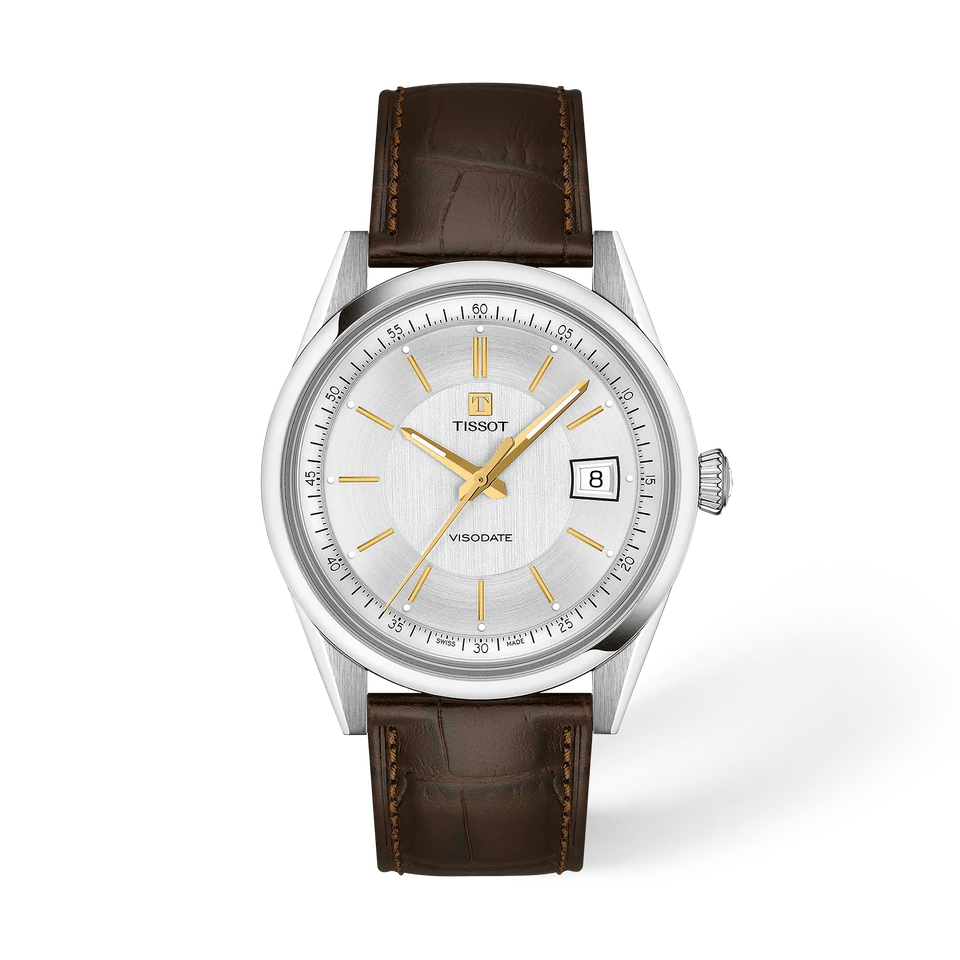
Imagen: Tissot, web oficial
The storyWhy this reference matters
In 1953, Tissot's centenary year, the firm launched the first automatic whose date changed in one snap as the clock struck twelve rather than sliding over the best part of half an hour. Today it sounds like nothing; then it was the state of the art, and the proof is that Rolex took two more years to work that instant jump into the Datejust. The Visodate name stuck to the family and it's still there, 70 years later, holding up an entire collection.
The modern version arrived in 2010: the Heritage Visodate, 40 mm across and 11.6 mm tall, with an ETA 2836-2 at 4 Hz, 40 hours of reserve and the day of the week beside the date in a single window, Sundays printed in red. For more than a decade it was one of the most recommended ways into Swiss watchmaking, and also one of the thickest watches in its class.
In 2026 Tissot redesigned it from the ground up and the result is a different watch. It drops to 39 mm and 10.45 mm thick — a millimetre narrower and 1.2 shallower — and gains straight lugs, a flat polished bezel and a polished chamfer along the case edge, takes a box-domed sapphire, and swaps the 2836-2 for the Powermatic 80. And along the way it loses the day of the week.
SpecificationsThe numbers, in one table
| Brand | Tissot |
|---|---|
| Family | Visodate |
| Reference | T157.407.16.031.00 |
| Years made | desde 2026 |
| Calibre | Tissot Powermatic 80 (base ETA C07) |
| Movement | Automático |
| Frequency | 21.600 alt/h (3 Hz) |
| Power reserve | 80 horas |
| Complications | Fecha |
| Diameter | 39 mm |
| Thickness | 10.45 mm |
| Lug width | 20 mm |
| Case | Acero inoxidable 316L |
| Crystal | Zafiro abombado tipo box con tratamiento antirreflejos en la cara interior |
| Water resistance | 50 m (5 bar) |
IdentificationHow to tell it apart
The one-second check: is there a day of the week? If the window shows day and date together, you're looking at the older 40 mm Heritage Visodate. The 2026 watch shows the date only, in a framed trapezoidal window at three. That's the feature that tells the two generations apart with no room for error.
The measurements confirm it: 39 mm across, 10.45 mm thick and 20 mm lugs, against 40 by 11.6 on the older watch. The dial mixes circular and vertical brushing with contrasting finishes, and the crystal is domed, not flat. Display case back and 50 metres of water resistance.
The collection launched with three dials: silver with gold indices on alligator-grain brown leather — this reference, T157.407.16.031.00 — black with silver indices on a steel bracelet, and dark blue, also on the bracelet. If you see a silver dial fitted to steel from the factory, check the reference before you assume anything.
CollectingWhat collectors check
The change of calibre is the decision to weigh up. The Heritage Visodate carried an ETA 2836-2 at 4 Hz, 25 jewels and 40 hours of reserve, with day and date. The new one takes the Powermatic 80: 3 Hz, 80 hours and an antimagnetic Nivachron hairspring, but date only. You gain two long days of autonomy and peace of mind around magnets; you lose half a beat of frequency and one indication. There's no right answer, only preferences.
Fifty metres of water resistance puts it where it belongs: an everyday watch, rain and wet hands without drama, no pool and no sea. The box-domed crystal is handsome and also a weak point, because the edge stands proud and is the first thing to meet a door frame. Look at that rim on any used example.
Being a 2026 model, the used market is still all but empty. What there is plenty of is the 40 mm Heritage Visodate, and the two are not interchangeable: if it's specifically the new one you want, confirm the diameter and the missing day before you bid on anything. On the leather strap, check the original quick-release system is still there.
Common questionsWhat people ask us about this reference
Does the Tissot Visodate show the day of the week?
The 2026 Visodate doesn't: it shows the date only, in a trapezoidal window at three. The older 40 mm Heritage Visodate did show day and date together in a single window.
What's special about the Visodate's date?
The 1953 original was the first automatic whose date snapped over at midnight instead of creeping round. Rolex didn't add that instant jump to the Datejust until 1955.
How much power reserve does the new Visodate have?
Eighty hours, thanks to the Powermatic 80 calibre. That's double the 40 hours the older Heritage Visodate's ETA 2836-2 gave, at the cost of dropping the beat rate from 4 to 3 Hz.
Can you swim with the Tissot Visodate?
It isn't the watch for it. With 50 metres of water resistance it handles rain, splashes and washing your hands, but for regular swimming you want more margin and a screw-down crown.
Keep readingWhere to go from here
Close relativesThe ones it gets confused with
Confidence: alta — this page was checked against the sources below. If a detail looks wrong to you, write to us and we will fix it.