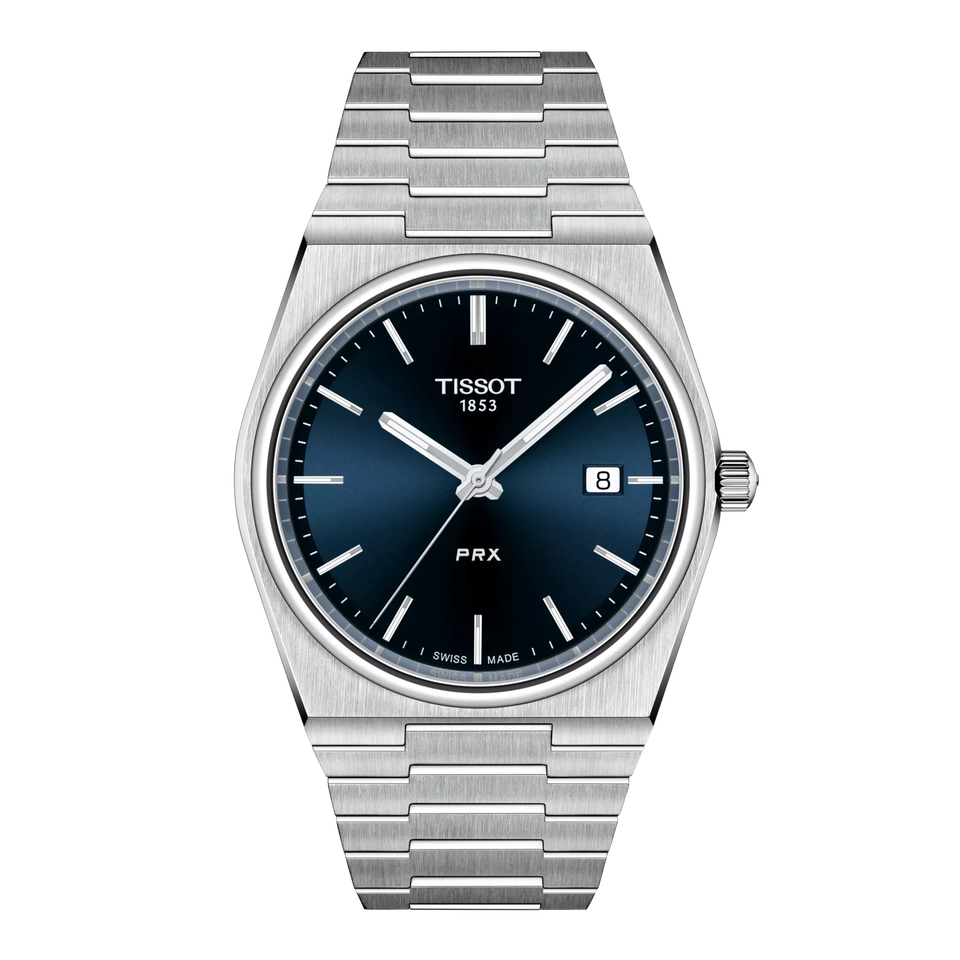
Imagen: Tissot, web oficial
The storyWhy this reference matters
In his first week running Tissot, in 2020, Sylvain Dolla went digging through the brand's archive and came out with an original PRX. What followed was quick: the team CT-scanned the piece to copy its proportions without distorting them, grew it to 40 mm and put it on sale in February 2021. No round anniversary, no commemorative excuse. It was sitting in a drawer, and somebody decided it deserved another go.
The 1978 original wasn't called PRX. It came out as a Seastar, with a flat barrel case, a prominent bezel, sharp edges everywhere and an integrated bracelet of wide links: the affordable answer to the Royal Oak and the Nautilus, which had spent a few years showing the way. The PRX name was registered later and the acronym is fairly literal: PR for Precise and Robust, and the X of the Roman ten, for ten atmospheres of water resistance.
That Seastar was a quartz watch, and the detail matters: the version Tissot sold first in 2021, the one on this page, is the faithful one. The automatic came afterwards. The forecasts got away from them — Dolla admitted they had to multiply initial production twentyfold and there were still waiting lists — and everything else grew out of that success: the 35 mm, the chronograph, the titanium, the Damascus steel. It all started with this battery-powered watch.
SpecificationsThe numbers, in one table
| Brand | Tissot |
|---|---|
| Family | PRX |
| Reference | T137.410.11.041.00 |
| Years made | desde 2021 |
| Calibre | ETA F06.115 |
| Movement | Cuarzo |
| Frequency | 32.768 Hz |
| Complications | Fecha · Indicador de fin de vida de la pila (EOL) |
| Diameter | 40 mm |
| Thickness | 10.4 mm |
| Lug to lug | 44 mm |
| Lug width | 12 mm |
| Case | Acero inoxidable 316L |
| Crystal | Zafiro resistente a los arañazos |
| Water resistance | 100 m (10 bar) |
IdentificationHow to tell it apart
You can tell quartz from automatic without opening anything: look at the dial. The quartz one is plain vertical brushing; the Powermatic 80 has a stamped waffle relief. From the back the difference is clearer still, because this reference has a solid steel case back and the automatic a sapphire one. And the thickness gives it away: 10.40 mm here against 10.93 on the automatic.
The reference gives it away before the dial does. Within the 40 mm family, T137.410 is the quartz and T137.407 the Powermatic 80; the .041 block is the blue dial on a steel bracelet. The case: 40 mm wide, 39.50 long according to Tissot, 12 mm lugs and 130 grams with the bracelet fitted.
The 12 mm integrated lug is the classic trap. A standard 20 mm strap will not go in, however wide the case: the fitting is proprietary and quick-release, and only the straps Tissot makes for the PRX will do. The steel bracelet closes on a butterfly clasp with pushers.
CollectingWhat collectors check
Inside is an ETA F06.115, a Swiss three-hand quartz with a date and an end-of-life indicator: when the charge runs down, the seconds hand warns you by changing its rhythm. It is an entry-level movement and it was never meant to come apart; when the time comes, the whole thing is replaced. That isn't a hidden flaw, it is how affordable Swiss quartz has worked for thirty years.
The thing to know before buying one blind: Worn & Wound measured 44 mm from case tip to case tip, but the first link of the bracelet doesn't articulate, so on the wrist it behaves as though it were 51. Under a 16 cm wrist that shows, and it shows badly. Trying it on here isn't a stock piece of advice, it is the advice.
Second-hand, the bracelet is the expensive part: spare links are scarce and the butterfly clasp suffers if anyone has forced it. Check every link is there and that the clasp lines up without play. The brushed dial forgives very little and any mark shows up against the light. And be wary of listings selling it as a "vintage PRX": the 1978 watch is a different thing and it goes under the Seastar name.
Common questionsWhat people ask us about this reference
Did Gérald Genta design the Tissot PRX?
No source credits him with it. The 1978 Seastar was born in the wake of the Royal Oak and the Nautilus, which are his, and that is where the confusion comes from. Tissot has never linked the PRX design to his name.
What is the difference between the quartz PRX and the automatic?
A brushed dial against a waffle relief dial, a steel case back against sapphire, and 10.40 mm of thickness against 10.93. The quartz is thinner and more casual; the automatic gives you 80 hours of power reserve.
How long does the Tissot PRX battery last?
Tissot doesn't publish an figure for this reference. Owners report between two and five years depending on use. The EOL indicator warns you before it stops, so you get time to book it in.
Can you change the PRX strap?
Yes, but only with parts from the PRX catalogue. The lug is integrated and 12 mm wide, so a standard 20 mm strap won't fit. Tissot sells quick-release rubber and leather straps for this case.
Keep readingWhere to go from here
Close relativesThe ones it gets confused with
Confidence: alta — this page was checked against the sources below. If a detail looks wrong to you, write to us and we will fix it.