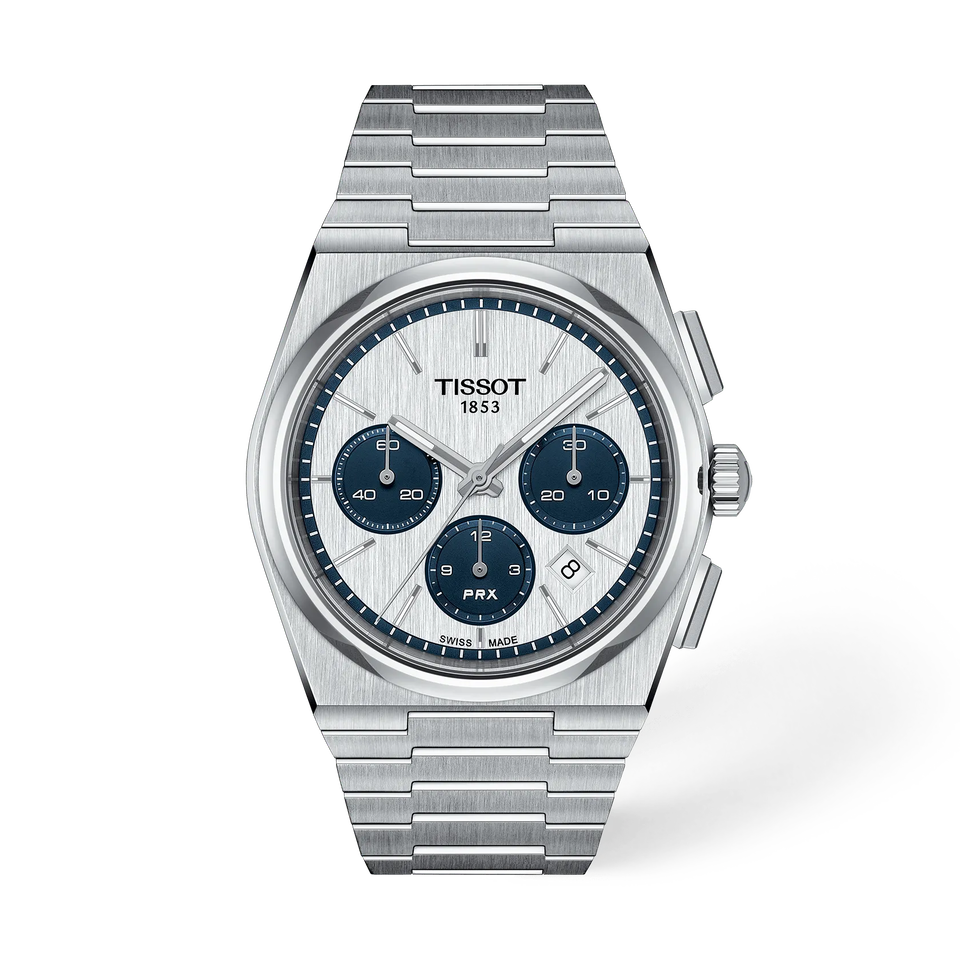
Imagen: Tissot, web oficial
The storyWhy this reference matters
The original PRX dates from 1978 and was called the Seastar PRX: P for Precise, R for Robust and an X that isn't a letter at all but the Roman ten, for ten bar of water resistance. Case and bracelet formed a single piece, in the flattened barrel profile the industry churned out for half a decade and then buried without ceremony. Tissot dug it up in 2021 and landed its biggest commercial success in years.
The chronograph arrived in 2022 and changed the scale of the project. Inside is the ETA A05.H31, derived from the Valjoux 7753: twenty-seven jewels, 4 Hz, cam switching instead of a column wheel — the decision that keeps the whole thing priced where it is — and perlage decoration with a skeletonised rotor visible through the back. Tissot quoted sixty hours of reserve at launch; the current spec sheet for this reference says sixty-five.
The technical detail that explains the dial is the 7753 itself. The familiar 7750 puts its counters at six, nine and twelve, a triangle pushed upwards that forces you to design the dial around it. The 7753 rearranges them to three, six and nine, which makes the face symmetrical and puts the date on the centre line. Without that movement, a PRX chronograph looking like this wouldn't exist.
SpecificationsThe numbers, in one table
| Brand | Tissot |
|---|---|
| Family | PRX |
| Reference | T137.427.11.011.01 |
| Calibre | Valjoux A05.H31 (base 7753) |
| Movement | Automático |
| Frequency | 28.800 alt/h (4 Hz) |
| Power reserve | 65 horas |
| Jewels | 27 |
| Complications | Cronógrafo · Fecha |
| Diameter | 42 mm |
| Thickness | 14.54 mm |
| Case | Acero inoxidable 316L |
| Crystal | Zafiro con antirreflejos |
| Water resistance | 100 m (10 bar) |
IdentificationHow to tell it apart
Forty-two millimetres and 14.54 thick, a brushed 316L steel case, pushers built into the flank at two and four, and an anti-reflective sapphire crystal. This reference is the white dial with the three counters in contrast; Tissot's own catalogue calls it a reverse panda. The near-identical T137.427.11.011.00 comes in silver with black counters and rose gold details.
Don't confuse it with the PRX Powermatic 80: that one is a three-hander with a date, measures 40 mm and has no pushers. The chronograph always comes on the integrated single-link bracelet, tapering to a butterfly clasp, with quick-change levers tucked under the lugs.
Through the display back you should see a skeletonised rotor over a perlage-finished mainplate, and on the dial three counters at three, six and nine with the date on the centre line. If the counters sit at six, nine and twelve, the movement is not the A05.H31.
CollectingWhat collectors check
Fit is the whole question with this watch. With an integrated bracelet you can't correct the drape by changing strap: what you see is what you get, and fourteen and a half millimetres of thickness on a forty-two millimetre case makes itself felt under a shirt cuff. Try it on before buying at a distance, because no strap is going to rescue the wrong fit here.
On an integrated case, polishing is the enemy. Flat brushed surfaces and polished chamfers define the silhouette, and a pass with a motor rounds them off for good. Hold the flank up to the light and look for waviness: if the brushing has lost its direction or the edges have gone soft, somebody has been at it with more enthusiasm than judgement.
On the movement, check that all three counters reset to zero and how the integrated pushers feel: they work at a different angle from a conventional pusher and pick up dirt sooner. And test the reserve by actually running it down. Between the sixty hours announced in 2022 and the sixty-five on the current spec sheet there is plenty of room to spot a tired movement.
Common questionsWhat people ask us about this reference
What does PRX stand for?
Precise, Robust and the X of the Roman ten, for ten bar of water resistance. The 1978 original was called the Seastar PRX and already had the integrated case and bracelet.
Which calibre does the PRX Chronograph Automatic use?
The ETA A05.H31, derived from the Valjoux 7753. It beats at 4 Hz, counts twenty-seven jewels and uses cam switching rather than a column wheel.
How big is the PRX chronograph?
Forty-two millimetres across and 14.54 thick, with 100 metres of water resistance and an integrated bracelet. It is considerably more watch than the 40 mm three-hand PRX.
Can you change the bracelet?
Yes, through the quick-release system, but only for straps whose end is cut to fit the 42 mm PRX. A conventional straight strap won't go in.
Keep readingWhere to go from here
Close relativesThe ones it gets confused with
Confidence: media — this page was checked against the sources below. If a detail looks wrong to you, write to us and we will fix it.