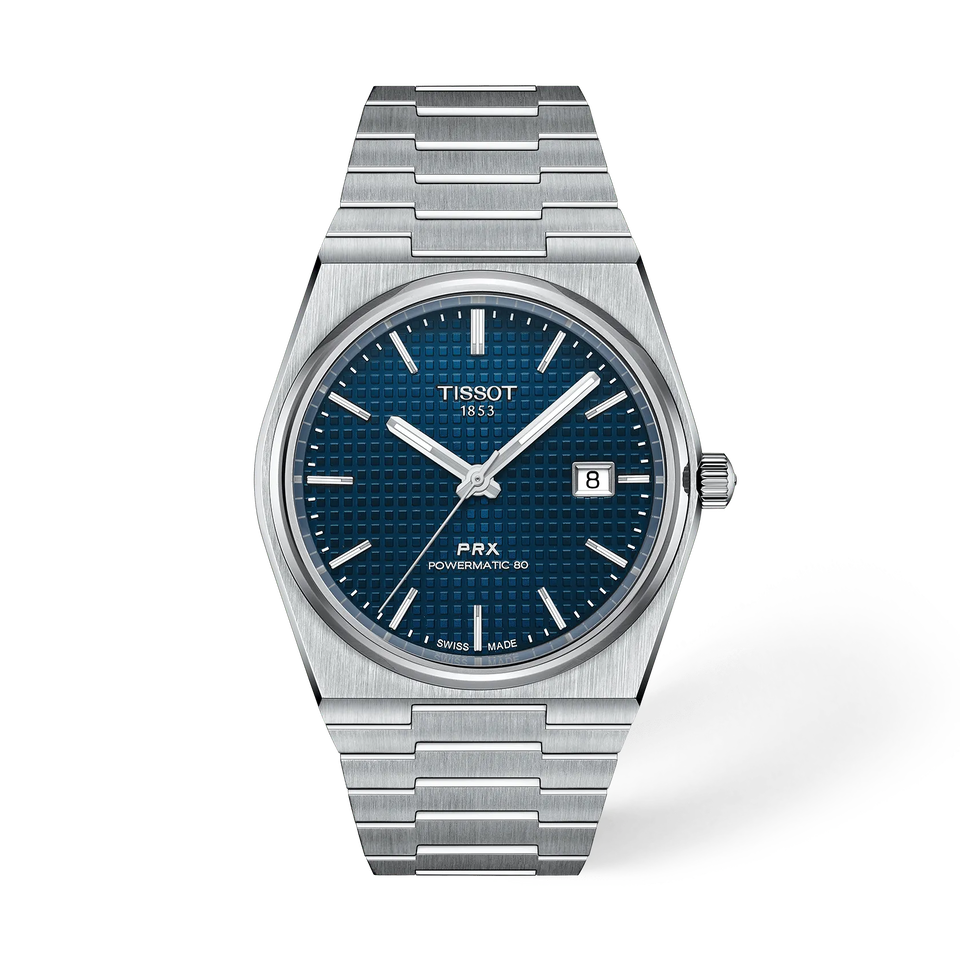
Imagen: Tissot, web oficial
The storyWhy this reference matters
The modern PRX begins in an archive. In 2020, newly installed in the job, Tissot's chief executive found an original 1978 PRX — sold at the time under the Seastar name — and decided to bring it back. They CT-scanned the case to keep its proportions honest, grew it to 40 mm and went on sale in February 2021. The PRX name, registered years after the original, means Precise, Robust and the X of the Roman ten, for ten atmospheres.
The quartz version came first. The automatic followed, and Tissot took the chance to separate the two with more than a movement: it got a dial stamped in relief with a honeycomb pattern, the waffle motif that has become the line's visual signature, and a case back opened up with sapphire. In practice the automatic PRX is a different watch from the battery one, not the same case with another heart in it.
Inside is the Powermatic 80, an ETA C07.11: a reworked 2824 with a new gear train and an improved barrel. The frequency drops from 4 to 3 Hz — 21,600 vibrations per hour — and in exchange the reserve climbs to 80 hours. Twenty-three jewels and an antimagnetic Nivachron hairspring. This is the calibre that has let the group sell Swiss automatics with three days of autonomy at prices that would have been unthinkable fifteen years ago.
SpecificationsThe numbers, in one table
| Brand | Tissot |
|---|---|
| Family | PRX |
| Reference | T137.407.11.041.00 |
| Years made | desde 2021 |
| Calibre | Tissot Powermatic 80 (base ETA C07.11) |
| Movement | Automático |
| Frequency | 21.600 alt/h (3 Hz) |
| Power reserve | 80 horas |
| Jewels | 23 |
| Complications | Fecha |
| Diameter | 40 mm |
| Thickness | 10.93 mm |
| Lug to lug | 44 mm |
| Lug width | 12 mm |
| Case | Acero inoxidable 316L |
| Crystal | Zafiro con tratamiento antirreflejos en la cara interior |
| Water resistance | 100 m (10 bar) |
IdentificationHow to tell it apart
The decisive difference from its quartz sibling is the dial: there is relief here, a stamped honeycomb that catches the light on the diagonal. The quartz is plain vertical brushing. Round the back, this one has sapphire and that one solid steel. And the thickness climbs from 10.40 to 10.93 mm for exactly that reason.
The reference gives it away too. In the 40 mm family, T137.407 is the Powermatic 80 and T137.410 the quartz; the .041 block is the blue dial on a steel bracelet. A third clue you can see with the naked eye: running at 3 Hz, the seconds hand moves in six steps a second, a choppier sweep than a 4 Hz automatic and nothing like the dry tick of quartz.
The case measures 40 mm wide by 39.50 long according to Tissot, and the integrated lug is 12 mm. That proprietary fitting is why you can't put a standard strap on it: only the quick-release parts from the PRX catalogue will go in. The bracelet closes on a butterfly clasp with pushers.
CollectingWhat collectors check
The awkward fact before you buy: Monochrome measures 44 mm from case tip to case tip, but Worn & Wound pointed out that the first bracelet link doesn't articulate, so the whole thing behaves as though it were 51. On a flat or narrow wrist that means the bracelet never quite wraps and the ends lift. It is the most discussed flaw in the 40 mm line and the reason Tissot eventually produced the 38.
The 80 hours changes how you live with it more than you would expect. Put it down on Friday afternoon and it is still on time on Monday morning without touching the crown. The price of that autonomy is a lower frequency, so don't expect the rate stability of a well-regulated 4 Hz calibre. The Nivachron hairspring, on the other hand, buys genuine peace of mind around speaker magnets and handbag clasps.
Second-hand, the integrated bracelet rules everything. Spare links are scarce and expensive, so count what comes with it and check the butterfly clasp lines up without play. Look at the sapphire in the case back too, which on hard-worn examples arrives scratched by the clasp or from setting the watch down on its back. And hold the waffle dial against the light: the relief records every scuff and there is no touching it up.
Common questionsWhat people ask us about this reference
What is the difference between the automatic PRX and the quartz?
The automatic has a waffle relief dial, a sapphire case back and 10.93 mm of thickness; the quartz has a plain brushed dial, a steel back and 10.40. The reference changes too: T137.407 for the automatic, T137.410 for the battery version.
Does it really have 80 hours of power reserve?
Yes, that is the official figure for the Powermatic 80, achieved by dropping the frequency to 21,600 vibrations per hour and fitting a bigger barrel. In practice it means putting it down on Friday and picking it up on Monday without resetting the time.
Does the 40 mm PRX wear big on a small wrist?
It can, for a reason that isn't obvious: the first bracelet link doesn't articulate, so the whole thing behaves as though it were about 51 mm lug to lug. Try it on first, or look at the 38.
Can you change the PRX bracelet?
Only for parts from the PRX catalogue. The lug is integrated and 12 mm wide, so standard straps won't fit. Tissot sells rubber and leather straps with the same quick-release system.
Keep readingWhere to go from here
Close relativesThe ones it gets confused with
Confidence: alta — this page was checked against the sources below. If a detail looks wrong to you, write to us and we will fix it.