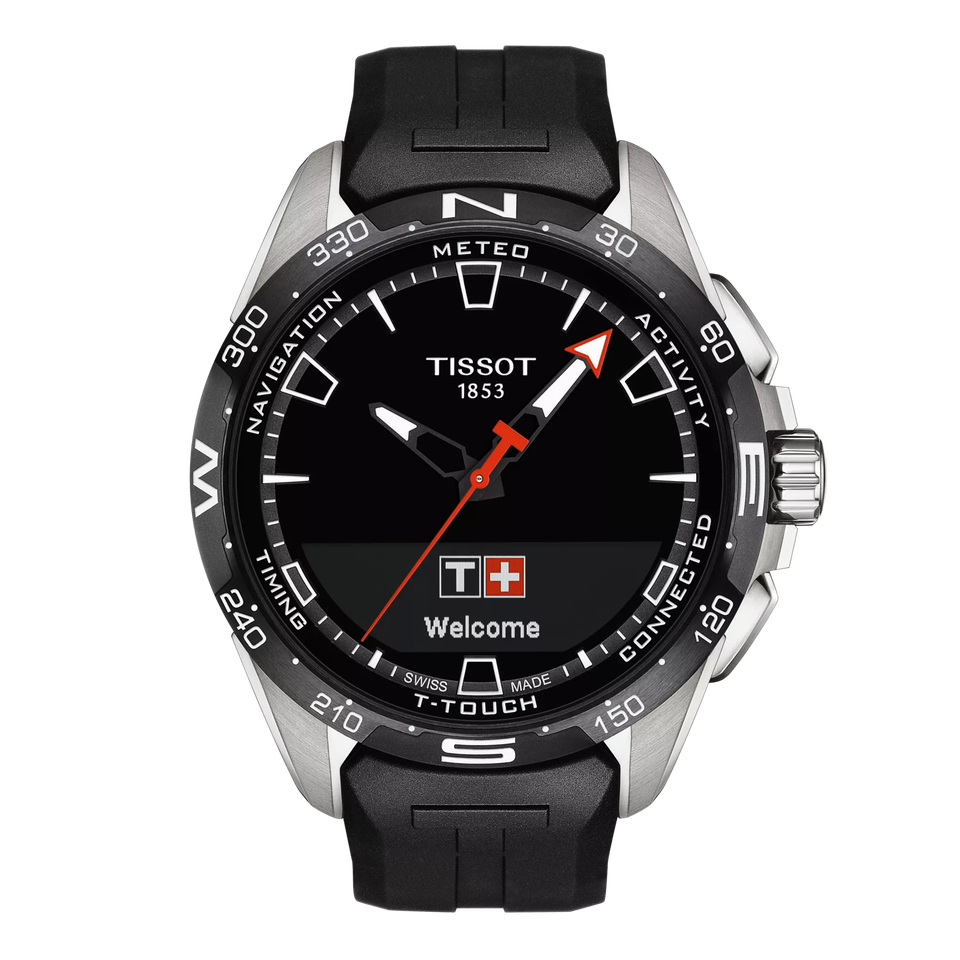
Imagen: Tissot, web oficial
The storyWhy this reference matters
In 1999 Tissot launched the first T-Touch: a watch whose sapphire crystal answered to your finger and opened up a compass, altimeter, barometer and thermometer. Fifteen years before Apple and Samsung showed theirs, a Swiss manufacturer was already selling a touchscreen on the wrist — only there were still hands underneath it. In 2014 came the T-Touch Expert Solar, which added charging by light and laid the groundwork for what followed.
That something arrived in 2020 with the Connect Solar. Rather than license somebody else's operating system, Swatch Group developed its own in Switzerland alongside CSEM: SwALPS, for Swiss Autonomous Low Power System. The consequences run two ways. One is a power draw so low that autonomy gets measured in months rather than days. The other is an unusual line on privacy: the data sits on the group's own servers, and neither the watch nor the app hands it to third parties.
The result is an odd but coherent hybrid. The dial carries photovoltaic cells, the hands move themselves out of the way to uncover the screen when a notification lands, and in pure watch mode battery life stops being something you think about. It doesn't take your pulse and doesn't pretend to replace your phone: it does altimeter, barometer, compass, chronograph with splits, alarm and perpetual calendar, which is exactly what the T-Touch family has been doing from the start.
SpecificationsThe numbers, in one table
| Brand | Tissot |
|---|---|
| Family | T-Touch |
| Reference | T121.420.47.051.00 |
| Years made | desde 2020 |
| Calibre | Cuarzo solar táctil con sistema operativo SwALPS |
| Movement | Cuarzo |
| Power reserve | Hasta unos seis meses en modo conectado; autonomía muy superior en modo desconectado |
| Complications | Altímetro · Barómetro · Brújula · Cronógrafo con parciales · Alarma · Calendario perpetuo · Husos horarios · Podómetro |
| Diameter | 47.5 mm |
| Thickness | 15.3 mm |
| Lug width | 23 mm |
| Case | Titanio con bisel de cerámica |
| Crystal | Zafiro táctil |
| Water resistance | 100 m (10 bar) |
IdentificationHow to tell it apart
Forty-seven and a half millimetres of titanium, 15.3 mm thick and 92 grams: light for the space it takes up. The bezel is ceramic with Super-LumiNova, the crystal is the touch-sensitive sapphire, water resistance is 100 metres and the nitrile rubber strap is 23 mm. This reference is titanium on a black strap; the family also exists in black PVD and rose gold PVD.
The crystal won't respond until you switch the touch function on from the crown, so if you try it and nothing happens, it isn't broken. Several touch generations sit side by side in the catalogue, among them the T-Touch Expert Solar, which doesn't connect, and the Connect Sport models, which use different numbering. The only thing that never lies is the reference: here, T121.420.47.051.00.
CollectingWhat collectors check
You buy a connected watch knowing the electronics have an expiry date and the mechanics don't. The good news is that the cell recharges from light, so you aren't tied to a proprietary cable, and the watch keeps telling the time and running standalone even if the app disappears one day. The bad news is that a rechargeable cell ages: ask how many years it has been in there and how well it holds a charge.
Before buying used, walk through the functions one by one: compass, altimeter, barometer, alarm, chronograph. Check the hands return to their positions when you leave each mode, because a misaligned hand motor is the classic fault on these watches and isn't something the shop round the corner will sort out. Then look at the edges of the ceramic bezel, which is where knocks show.
Brushed titanium marks easily and doesn't polish like steel: a case gone over by somebody with more enthusiasm than skill gives itself away in rounded edges and uneven shine. On a watch like this, always prefer an honest case with wear marks to one that looks too bright.
Common questionsWhat people ask us about this reference
Does the Tissot T-Touch Connect Solar work without a phone?
Yes. The time and all the instrument functions are standalone; the phone only adds notifications and settings. That's the advantage of an operating system designed to run on its own.
How long does the battery last?
In connected mode, up to around six months depending on use and the light it gets. Disconnected, autonomy goes much further, because the dial carries photovoltaic cells and the system draws almost nothing.
Does it measure heart rate?
No. It counts steps, distance and calories, and gives you altimeter, barometer, compass, azimuth and a weather trend, but there's no pulse sensor.
What is SwALPS?
The low-power operating system Swatch Group developed in Switzerland with CSEM. It's what explains the months of autonomy and the commitment not to pass your data to third parties.
Keep readingWhere to go from here
Close relativesThe ones it gets confused with
Confidence: media — this page was checked against the sources below. If a detail looks wrong to you, write to us and we will fix it.