Imagen: Tissot, web oficial
The storyWhy this reference matters
PR stands for Particulièrement Robustes, and the family starts in 1956. The PR 516 as everyone remembers it was drawn by Lucien Gurtner in 1965, with a perforated steel bracelet that copied the racing steering wheels of the day, holes and all. That watch got into the paddock, onto drivers' wrists and, in 1973, into Live and Let Die. Not many watches at this price have a service record like that.
The return was announced in February 2024, and the movement was the surprise. Calibre A05.291 is a Valjoux 7753 with the automatic winding stripped out: where the oscillating weight used to sit there is now a bridge carrying the Tissot 1853 logo, on show through the case back. A redesigned barrel takes it to sixty-eight hours, it beats at 28,800 vibrations per hour, runs a Nivachron hairspring and Nivachoc shock protection, and is regulated to within plus or minus five seconds a day.
A hand-wound chronograph at this price is a genuine rarity. Almost everything sold on a 7750 base is automatic, because taking the rotor out costs money and adds no function at all. What it does add is something else: the case back shows the whole mechanism instead of half a machine under a lid, and it imposes a daily ritual at the crown that plenty of people consider the best argument of the lot. The original was 36 mm; this is 41.
SpecificationsThe numbers, in one table
| Brand | Tissot |
|---|---|
| Family | PR516 |
| Reference | T149.459.21.051.00 |
| Years made | desde 2024 |
| Calibre | Valjoux A05.291 (base 7753 sin cuerda automática) |
| Movement | Cuerda manual |
| Frequency | 28.800 alt/h (4 Hz) |
| Power reserve | 67 horas |
| Jewels | 25 |
| Complications | Cronógrafo · Escala taquimétrica |
| Diameter | 41 mm |
| Thickness | 13.67 mm |
| Lug to lug | 49 mm |
| Lug width | 20 mm |
| Case | Acero inoxidable 316L |
| Crystal | Zafiro con antirreflejos en la cara interior |
| Water resistance | 100 m (10 bar) |
IdentificationHow to tell it apart
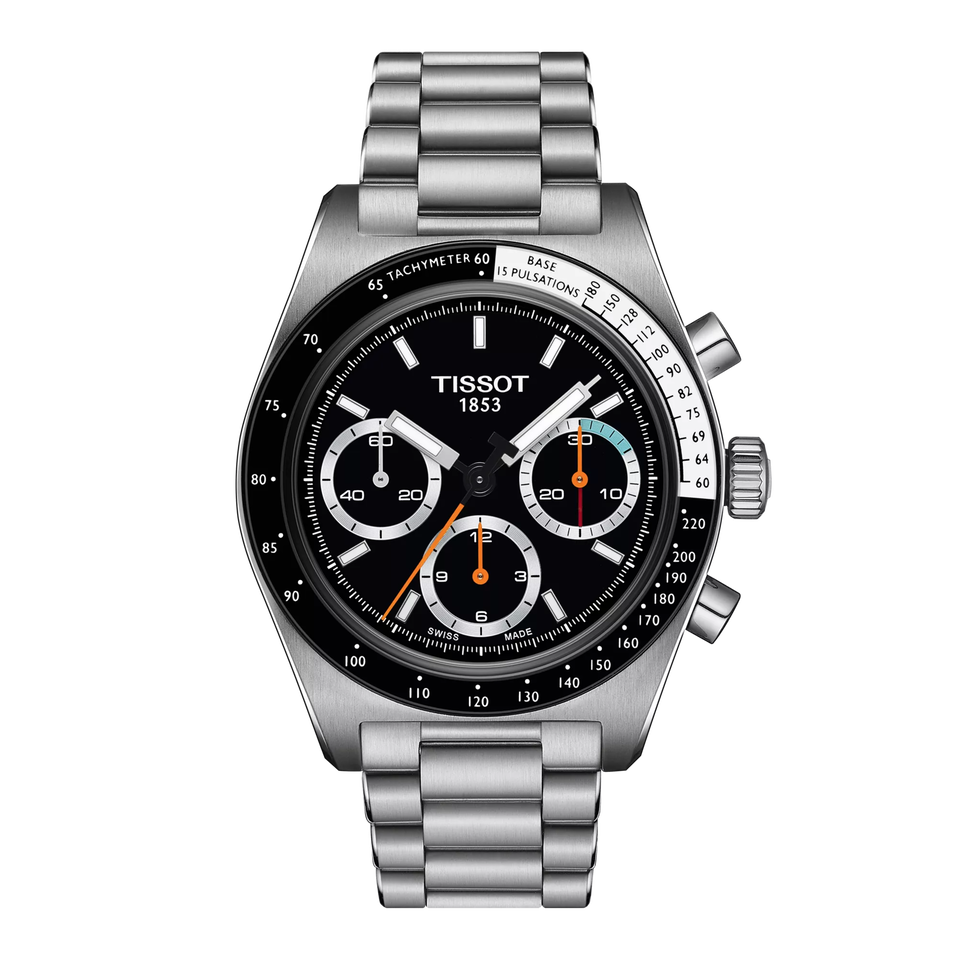
Forty-one millimetres, 13.67 thick, 20 mm lugs and around 49 lug to lug: it fills a wrist more than the diameter suggests. Matte black dial with silvered rings around the counters, orange chronograph hands and, on the thirty-minute counter, a blue sector painted over the first five minutes — a nod to the countdown before a race start.
The key to not mixing it up: the mechanical version has no date. The quartz PR516s from the same launch do have a calendar, and their seconds hand jumps once a second. The bezel is a tachymeter and the steel bracelet uses Tissot's quick-release system.
Through the back you can see the signature of the trick: a bridge with the Tissot 1853 logo filling the space where a rotor would go. If an oscillating weight swings into view behind that crystal, you are looking at one of the automatic PR516s, not this one.
CollectingWhat collectors check
Hand-wound chronographs are judged by their pushers. Press the start button: on this base the feel is firm with a defined click, a long way from the mushy point that sometimes comes with automatic 7750s. Try the reset too, because all three hands should snap to twelve without overshooting. A counter that comes to rest a hair off zero gives you plenty of room to negotiate.
Manual winding wears differently. Wind it slowly to the stop and listen: it should neither crunch nor slip. And test the reserve properly by leaving it fully wound over a whole weekend; if it stops well short of sixty-odd hours, the barrel or the lubrication is asking for attention.
This is a recent model and still in production, so condition rules here, not rarity. Look at the edges of the tachymeter bezel, the first thing to take a knock, and be suspicious of a case that gleams where it should be brushed: polishing a PR516 wipes out the contrast of finishes that gives it its face.
Common questionsWhat people ask us about this reference
What movement is in the Tissot PR516 Chronograph Mechanical?
The Valjoux A05.291, a 7753 with the automatic winding removed. It beats at 28,800 vibrations per hour, runs a Nivachron hairspring and gives around sixty-seven hours of reserve according to the watch's official spec sheet.
Does the mechanical PR516 have a date?
No, and it is the quickest way to recognise it. The quartz PR516s from the same launch do carry a calendar.
What does PR516 mean?
PR comes from Particulièrement Robustes, the name Tissot gave the family in 1956. The 516 identifies the model Lucien Gurtner redesigned in 1965 with the famous perforated bracelet.
Is the 41 mm PR516 big?
At 13.67 mm thick and roughly 49 lug to lug, it takes up more room than the diameter suggests. The original sixties chronograph stopped at 36 mm.
Keep readingWhere to go from here
Close relativesThe ones it gets confused with
Confidence: media — this page was checked against the sources below. If a detail looks wrong to you, write to us and we will fix it.