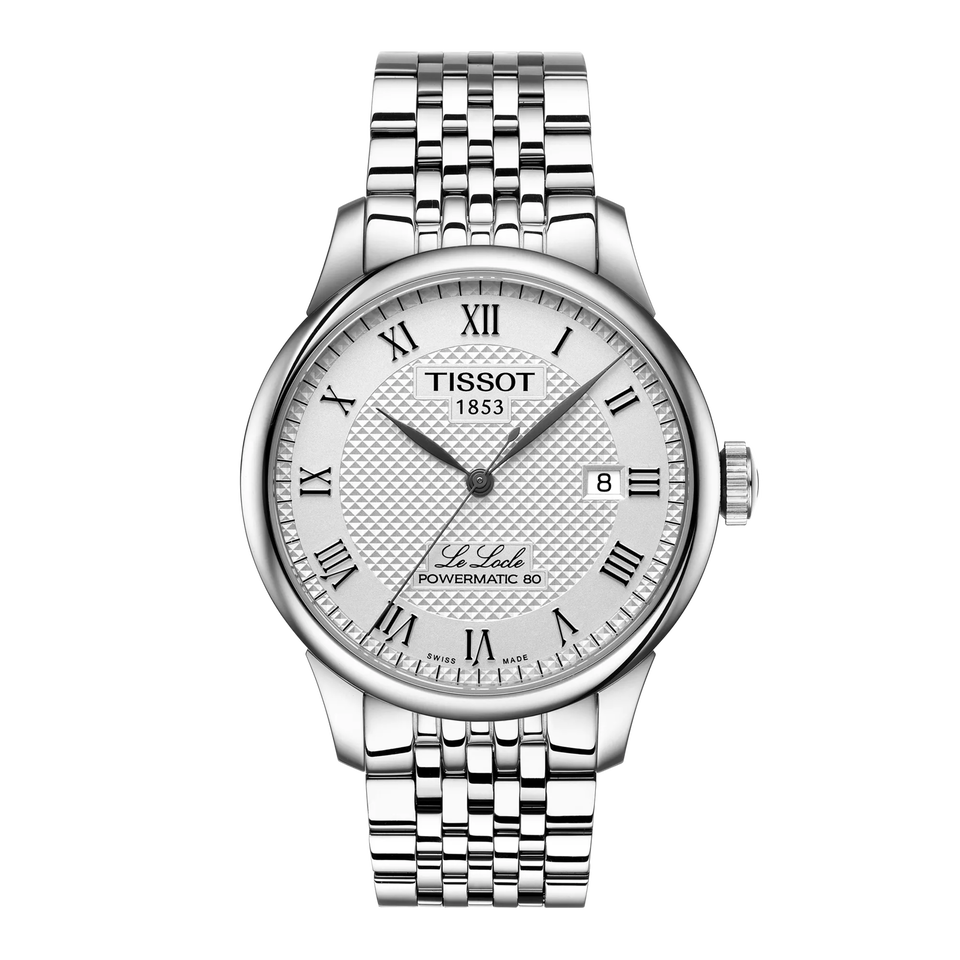
Imagen: Tissot, web oficial
The storyWhy this reference matters
In 1853, in a Jura town called Le Locle, the Tissot family set up a workshop on the ground floor of their own house. The father, Charles-Félicien, made cases; the son, Charles-Émile, was the watchmaker. That division of labour explains a good deal about the business: the case maker and the movement maker under one roof. A few years later Charles-Émile went to Russia and sold his savonnettes across the Empire, which became the firm's first big market.
The town is not set dressing. Le Locle is laid out for watchmaking: long blocks angled so light reached the workshops inside the houses, town planning odd enough to earn it World Heritage status alongside La Chaux-de-Fonds. In the centre stands a clock tower which, Tissot says, is what inspired this collection. Hence the Roman numerals and the restraint of the dial.
And here is the bit almost nobody knows: the Le Locle is a reissue of nothing. Tissot created the collection in 2003 for the brand's 150th anniversary, using a deliberately old vocabulary — applied Roman numerals, blued leaf hands, raised clous de Paris guilloché — with no specific historical model behind it. It is a classic invented from scratch, and invented so well that people now credit it with an age it never had.
SpecificationsThe numbers, in one table
| Brand | Tissot |
|---|---|
| Family | Le Locle |
| Reference | T006.407.11.033.00 |
| Calibre | Tissot Powermatic 80 (base ETA C07) |
| Movement | Automático |
| Frequency | 21.600 alt/h (3 Hz) |
| Power reserve | 80 horas |
| Complications | Fecha |
| Diameter | 39.3 mm |
| Thickness | 9.75 mm |
| Lug width | 19 mm |
| Case | Acero inoxidable 316L |
| Crystal | Zafiro resistente a los arañazos |
| Water resistance | 30 m (3 bar) |
IdentificationHow to tell it apart
The numbers that separate it from its neighbours: 39.3 mm across, 9.75 mm thick, 19 mm lugs. That 19 is unusual and very handy for identification, because almost everyone expects 18 or 20. Getting under ten millimetres tall with an automatic and a date inside is what gives it the drape of a real dress watch.
The dial carries a stamped clous de Paris pattern in relief — tiny pyramids that shift tone as the light moves — with a sunray-brushed raised hour ring, applied Roman numerals and blued leaf hands. If the pyramids look printed and flat, it isn't this reference. T006.407.11.033.00 is the silver dial on a steel bracelet with a butterfly clasp and pushers; black-dial and leather-strap variants exist.
Round the back, the case back is glazed but only partly open, with a steel bridge crossing the window down the middle. Round the front there is a limit worth being clear about: 30 metres of water resistance. That figure identifies as much as it restricts, because it separates this dress family from any sporting Tissot.
CollectingWhat collectors check
The Powermatic 80 is the key to this watch and it deserves to be understood. It is an ETA from the C07 family, derived from the 2824-2, but with the frequency dropped from 4 to 3 Hz and a bigger barrel: that swap alone is what buys the 80 hours. What you gain is leaving it on Friday and finding it on time on Monday. What you pay is a rate slightly less stable than a classic 2824's. The hairspring is Nivachron, a titanium alloy that copes well with magnetic fields.
The 30 metres isn't a catch buried in the small print, it is the nature of the watch: splashes and rain yes, shower and pool no. The crown doesn't screw down and the back is glazed, so the gaskets do little work but age all the same. Buying a used one with a few years on it, assume you will be replacing them.
On the second-hand market there are two things I always look at. The clous de Paris dial, because the relief holds any fingerprint or sign of handling and there is no graceful way to hide it. And the blueing on the hands, which on hard-worn examples goes dull where the crystal has rubbed. The butterfly clasp is the third: if it doesn't close flush and aligned, somebody has forced it.
Common questionsWhat people ask us about this reference
Is the Tissot Le Locle an old model?
No. The collection was created in 2003 for the brand's 150th anniversary and takes its name from the town where Tissot was founded in 1853. The classic look is deliberate, but it doesn't reissue any specific historical model.
Can I shower with the Tissot Le Locle?
Better not. Its 30 metres covers splashes and rain, not the steam and direct jet of a shower, which punish the gaskets. Swimming needs a different watch.
How much power reserve does the Powermatic 80 have?
Eighty hours, a little over three days. It is the calibre's big selling point, achieved by dropping the frequency to 21,600 vibrations per hour and enlarging the barrel of the ETA 2824-2 it derives from.
Why is it called Le Locle?
After the town in the Swiss Jura where the Tissot family set up their workshop in 1853, on the ground floor of their own house. Tissot says the town's clock tower inspired the collection's design.
Keep readingWhere to go from here
Close relativesThe ones it gets confused with
Confidence: alta — this page was checked against the sources below. If a detail looks wrong to you, write to us and we will fix it.