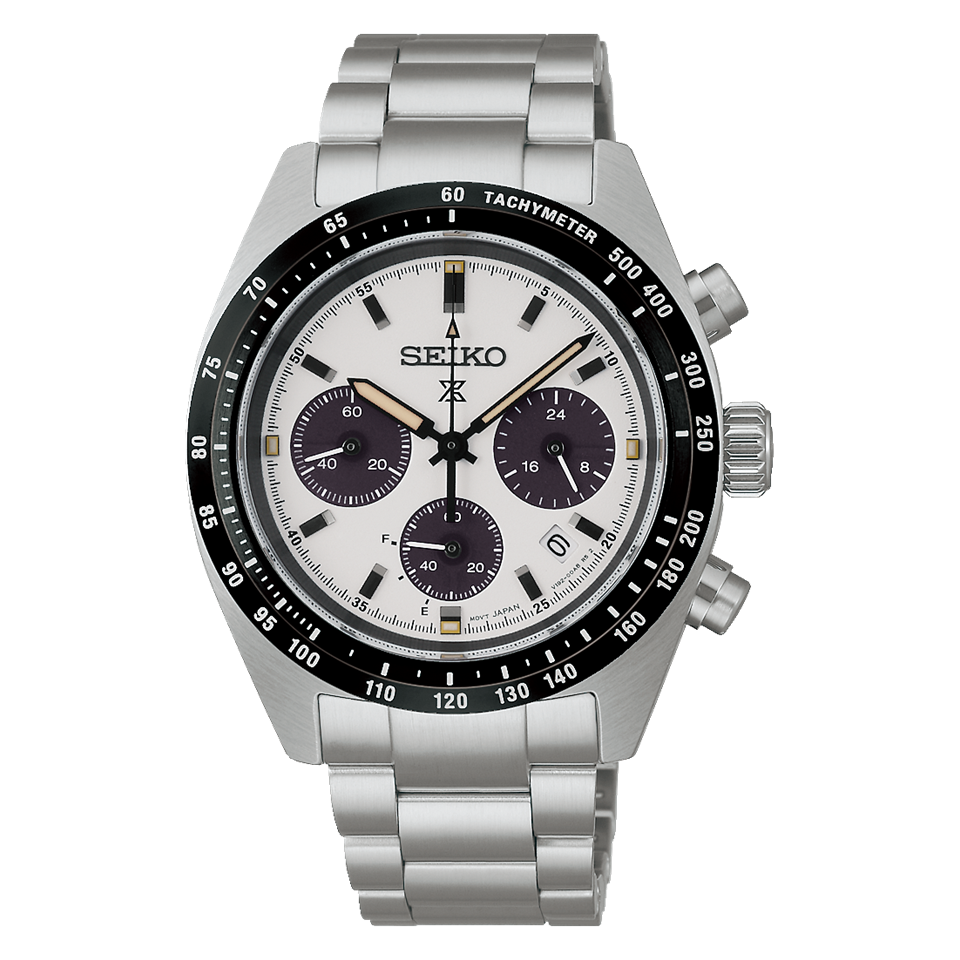
Imagen: Seiko, web oficial
The storyWhy this reference matters
A great deal happened in watchmaking in 1969, and nearly all of it in the same year: Zenith showed El Primero, the Heuer-Breitling consortium the Calibre 11, and Seiko the 6139, its first automatic chronograph. The Speedtimer name comes out of that sports-timing tradition, and Seiko brought it back a few years ago for a whole collection. The SSC961 is not a reissue of anything in particular. It is the solar branch of that family, the one that gives up mechanics in exchange for never being wound again.
The interesting part is under the dial. The three chronograph subdials are translucent and the solar cell sits behind them: the counters do the job of windows. That is why earlier versions had the bluish, violet sheen everyone talked about, and why this model fixes exactly that, with counters in a franker black. The V192 calibre stores up to six months of running at full charge and keeps to about fifteen seconds a month.
Seiko launched it on 2 February 2026 to replace the SSC813, from which it inherits the 39 mm case and the panda look of a pale dial with dark counters. It does not change the argument, it sharpens it: slightly warmer lume, cleaner subdials, and two siblings with salmon and mint dials, the SSC963 and the SSC965. And it goes into the permanent catalogue rather than arriving as a limited edition, which in Seiko's world is never safe to assume.
SpecificationsThe numbers, in one table
| Brand | Seiko |
|---|---|
| Family | Prospex |
| Reference | SSC961P1 |
| Years made | desde 2026 |
| Calibre | Seiko V192 |
| Movement | Cuarzo |
| Power reserve | 6 meses a plena carga |
| Complications | Cronógrafo · Aguja de 24 horas · Fecha · Indicador de reserva de carga · Taquímetro |
| Diameter | 39 mm |
| Thickness | 13.3 mm |
| Lug to lug | 45.5 mm |
| Lug width | 20 mm |
| Case | Acero inoxidable |
| Crystal | Zafiro curvado con antirreflectante interior |
| Water resistance | 100 m (10 bar) |
IdentificationHow to tell it apart
The measurements are half the argument: 39 mm across, 45.5 mm lug to lug and 13.3 mm thick, on 20 mm lugs. Very little chronograph for what a chronograph usually measures. The crystal is curved sapphire with anti-reflective coating on the inner face, the case back screws down and it is rated to 100 metres.
There is more on the dial than you notice at first: a 60-minute counter, a fifth-of-a-second scale for the chronograph, a 24-hour hand, a date, a charge-level indicator and a tachymeter scale. If that sounds like a lot of function for a 39 mm plate, that is precisely the point of the watch.
Against the SSC813 it replaces, the changes are matters of degree: subdials in a purer black, with less of the blue shimmer that gives the solar cell away, and lume in a slightly warmer tone. If you are comparing photographs, look at the counters against the light. Within the new trio, the SSC961 is the white dial, the SSC963 the salmon and the SSC965 the mint one with a steel bezel.
CollectingWhat collectors check
You buy a solar chronograph for the trouble it does not give you: no winding, no battery every two years, no expensive mechanical service. What needs watching in exchange is the cell. Buying used, charge it fully, keep it in the dark for a few days and look at the reserve indicator. If it falls much faster than the spec claims, the secondary battery is tired.
After that, the usual chronograph routine: the counters should snap back to a true zero on reset, the pushers should feel firm rather than spongy, and the minute hand should line up with the marks on the tachymeter scale. Check the sapphire under raking light too. Being curved, a knock on the rim shows up straight away and the replacement is not a flat crystal.
On resale it competes against itself, because the SSC813 it replaces is still circulating and is practically the same watch with slightly bluer counters. If the used one comes close to the price of a new one, there is no argument to have. And if the watch appeals but the bracelet does not, 20 mm lugs open up an enormous catalogue of straps.
Common questionsWhat people ask us about this reference
Is the Seiko SSC961 automatic?
No. It is solar quartz, calibre V192: it charges from natural or artificial light and has no battery to swap every couple of years.
How long does the Speedtimer solar charge last?
Up to six months at full charge with no light at all, according to Seiko. Stated accuracy is around fifteen seconds a month.
What is the difference between the SSC961 and the SSC813?
They share the 39 mm case, the V192 calibre and the functions. The SSC961 replaced it in February 2026 with subdials in a purer black and slightly warmer lume.
Is the SSC961 crystal sapphire?
Yes, curved sapphire with anti-reflective treatment on the inner face. Not every Prospex at this level has it, and here it is one of the stronger arguments.
Keep readingWhere to go from here
Close relativesThe ones it gets confused with
Confidence: alta — this page was checked against the sources below. If a detail looks wrong to you, write to us and we will fix it.