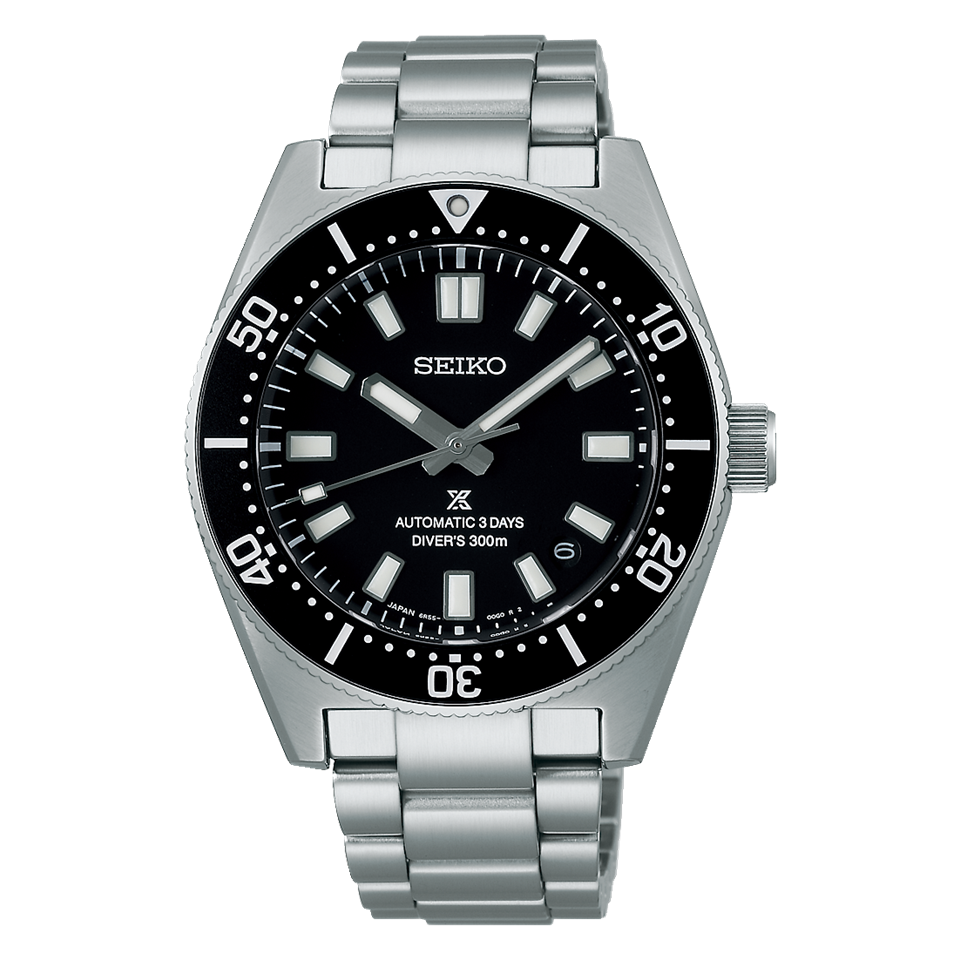
Imagen: Seiko, web oficial
The storyWhy this reference matters
In 1965 Seiko put its first dive watch on the market, reference 6217-8000, and collectors christened it the 62MAS. The nickname is not arbitrary: it contracts SeikoMAtic Selfdater, automatic with a date, and puts the 62 of the calibre in front. That watch is considered the first Japanese professional diver and opened a line that runs unbroken to today. Everything Seiko has done underwater since begins in that case.
The modern 62MAS reissues, the SPB143 series and its relatives, spent years as the way into a grown-up Prospex: 40.5 mm, 200 metres, calibre 6R35. In June 2024 Seiko rebuilt the whole family and tightened it point by point. Down to 40 mm, lug to lug cut from 47.6 to 46.4 mm, two tenths off the thickness, the screw-down crown sunk slightly so it stops digging into the back of your hand, and water resistance up to 300 metres.
The most argued-over change is on the dial. To meet the ISO standard for dive watches, the date moves to a small round window between four and five, with the date disc painted to match, and a full-size marker returns at three. Symmetry gained, tradition disputed. The collection launched with three references: the blue SPB451, this black SPB453 and the charcoal grey SPB455, a special edition for the brand's centenary with a braided Seichu strap made from recycled bottles.
SpecificationsThe numbers, in one table
| Brand | Seiko |
|---|---|
| Family | Prospex |
| Reference | SPB453J1 |
| Years made | desde 2024 |
| Calibre | Seiko 6R55 |
| Movement | Automático |
| Frequency | 21.600 alt/h (3 Hz) |
| Power reserve | 72 horas |
| Jewels | 24 |
| Complications | Fecha |
| Diameter | 40 mm |
| Thickness | 13 mm |
| Lug to lug | 46.4 mm |
| Lug width | 20 mm |
| Case | Acero inoxidable |
| Crystal | Zafiro curvado con antirreflectante interior |
| Water resistance | 300 m (Diver's) |
IdentificationHow to tell it apart
Forty millimetres exactly, 46.4 mm lug to lug and 13 mm thick, on 20 mm lugs: one of the modern divers that sits best on a small wrist. The crystal is curved sapphire with anti-reflective coating on the inside face, and the unidirectional bezel is steel with an aluminium insert and laser-engraved markings, matt rather than the circular brushing of the previous generation.
The date window is the giveaway for this batch: small, round, between four and five, with the disc in the same colour as the dial. If the date is at three and rectangular, you are looking at an SPB143 or an earlier relative. Another quick tell: the dial reads 300 metres, not 200.
Within the collection itself, the SPB453 is the one with the black dial and bezel. The SPB451 has both in blue, and the SPB455, the special edition, in charcoal grey with gold details and a braided strap instead of a bracelet. All three share the case, the 6R55 calibre and the Diver's 300 m designation.
CollectingWhat collectors check
The first thing is to work out which side of the date war you are on. There are buyers who prefer the older SPB143 precisely because the date sits at three, and that holds the older model's price on the used market. If you genuinely do not mind, this is objectively the better watch: 100 metres more, better proportions, a recessed crown and 72 hours of reserve.
On a diver with an aluminium bezel, the insert is the part that ages. Look along the edge of the engraved markings and hunt for dents on the rim, because that is the first thing to catch a door frame. Check as well that the bezel turns anticlockwise only and with no side play, and that the crown screws down without odd resistance.
The 6R55 is rated at +25 to -15 seconds a day, a good deal tighter than the 4R calibres further down the range. It is not a certified chronometer, but a healthy example should stay inside that without drama. And if you plan to get it properly wet, ask for a pressure test: the 300 metres with the Diver's designation are real, but gaskets age the same as in any other watch.
Common questionsWhat people ask us about this reference
What is the 62MAS?
It is the nickname of the 1965 Seiko 6217-8000, the brand's first dive watch and considered the first Japanese professional diver. The name contracts SeikoMAtic Selfdater with the 62 of the calibre in front.
What is the difference between the SPB453 and the SPB143?
The SPB453 is half a millimetre smaller across, shorter lug to lug, rated to 300 metres, runs the 72-hour 6R55 and puts the date between four and five instead of at three.
Is the Seiko SPB453 a real dive watch?
Yes. It carries Seiko's Diver's 300 m designation, a screw-down crown and case back, and a unidirectional bezel. It meets the requirements for a diving watch. This is not styling.
What is the power reserve of the 6R55 calibre?
Seventy-two hours, three full days. Leave it in a drawer on Friday and it will still be running on Monday morning.
Keep readingWhere to go from here
Close relativesThe ones it gets confused with
Confidence: alta — this page was checked against the sources below. If a detail looks wrong to you, write to us and we will fix it.