Imagen: Seiko, web oficial
The storyWhy this reference matters
By 1959 climbing and skiing had caught on in Japan, and Seiko built its first watch made for sport: the Laurel Alpinist. A screw-down back so neither dust nor sand got in, a leather guard against sweat, luminous paint on hands and markers, and the detail that gives it away, mountain-shaped marks at three, six, nine and twelve. Every sporting branch of the company, divers included, starts there.
The Alpinist's great reincarnation came thirty years later, when the forest green dial with gold numerals and markers appeared, the combination everyone now pictures when the name comes up. In 2006 came the SARB017, which stayed in the catalogue for eleven years and became the Alpinist: the watch almost every Seiko enthusiast has owned, sold, and regretted selling. When it disappeared in 2017, finding a replacement became a national sport.
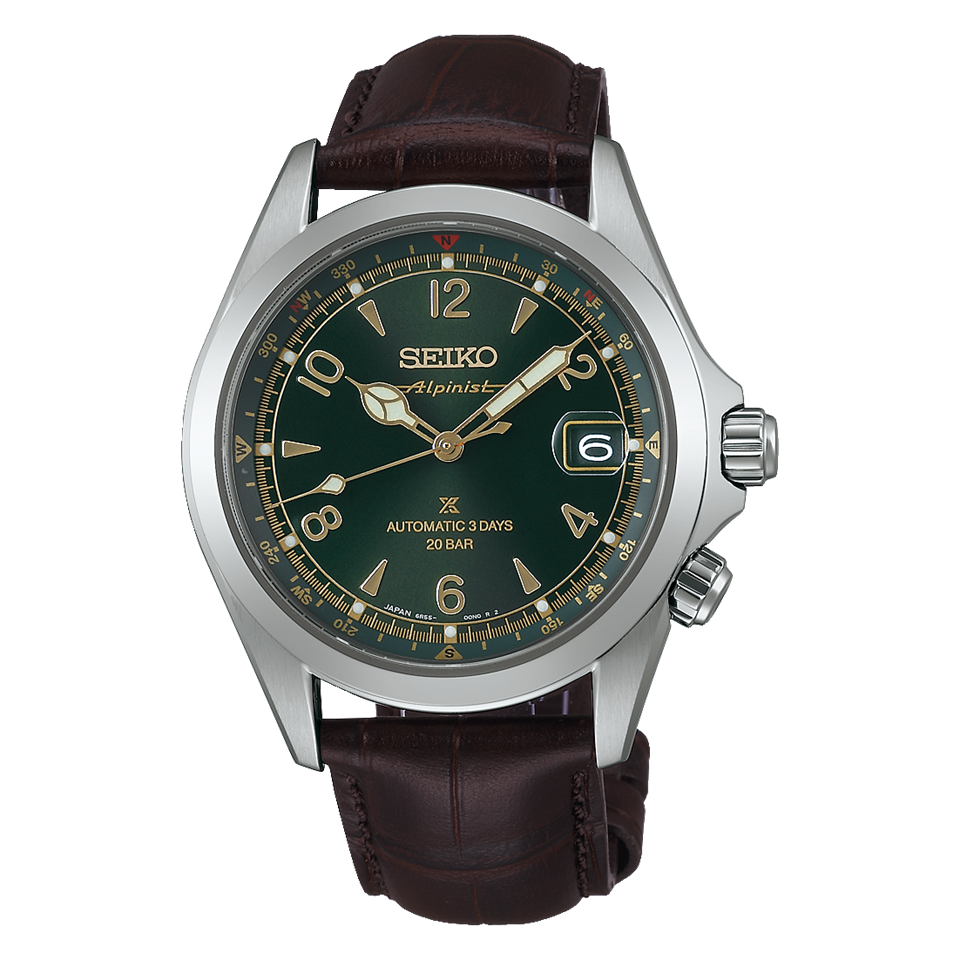
The SPB507 heads the eighth generation, launched in 2025, and answers the model's two historic complaints. It loses half a millimetre in height, down to 12.7 mm, without touching the 39.5 mm diameter or the 46.4 mm lug to lug, and it takes the 6R55 calibre with 72 hours of reserve, the same one Seiko uses in King Seiko. It also adds Diashield, a ceramic layer that hardens the steel. The internal compass bezel, driven by the crown at four, stays exactly where it was.
SpecificationsThe numbers, in one table
| Brand | Seiko |
|---|---|
| Family | Prospex |
| Reference | SPB507J1 |
| Years made | desde 2025 |
| Calibre | Seiko 6R55 |
| Movement | Automático |
| Frequency | 21.600 alt/h (3 Hz) |
| Power reserve | 72 horas |
| Jewels | 24 |
| Complications | Fecha · Bisel brújula interior |
| Diameter | 39.5 mm |
| Thickness | 12.7 mm |
| Lug to lug | 46.4 mm |
| Lug width | 20 mm |
| Case | Acero inoxidable con recubrimiento Diashield |
| Crystal | Zafiro con lupa de fecha y antirreflectante interior |
| Water resistance | 200 m (20 bar) |
IdentificationHow to tell it apart
Two crowns: the one at three winds and sets, the one at four turns the inner ring with the compass rose. If someone shows you an Alpinist with a single crown, it is not this one. The forest green dial with gold numerals is the SPB507. The SPB505 is black with brown undertones and the SPB503 leans turquoise, and both come on a steel bracelet rather than leather.
There is a cyclops built into the sapphire over the date, unusual at this level. The case back is sapphire too, screwed down, and shows the 6R55 at work. The strap is brown cowhide with a three-fold deployant clasp, the lugs are 20 mm and stated water resistance is 20 bar.
Against the previous generation, the reliable tells are the thickness and the paperwork: 12.7 mm instead of 13.2, and 72 hours of power reserve on the spec sheet. The Diashield case shows itself with use as well, because it holds the brushed sheen a good deal longer than bare steel.
CollectingWhat collectors check
The typical buyer arrives looking for a SARB017 they cannot find in decent condition, or that no longer suits them, so the comparison is unavoidable. What this one gains is concrete: 72 hours of reserve, sapphire front and back, and a slimmer case. What it loses, for anyone who values such things, is the aura of the discontinued and the price of that era.
Diashield cuts both ways. It hardens the surface and holds up far better day to day, but when a deep mark does appear it does not sort out the way bare steel does: a conventional polish takes the coating off with it. Look along the edges and flanks under raking light before you buy, and be suspicious of a suspiciously bright case on a watch described as heavily worn.
Try both crowns separately. The inner one should turn the compass ring with even resistance and no slipping, and the main one should screw down smoothly. A stiff thread means a dried-out gasket or a crown that has been forced. Check the state of the date cyclops too: because it is part of the sapphire, a knock in exactly that spot means replacing the whole crystal.
Common questionsWhat people ask us about this reference
What is the Alpinist's internal bezel for?
It is a compass ring turned by the crown at four. Using the position of the sun as a reference, it lets you find your bearing in the field. With no sun in sight, it does nothing for you.
Does the SPB507 replace the SARB017?
In spirit, yes: it is the current version of the green dial with gold. In practice it is dearer and more refined, with sapphire front and back, a 12.7 mm case and 72 hours of reserve.
What is the Diashield coating?
A hard layer Seiko applies over the steel so it scratches less. It survives daily wear better, but it complicates polishing: once it is properly marked, a normal refinish takes the treatment off with it.
How water resistant is the Seiko Alpinist?
Twenty bar, that is, 200 metres. Far more than a mountain watch needs and plenty for swimming without a second thought.
Keep readingWhere to go from here
Close relativesThe ones it gets confused with
Confidence: alta — this page was checked against the sources below. If a detail looks wrong to you, write to us and we will fix it.