Imagen: Citizen, web oficial
The storyWhy this reference matters
Tsuki-yomi is the name of a Japanese moon deity and, read almost literally, something close to reading the moon. The A-T suffix is more prosaic: Atomic Timekeeping. Citizen showed the collection in autumn 2023, the year of its watchmaking centenary and thirty years after building its first radio-controlled wristwatch in 1993. Picking the moon phase as the excuse has a certain internal logic, since it's the complication that drifts out of adjustment fastest and the one that benefits most from somebody keeping it honest without the owner lifting a finger.
The H874 calibre is an Eco-Drive that takes its time signal from atomic transmitters in Japan, China, the United States and Germany, and everything else follows from that: a perpetual calendar programmed to 2100, world time across twenty-six zones, daylight saving, and a fully analogue moon phase Citizen calls the Luna Program and presented as the first of its kind in a light-powered watch. With no radio signal within reach, the movement holds fifteen seconds a month on its own.
The other half of the interest is the material. Citizen's Super Titanium is titanium with Duratect surface hardening, a recipe the brand has been refining since the Attesa line appeared in 1987, and here it comes in the TIC variant. The arithmetic does the arguing: 43 mm of case, a full bracelet and 102 grams. A steel watch this size with these functions runs to nearly double that, and you feel the difference in your elbow at the end of a long day.
SpecificationsThe numbers, in one table
| Brand | Citizen |
|---|---|
| Family | Tsuki-yomi A-T |
| Reference | BY1010-81L |
| Years made | desde 2023 |
| Calibre | Citizen Eco-Drive H874 |
| Movement | Eco-Drive |
| Power reserve | 6 meses a plena carga (2,5 años en modo de ahorro) |
| Complications | Fase lunar · Calendario perpetuo hasta 2100 · Hora mundial (26 zonas) · Radiocontrol multibanda · Indicación 24 horas · Indicador de reserva de carga |
| Diameter | 43 mm |
| Thickness | 10.9 mm |
| Case | Super Titanium con tratamiento Duratect TIC |
| Crystal | Zafiro plano |
| Water resistance | 100 m (10 bar) |
IdentificationHow to tell it apart
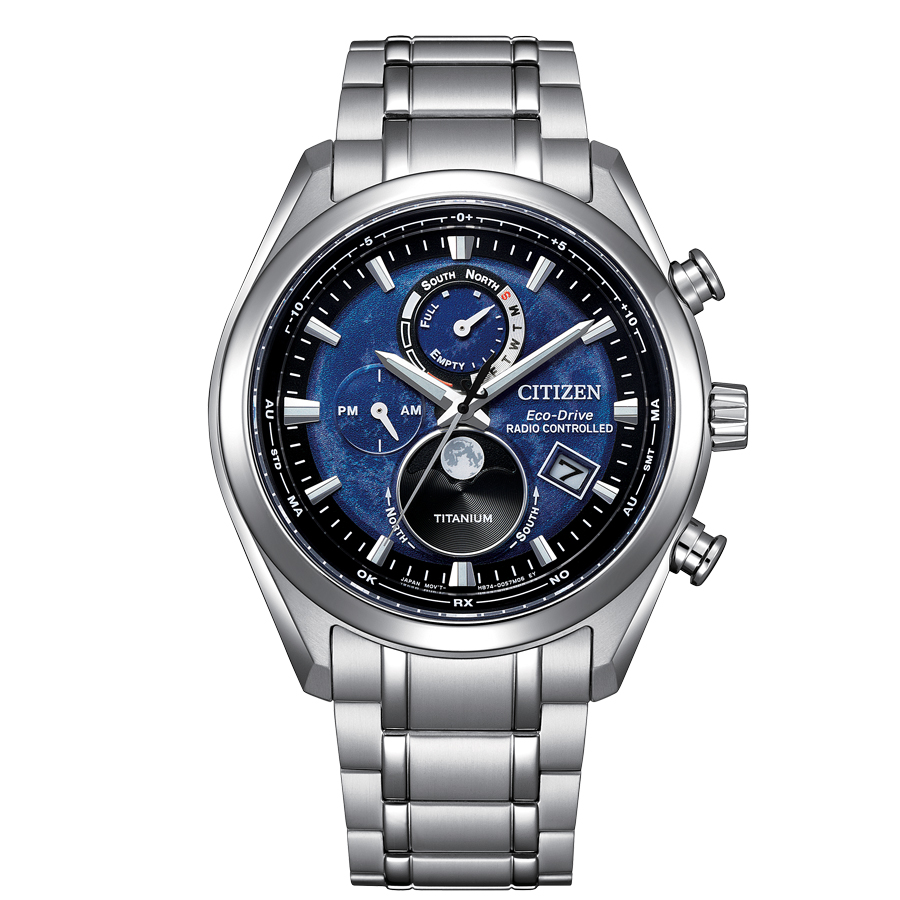
The BY1010-81L is the blue dial in a Super Titanium case and bracelet finished in Duratect TIC. The same family holds a grey BY1010-57H, a BY1010-57L that is also blue, and a red BY1018-55X marketed as a blood moon. It pays to learn to read the code here: the digits immediately after the hyphen describe the case and bracelet, not the dial, which is how a -57L and a -81L can both be blue. Go by colour alone and you'll buy the wrong one.
There are four things on this dial you won't find on an ordinary radio-controlled watch: the moon phase disc, the 24-hour counter, a four-position power reserve indicator and a hemisphere setting, because south of the equator the moon appears the other way up and the watch accounts for it. The crystal is flat sapphire and the profile stops at 10.9 mm, which for a radio-controlled watch with a moon phase and a perpetual calendar is unusually thin.
A daft but useful check: if the watch turns up stopped and the hands won't respond, it isn't broken. The H874 drops into power save after a spell in the dark, and it also has shock detection with automatic hand repositioning, so put it in the light and it sorts itself out. Water resistance is 100 metres: shower, pool and rain, not diving.
CollectingWhat collectors check
This is a watch for a collector of technology rather than a collector of classical watchmaking, and that shapes the market: no vintage to speak of, plenty of two- and three-year-old near-new. What you look at is the usual thing on a power-hungry Eco-Drive: if the reserve indicator won't climb after several days of bright light, the cell has stopped holding, and that's a service part with a price on it, not a nicety.
Duratect deserves its own paragraph. It's a hardened titanium surface, not a colour coat that a workshop can touch in: let an enthusiastic polisher at the case to lift a scratch and he takes the hard layer with him, leaving bare titanium underneath that marks if you look at it too hard. A Tsuki-yomi with polishing marks is worth less than one with an honest scratch. Pay particular attention to the faceted edges, which is where the damage shows first.
On the bracelet, check the double safety clasp and that no link is missing, because loose Super Titanium links are not easy to come by. And ask whether the seller still has the manual, because setting the moon phase by hand and choosing a hemisphere has a procedure of its own, with its own sequence of button presses, and without instructions you'll lose an entire afternoon to it.
Common questionsWhat people ask us about this reference
Do you ever have to adjust the moon phase on a Citizen Tsuki-yomi?
Under normal use, no. The H874 calibre syncs the calendar with atomic transmitters and moves the moon phase accordingly. You only set it by hand if the watch has run completely flat, or if you change hemisphere.
What does Tsuki-yomi mean?
It's the name of a moon deity in the Japanese pantheon and, read almost literally, reading the moon. The A-T suffix comes from Atomic Timekeeping: the watch sets itself from radio signals broadcast by atomic clocks.
Does the Citizen Tsuki-yomi pick up the radio signal in Europe?
Yes. The H874 receives the German transmitter as well as those in Japan, China and the United States, and the German one covers western Europe. If for any reason it doesn't lock on, the movement holds fifteen seconds a month by itself.
How much does the Citizen Tsuki-yomi BY1010-81L weigh?
102 grams with the bracelet on, for a 43 mm case 10.9 mm tall. It's Super Titanium with Duratect treatment: a good deal lighter than a steel equivalent, with a surface that is very hard to scratch.
Keep readingWhere to go from here
Close relativesThe ones it gets confused with
Confidence: media — this page was checked against the sources below. If a detail looks wrong to you, write to us and we will fix it.