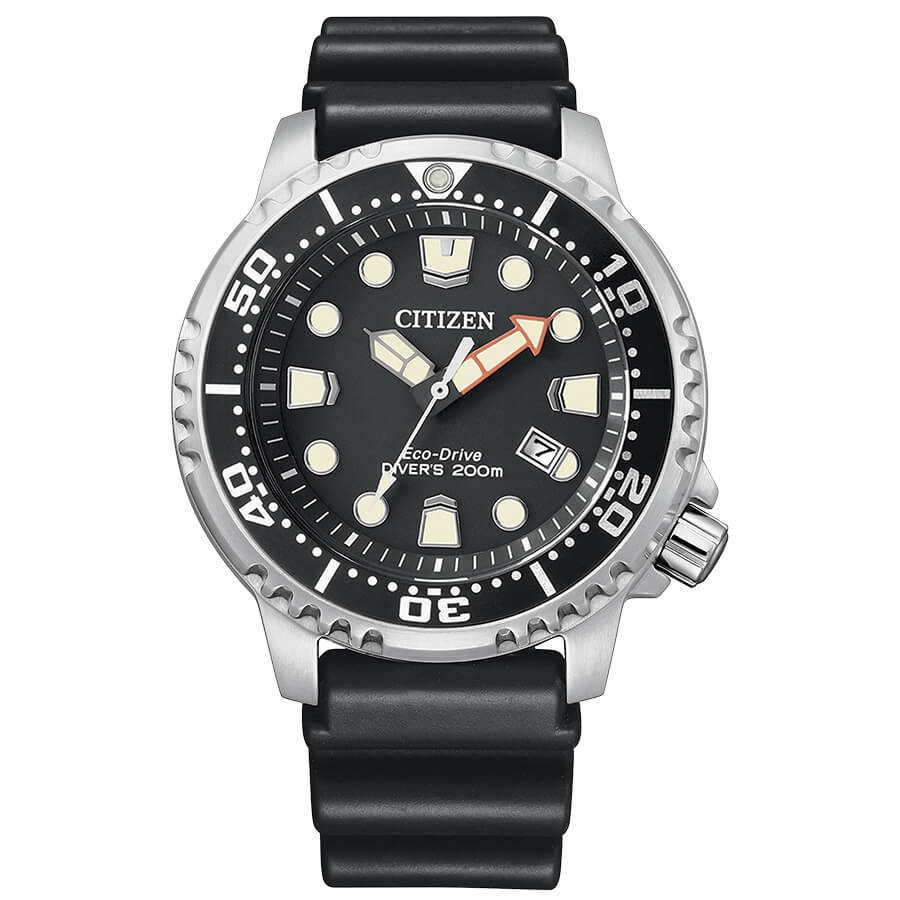
Imagen: Citizen, web oficial
The storyWhy this reference matters
Citizen has been running watches on light since 1976 and the Crystron Solar Cell, its first sun-powered analogue. What was then a technical eccentricity — visible cells and a dial only an engineer could love — turned into Eco-Drive, with the photovoltaic cell hidden under a normal-looking dial. The BN0150 is the least glamorous and most useful application of that whole history: a steel diver that charges itself while you wear it and will never see a caseback tool.
The other half of the name comes from 1989, when Citizen gathered its professional tools under the Promaster badge and gave them an arrow for a logo, with the stated aim of going higher and deeper. Some serious things live in that family: the 1,300-metre diver of 1982, the Aqualand with its electronic depth gauge in 1985, and a 1,000-metre Eco-Drive whose prototype was tested at depth with the Japanese oceanographic institute. The BN0150 is the entry rung of that line.
And then there is the marking almost nobody reads on the dial: Diver's 200 m, certified to ISO 6425. That standard is the border between a watch that survives twenty bar on a test bench and one certified to actually dive, with requirements for a unidirectional bezel, legibility in total darkness, resistance to shock, salt and magnetism, and testing unit by unit. Plenty of watches that look like divers do not have it. This one, among the most modest in the catalogue, does.
SpecificationsThe numbers, in one table
| Brand | Citizen |
|---|---|
| Family | Promaster |
| Reference | BN0150-10E |
| Calibre | Citizen Eco-Drive E168 |
| Movement | Eco-Drive |
| Power reserve | 6 meses a plena carga |
| Complications | Fecha · Bisel giratorio unidireccional |
| Diameter | 44 mm |
| Lug to lug | 48 mm |
| Case | Acero inoxidable |
| Crystal | Mineral con tratamiento antirreflejos |
| Water resistance | 200 m (20 bar), Diver's certificado ISO 6425 |
IdentificationHow to tell it apart
A 44 mm steel case, screw-down back and crown, unidirectional rotating bezel and mineral crystal with anti-reflective treatment — mineral again, not sapphire, which surprises people who arrive expecting otherwise. The -10E is the sober one of the family: black dial, black rubber strap, nothing added. Its more photographed sister, the -28E, adds an orange arrow-tipped minute hand that gives it away in any profile shot.
Telling the Eco-Drive from its automatic brother is instant, even if the size fools you. There is no rotor turning and no seconds hand sweeping at six beats a second: the hand steps cleanly, once a second. And if one day it starts moving in two-second jumps, it is not broken — that is the Eco-Drive low-charge warning, and it wants light, not a watchmaker.
The proportions are those of a full-size diver: 44 mm across, about 48 lug to lug, and a bit over ninety grams with the rubber strap on. It is a watch you feel on the wrist and one that shows under a shirt cuff; anyone after discretion needs to look elsewhere in the catalogue.
CollectingWhat collectors check
The critical point on any second-hand Eco-Drive is not the case, it is the storage cell under the dial. That secondary battery loses capacity over the years and is a service part like any other. The home test is simple: charge it properly in light, leave it two nights in a dark drawer and check it is still running normally. If it starts the two-second jumps within a few hours, the cell is spent.
Then come the usual suspects on a used diver. Bezel: firm click, and the luminous pip at twelve still lighting. Crystal: mineral scratches easily, so a few marks are normal and cheap to sort out. Crown: screw it down and undo it a couple of times looking for stripped threads, the one thing capable of turning an ISO 6425 into a wet dress watch.
And an expectation to settle before you pay: there is no steel bracelet here, there is a rubber strap, and rubber hardens. Replacing it is cheap and does not affect value. What does affect value is a caseback with marks from being forced open: if someone has been in there without the right tool, the water resistance is now a promise rather than a certificate.
Common questionsWhat people ask us about this reference
Does the Citizen BN0150 need a battery change?
No. It is an Eco-Drive: it charges from any light source and stores the energy in a rechargeable cell, so there is no battery to replace in normal use.
How long does the BN0150 last without light?
Citizen states about six months of reserve from full charge. If you put it away for a long stretch, it warns you by moving the seconds hand in two-second jumps before it stops.
Is the BN0150's crystal sapphire?
No. It is mineral with anti-reflective treatment. It scratches a good deal more than sapphire, though replacing it is one of the cheapest repairs there is.
Can you actually dive with it, or is it just for the pool?
You can dive with it. It is certified Diver's 200 m to ISO 6425, with a unidirectional bezel and screw-down crown, which is exactly what that certification requires.
Keep readingWhere to go from here
Close relativesThe ones it gets confused with
Confidence: media — this page was checked against the sources below. If a detail looks wrong to you, write to us and we will fix it.