Imagen: Citizen, web oficial
The storyWhy this reference matters
Citizen got into satellites in 2011, with the first light-powered watch that could sync to GPS. That one was more a demonstration of muscle than a comfortable product: big, slow and styled like a spacecraft. The F100 calibre of 2014 fixed the speed, three seconds to grab the time signal, and slimmed the case down until it was the thinnest of its kind. Citizen's whole run at this has gone the same way: fewer seconds, fewer millimetres.
The F900 landed in March 2015, at Basel, and added the missing half: it receives position as well as time. That means you never tell the watch which country you're standing in, it works it out, though position can take up to thirty seconds against three for the time, because they are two separate operations. Citizen billed it as the world's thinnest satellite-synchronised multifunction watch, with its own accuracy of five seconds a month when there's nothing overhead to talk to.
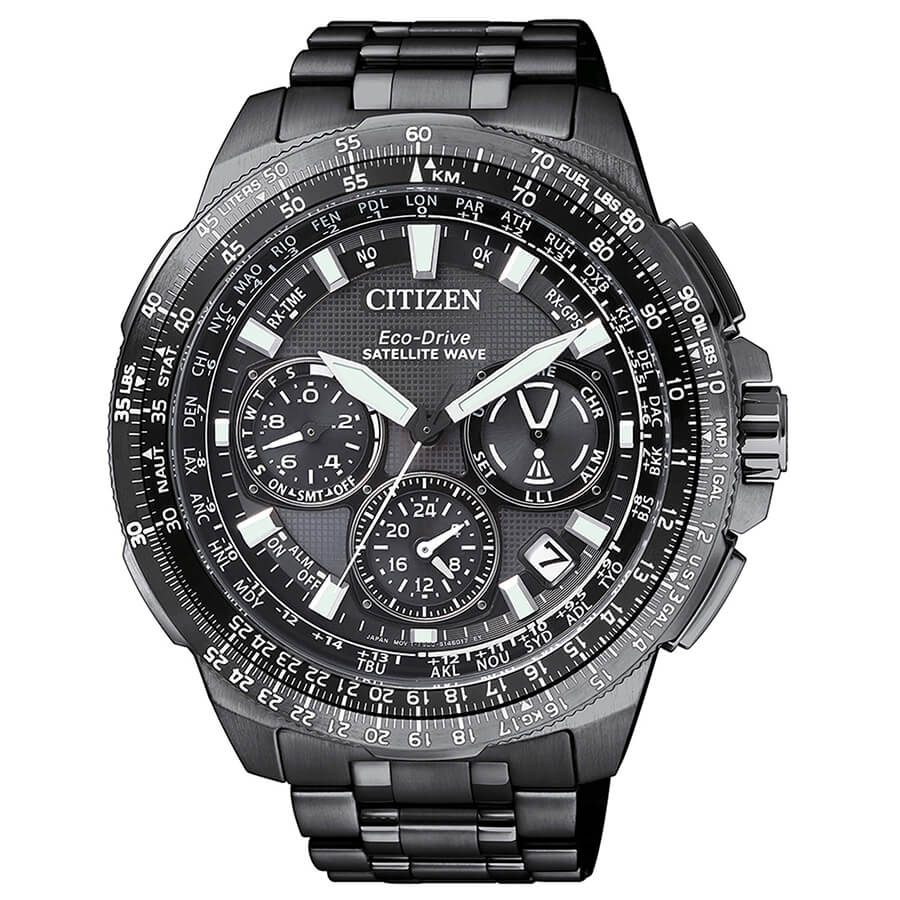
The CC9025-51E is the brutal end of the family: 47.1 mm, two hundred metres of water resistance, a bidirectional rotating bezel and a Super Titanium case and bracelet finished in Duratect DLC plus MRK, a combination Citizen rates at between 1,000 and 1,400 Vickers on the surface. For context, the stainless steel used in watchmaking sits below 200. This isn't a coat of colour, it's a different skin.
SpecificationsThe numbers, in one table
| Brand | Citizen |
|---|---|
| Family | Satellite Wave GPS |
| Reference | CC9025-51E |
| Years made | desde 2015 |
| Calibre | Citizen Eco-Drive Satellite Wave GPS F900 |
| Movement | Eco-Drive |
| Power reserve | 1,5 años a plena carga (5 años en modo de ahorro) |
| Complications | Sincronización horaria y de posición por GPS · Hora mundial (40 zonas) · Calendario perpetuo hasta 2100 · Cronógrafo de 1/20 de segundo hasta 24 horas · Segundo huso horario · Alarma · Indicador de nivel de luz y de reserva de carga |
| Diameter | 47.1 mm |
| Thickness | 14.6 mm |
| Case | Super Titanium con tratamiento Duratect DLC + MRK |
| Crystal | Zafiro plano con tratamiento antirreflejos |
| Water resistance | 200 m (20 bar) |
IdentificationHow to tell it apart
The measurements give it away: 47.1 mm across and 14.6 mm tall. This is the big case in the family, with a bidirectional rotating bezel and a black dial carrying pale hands and markers. It shares its generation with other F900 references in far more discreet cases, so if the watch doesn't reach 47 mm it isn't this one, however often the seller types F900 in the title.
The finish is the other tell: black throughout, case and bracelet, courtesy of Duratect DLC + MRK. It isn't paint and it isn't a decorative PVD, it's a surface treatment, which is why a well-kept example is still black years later instead of showing metal along the edges. The crystal is flat sapphire with an anti-reflective coating.
On the dial, besides the time, you're looking for the second time zone, the 1/20-second chronograph running to 24 hours, the power reserve indicator and the light-level indicator, that small hand which tells you whether the room you're standing in is charging the watch or not. World time covers forty zones and the perpetual calendar comes programmed to 2100.
CollectingWhat collectors check
The F900 is a decade old now, and that's the conversation that matters. It works exactly as it did on day one for as long as the cell holds up and the satellites stay where they are, but the cell in an Eco-Drive this complicated is not eternal. Before you buy, leave the watch in bright light for several days and see whether the reserve indicator climbs to the top. If it stalls halfway, you know what you're paying on top of the asking price.
Test the reception under a clear sky. The time sync should finish in seconds. If it takes the time but digs its heels in over position, don't panic: they are two separate operations and the second one is slower by design. What is a bad sign is getting nothing at all outdoors with the dial pointed at the sky.
On the Duratect, the usual rule applies: it doesn't polish. A black watch with grey edges has had the layer worn off, and no workshop puts it back without redoing the entire case. Look at the bezel, the bracelet clasp and the edges of the links. And think about the size before you fall in love: 47.1 mm on a titanium bracelet wears better than the paper suggests, but it will not go under the cuff of a slim shirt.
Common questionsWhat people ask us about this reference
How long does a Citizen Satellite Wave F900 take to set itself?
About three seconds for the time signal under a clear sky, and up to thirty if it goes looking for position as well. With no satellites in view, the calibre keeps its own accuracy of five seconds a month.
Can you dive with the Citizen CC9025-51E?
It's rated to 200 metres and has a rotating bezel, so water is not the problem. Its official specification doesn't list it as a certified dive watch, so for serious diving a Promaster with ISO 6425 certification is the better answer.
What is Citizen's Duratect DLC + MRK?
It's the surface treatment Citizen applies to the titanium on this model, with a stated hardness of between 1,000 and 1,400 Vickers. It gives the black colour and a scratch resistance well beyond steel, but it can never be polished afterwards.
How many time zones does the Citizen CC9025-51E have?
Forty world-time zones, plus an independent second time and a perpetual calendar programmed to 2100. All of it corrects itself every time the watch catches a satellite.
Keep readingWhere to go from here
Close relativesThe ones it gets confused with
Confidence: media — this page was checked against the sources below. If a detail looks wrong to you, write to us and we will fix it.