No watch on earth is faked as well as a Rolex, and none has generated as much folklore. The internet is full of foolproof tests — the weight, the sound, the serial number, the sweep of the seconds hand — and not one of them proves anything on its own. Worse, most of them change meaning depending on the reference, the decade and the exact generation of the watch in front of you. A test that works on a 2020 Submariner can be nonsense applied to a 1990 Datejust.
This guide works through the watch area by area, then model by model: what you can genuinely check, how much weight each check carries, and — the part everybody skips — which checks point somewhere without ever settling the question. The aim is not to hand you a list of tricks to memorise. It is to make clear why no single feature proves a Rolex genuine, and at what point the watch needs to go to someone who can open it.
The seven checks that matter most
Ordered from the one anyone can make with the naked eye and no tools, down to the one that needs real experience — or the watch opened up.
Dial and hands
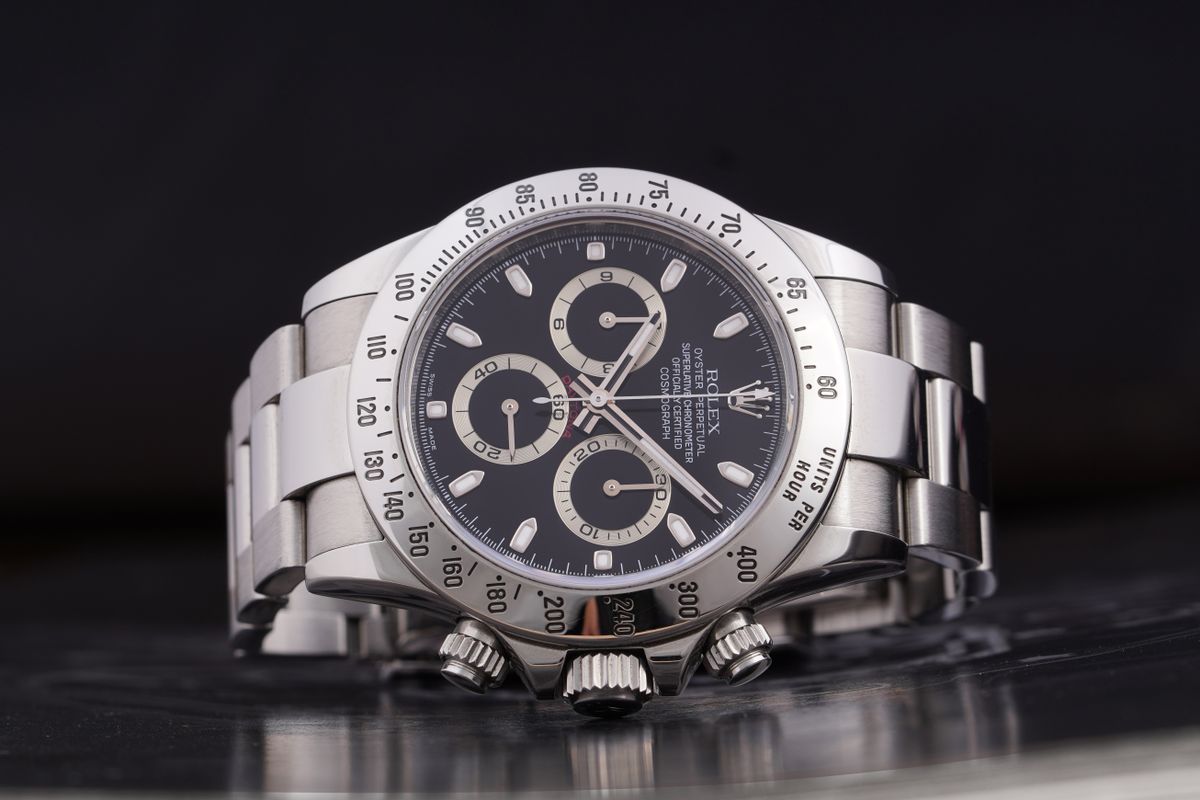
Dial printing — "ROLEX", "OYSTER PERPETUAL", the model name and, on certified watches, "SUPERLATIVE CHRONOMETER OFFICIALLY CERTIFIED" — is applied to a very consistent register and depth. On a genuine Rolex the text sits dead centre, the stroke weight stays even across every letter, and there is no ink bleeding at the edges. 🟡 Indicative
Hour markers should be perfectly straight and flush to the dial, with no gaps and nothing leaning off true, and the lume inside each marker should fill its recess evenly: no overspill, no dead corners. The hands must be the exact length, thickness and shape for that reference. Plenty of fakes fit hands of roughly the right outline but slightly wrong proportion, and the only way to catch that is to hold the watch against official photographs or a verified example of the same reference. 🟡 Indicative
Careful
Printing and typography are among the first things today's high-end fakes get right, so perfect text is no longer strong evidence by itself. It still throws out the cheap fakes quickly. It will not settle anything against a well-made superclone.
Dial, markers and hands — the first check you make, and the one high-end fakes have got closest to.
Date and Cyclops lens
On the models fitted with a date window and Cyclops (Datejust, Day-Date, Submariner Date, GMT-Master II — the Daytona has none), the lens is sapphire and magnifies the date exactly 2.5x. That figure is a real Rolex specification, not a legend. The date should read large, sharp and dead centre in the window. 🟢 High reliability
Cheap fakes usually land somewhere around 1.3-1.5x: the date looks small, off-centre and slightly soft. This remains one of the easiest checks to make with the naked eye and one of the hardest to fake cheaply — but the better counterfeits now get very close to the correct magnification, so on a quality piece it stops being decisive on its own.
- The date disc should change at midnight in one dry snap — quickset on the modern calibres — rather than dragging itself round. 🟡 Indicative
- The date numerals should match each other in weight and typeface. Numbers sitting off-centre in the window, or printed to an uneven thickness, are a real sign of poor quality. 🟡 Indicative
Bezel
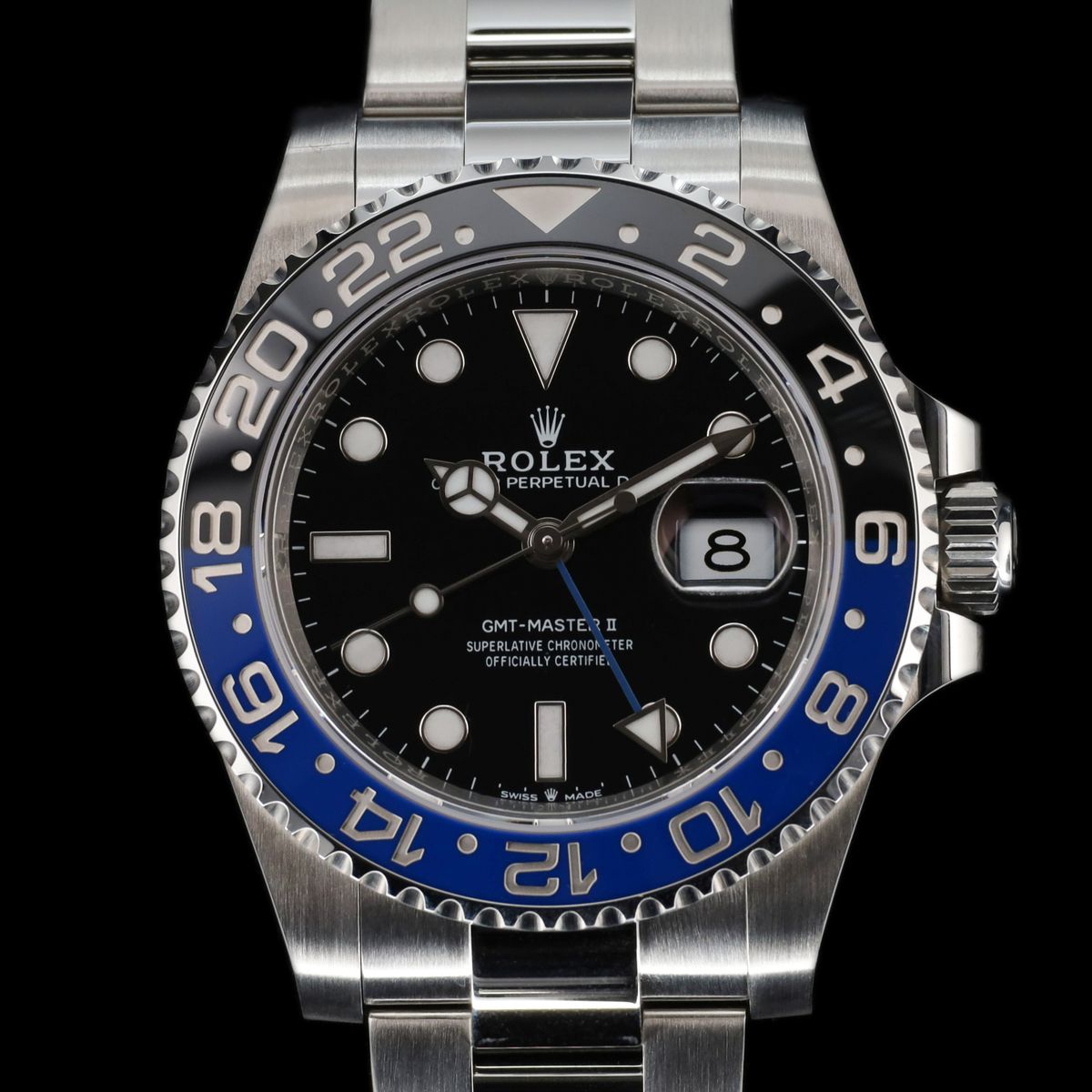
Bezel type depends entirely on the model and the period, so the first thing to establish is whether the material belongs on that reference at all. A modern Submariner (116610 onwards) should carry a Cerachrom ceramic bezel, near enough scratch-proof and very stable in colour. A Submariner from before 2005-2008 should have an aluminium insert, which does scratch and does fade with time. A ceramic bezel on a reference only ever built with aluminium — or the reverse — is a very strong signal that the watch has been altered, or is simply fake. 🟢 High reliability
On fluted bezels (Datejust, Day-Date), look at the spacing and depth of the flutes. On a genuine Rolex they are uniform, cleanly cut, and not sharp to the fingertip. Fakes commonly show flutes of uneven width, edges that feel sharp, or visible marks left by the machining tool. 🟡 Indicative
On graduated bezels — divers and GMTs — the numerals should carry the typeface used in that specific period. Rolex changed font several times across the decades, the fat font and the thinner ones, and the engraving should be filled evenly, with no burrs and no PVD fill spilling out over the ceramic.
Careful
Do not apply the correct font or material of a current Submariner to one from the 1990s, or the other way round. That is exactly the mistake that gets a genuine vintage watch written off as fake, or waves a hybrid straight through. Establish the exact reference and its production range first, then judge the bezel.
The bezel material, aluminium or ceramic, has to match the exact generation of the reference — not a vague sense of vintage versus modern.
Case and finishing
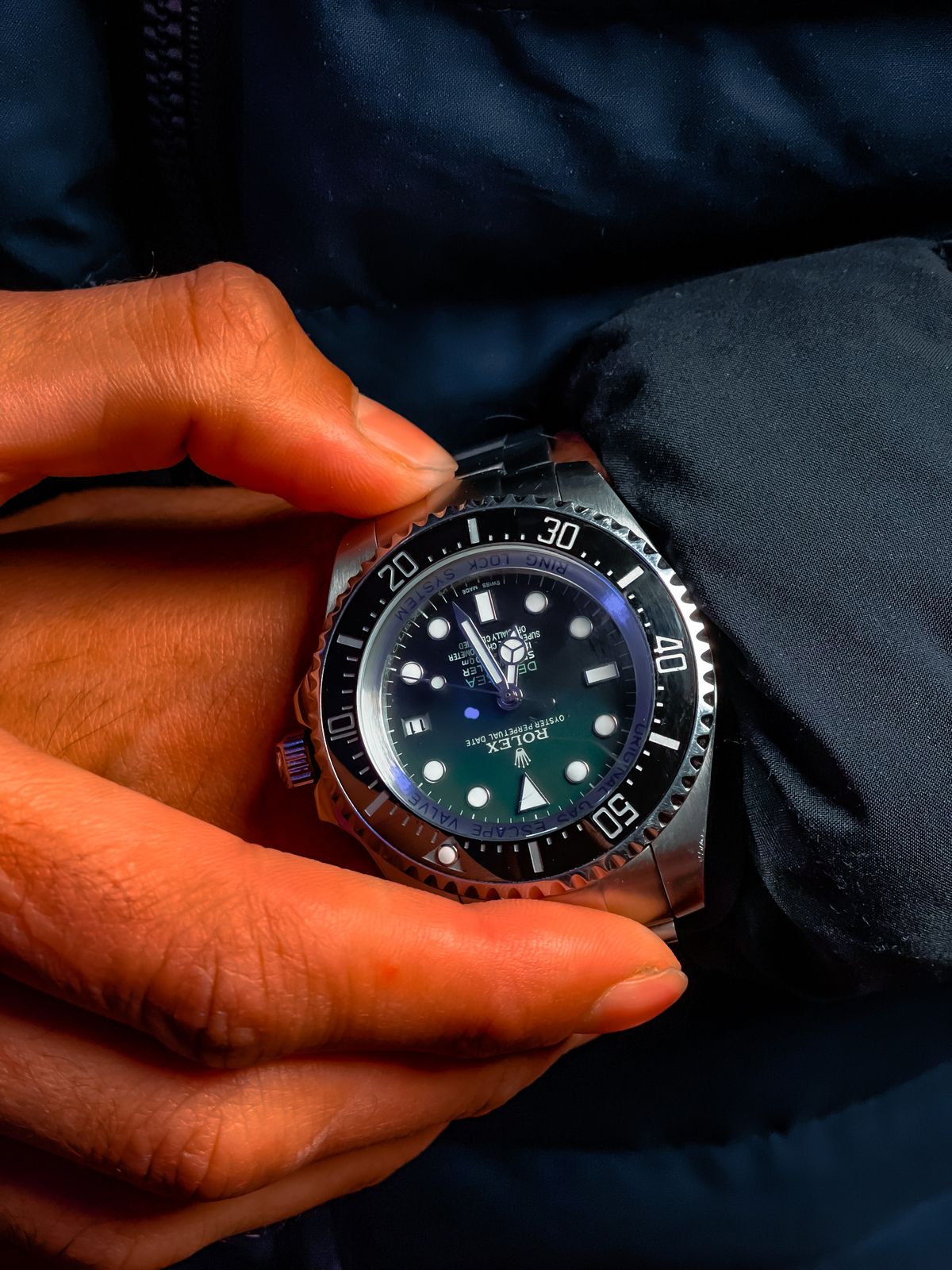
An Oyster case shows clean, sharply defined transitions between the polished surfaces — bezel, the centre of the lugs — and the brushed ones on the top of the lugs and the case sides. On fakes those transitions tend to go soft and vague, as though the whole case had been given one finish and left at that. Lug shape and crown guards have to belong to the period of the reference: both changed in documented ways over the decades, and crown guards from one generation sitting on a case from another are a sign the watch has been put together from parts. 🟡 Indicative
The caseback of a Rolex Oyster is plain. No visible engraving, and no display back on any model in the range. A transparent caseback showing off the movement is, by itself, reason enough to walk away without looking at anything else. 🟢 High reliability
Several of these case checks need the bracelet off, or at least enough clearance between the lugs to read the rehaut and the inside faces properly. It is not essential, but if you can do it — or get a watchmaker to do it for you — you will see information that is simply invisible with the watch on the wrist.
Polished-to-brushed transitions, lug shape — detail you only read properly in good light, up close.
Serial numbers and engraving
The reference number is engraved between the lugs, on the case side above 12 o'clock. The serial number traditionally went on the opposite side at 6, visible only once the bracelet or strap comes off. From 2005, with the change of serial generation (the M prefix onwards), Rolex also began engraving the serial on the rehaut — the inner ring between the dial and the crystal — where it can be read without taking anything apart. Between 2005 and 2008 both locations ran side by side depending on the model, and from 2008-2010 the rehaut is the only place a newly built watch carries it. 🟡 Indicative
The most common mistake
It has a serial number, so it is genuine — false. Rolex publishes no serial database the public can search, and counterfeiters engrave real serial numbers, lifted from authentic watches, onto fake cases. The serial helps you date a watch and test it for consistency: does that serial range belong with that reference, in that year? It is never proof by itself. And do not go hunting for a rehaut engraving on a watch made before 2005-2007. The location did not exist yet, and its absence there means nothing at all.
The crown laser-etched into the crystal at 6 o'clock arrived on some models from the early 2000s as an extra security measure. It is a useful corroborating detail when the watch belongs to that period, but its absence on anything older than its introduction proves nothing, and high-end fakes now reproduce it fairly faithfully. 🟡 Indicative
Bracelet and clasp
Links on a genuine Rolex bracelet — Oyster, Jubilee or President — are solid, not folded. A bracelet that rattles hollow, or feels light for its bulk, is a real warning. The articulation between links should be firm, with no side play you can feel, and the finish (brushed or polished depending on the link) should hold consistent along the whole length. 🟡 Indicative
Inside the clasp, a genuine Rolex carries the crown emblem with "ROLEX" at the centre and, in very small lettering, "GENEVA" and "SWISS MADE" — engraved to an even depth, with a clean bead-blasted finish around it. The outer face of the clasp should carry no additional engraving at all; some fakes stamp "STAINLESS STEEL" there, which Rolex does not do. The clasp mechanism should open and close with a firm, precise click, neither loose nor mushy. 🟡 Indicative
Stamped inside the clasp you will usually find a bracelet reference and, on more recent pieces, a manufacturing date code for the bracelet itself — which either agrees with the period of the watch or does not. Reading that properly, like judging how the links are built internally, normally means opening the clasp or taking a link out.
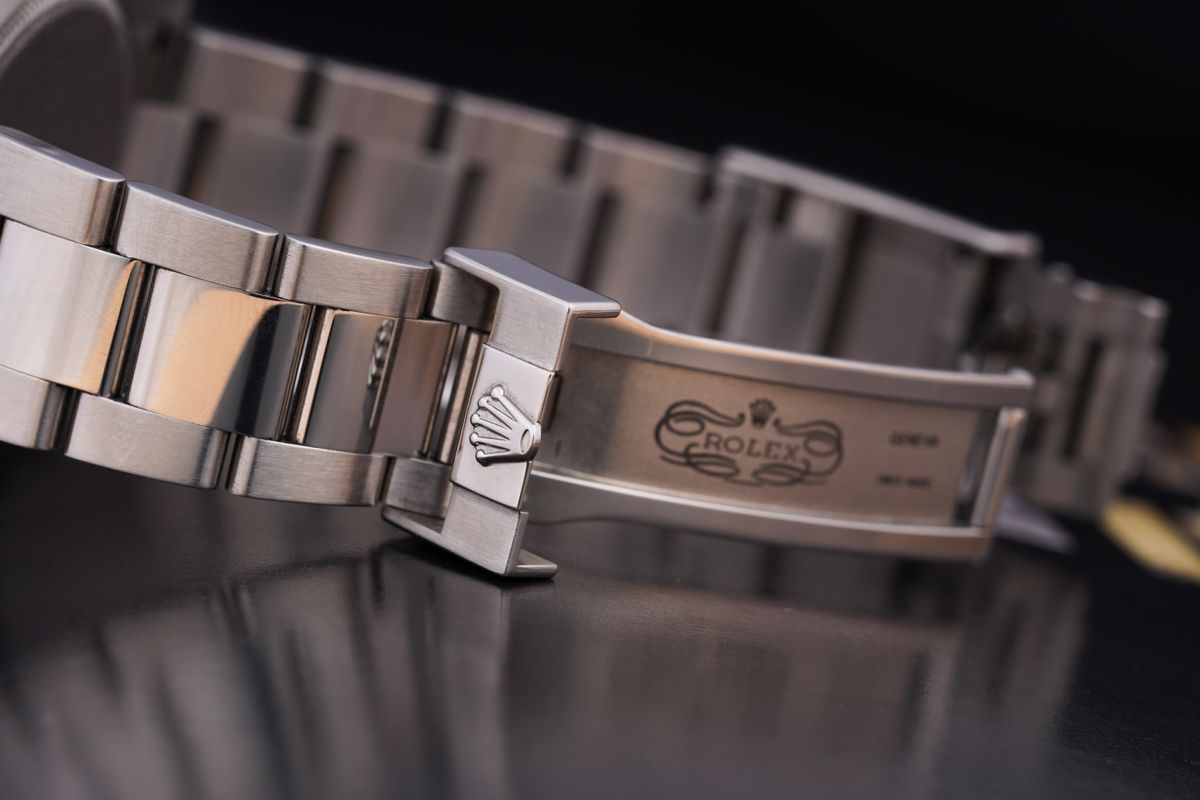
The inner face of the clasp, crown emblem and "ROLEX" engraved — one of the most precisely executed points on the entire watch.
A note on screws and components
There is a persistent idea that every screw on a genuine Rolex has its slot perfectly aligned. It is half a myth. Rolex neither guarantees nor advertises slot alignment as a factory characteristic, so it proves nothing in either direction: aligned slots do not make a watch genuine, and misaligned ones do not make it fake. 🔴 Proves nothing
What does mean something is the quality of the machining, both on the bracelet screws and on the screws inside the movement: heads properly centred, an even finish with no burrs, and no tool marks or signs of having been forced. That last one may only mean the watch has been through a service at some point, not that it is fake, so weigh it against the rest of the piece rather than reading it on its own.
The movement
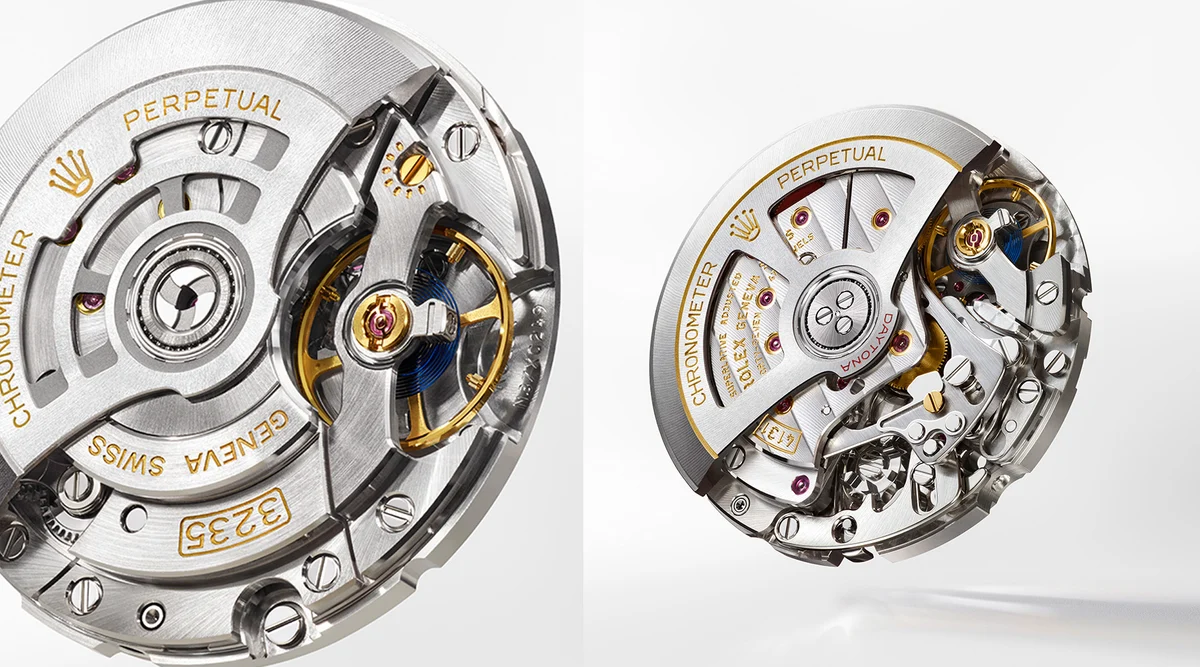
This is by a distance the check that carries the most real weight, and the one demanding the most experience — or a professional outright. The rotor of a genuine Rolex calibre is engraved with the crown and the words "ROLEX SWISS MADE" in a specific typeface and to a specific depth, alongside perlage or Côtes de Genève finishing depending on the calibre and the bridge. On fakes the movement finishing is usually far cruder: shallow stamped patterns, rotor engraving in the wrong typeface, and a gritty feel when you wind it by hand, against the smooth, oiled action of a genuine Rolex calibre. 🟢 High reliability
One technical detail specialist watchmakers keep coming back to: on genuine calibres such as the 3135, the balance bridge carries a single arm — free-sprung regulation, adjusted through the Microstella weights on the balance itself — whereas many cloned movements use index regulation, which shows two arms on the bridge. It is a real tell, but you can only see it with the watch open, and you need to know calibres well enough to read it. Nothing about it is visible from the outside. 🟢 High reliability
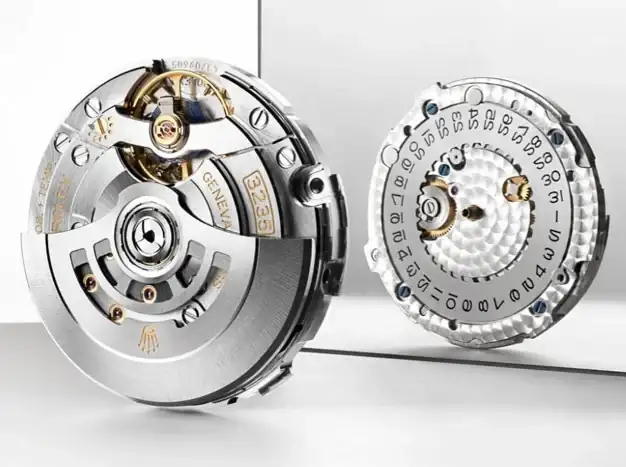
The calibre 3235 from both sides — the engraved rotor on one face, the date wheel on the other.
Why this one counts
The movement is the most expensive component and the hardest to reproduce faithfully, which is exactly why it is also the check you cannot make without opening the case. On any purchase involving real money, this is the one that actually decides the question, and it normally takes a watchmaker's hands.
Rolex, model by model
Everything above shifts meaning depending on the model and, above all, on the exact generation of that model. Never carry the details of a modern Rolex across to a vintage one, or the other way round.
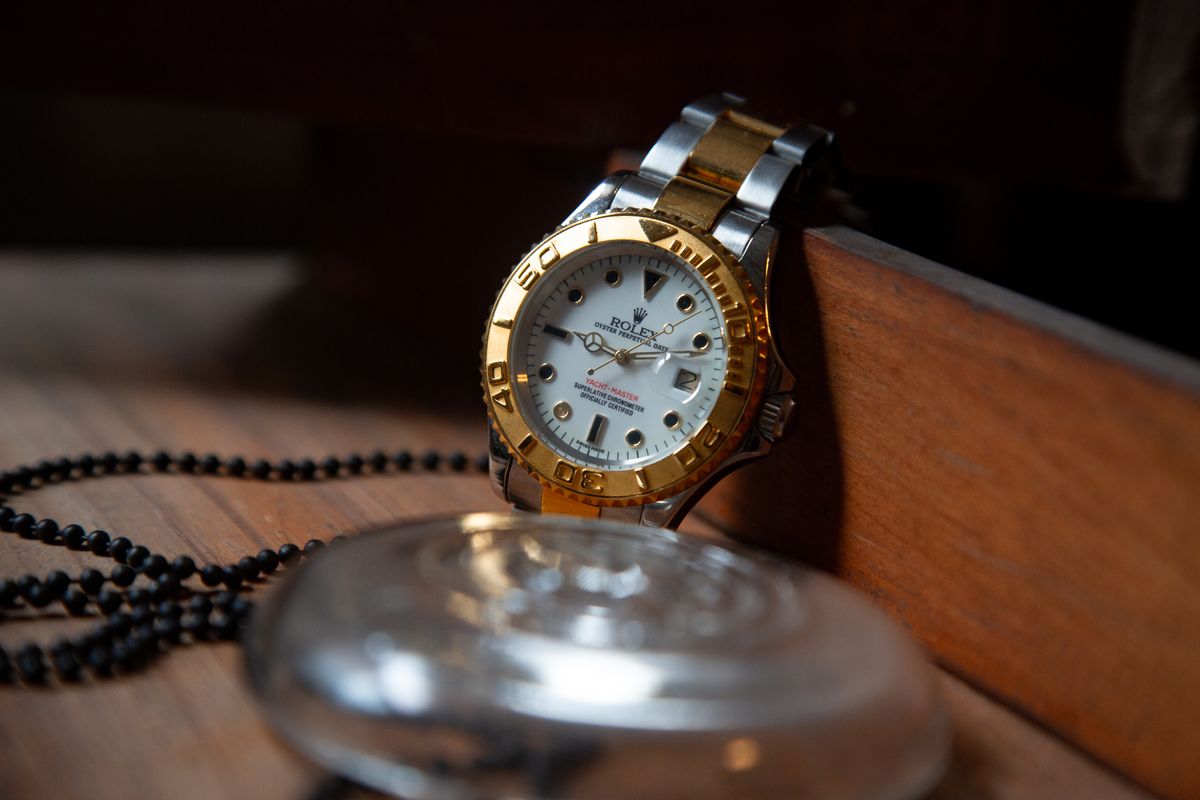
Datejust, Submariner, Day-Date, GMT-Master and Daytona share a family, but each has its own anachronisms to watch for.
Datejust, and the ref. 16233 in particular
The 36 mm Datejust family (references 16000-16299) was built from the late 1980s to the mid-2000s, before the Datejust II arrived. The 16233, steel and yellow gold with a gold fluted bezel, is one of the most heavily faked combinations in the whole range: popular, and with an entry price low enough that the fakers see a market in it.
Because the run is mostly earlier than 2005-2007, on the overwhelming majority of 16233s the serial number is engraved between the lugs only, not on the rehaut. Looking for it on the rehaut and finding nothing is not suspicious on this reference — it is what you should expect. Check instead that the fluted bezel is solid yellow gold rather than plated or painted steel, and that the Jubilee bracelet mixes steel and gold links in the proportion correct for that reference.
Submariner, vintage against modern
A Submariner from before 2003-2008 — the 16610 family, for instance — has a sapphire crystal but an aluminium bezel insert, tritium or Luminova lume depending on the decade, and the serial number between the lugs. The older no-date models do not carry a Cyclops at all.
A modern-generation Submariner (116610 onwards, 2010+) has a Cerachrom ceramic bezel, Chromalight lume with its distinctive blue glow, the serial engraved on the rehaut, and a Glidelock clasp with fine adjustment. A ceramic bezel on a vintage-generation case, or the reverse, is a serious inconsistency and points squarely at a watch that has been altered or faked.
Day-Date
The Day-Date has only ever been built in gold or platinum — never in steel — with a fluted bezel as near as makes no difference standard, and a President bracelet of solid semi-circular links. Check that the metal of the bezel, case and bracelet agree with one another: the same type and carat of gold, or platinum throughout.
Its most particular feature is the day wheel, spelled out in the language chosen for that watch — as many as 26 different languages across the model's history. The spelling and the typeface of that word have to be right. Fakes have got the spelling wrong here more than once, and that is a mistake a genuine Rolex should never make.
GMT-Master and GMT-Master II
The original GMT-Master has a single 24-hour hand locked to the hour hand; to change time zone you turn the bidirectional bezel. The GMT-Master II, from the late 1980s, adds an independent 24-hour hand that can be set on its own without disturbing local time. That is the fastest way to tell the two apart at a glance, and a fake pairing a GMT-Master bezel with GMT-Master II behaviour — or the reverse — has given itself away as an incoherent watch.
The classic two-colour bezels, Pepsi in red and blue, Batman in black and blue, were aluminium until the mid-2000s. From 2013 Rolex began making them in two-colour Cerachrom ceramic using a process of its own, so anything earlier than that date wearing a two-colour ceramic bezel on a GMT-Master II is an anachronism.
Cosmograph Daytona
The chronograph pushers must be screw-down on any Daytona from the late 1980s onwards. Pushers that work without unscrewing first, on a Daytona of that period, are an immediate alarm. The tachymetric bezel was engraved steel until 2016, and from then on black Cerachrom ceramic on most versions: once again, the material has to fit the exact generation.
The calibres mark the generations too. Daytonas from the late 1980s to 2000 run the calibre 4030, a heavily reworked Zenith El Primero; from 2000 Rolex fitted its own calibre 4130, entirely in-house. A watchmaker can confirm which one is inside by opening the case, but it also has to agree with the year of manufacture the serial number points to.
The Frankenstein Rolex problem
Not every problem watch is a fake in the strict sense. A Frankenstein Rolex is one assembled from genuine parts belonging to different references or different periods — a case from one model wearing a bezel, a dial or a caseback from another — and sold as though it left the factory that way. Because a good share of its components genuinely are authentic, it can pass check after check, area by area, without raising anything obvious. The only real defence is to confirm that every part — case, dial, bezel, bracelet, movement — belongs to the same reference and the same period, not merely that each part on its own looks genuine.
Tells you should NOT use to authenticate a Rolex
These claims circulate endlessly on forums and in videos, and every one of them has something in it. Not one works as proof on its own.
"If it has a serial number, it's genuine"
🔴 False as sole proofRolex offers no public serial number database. Counterfeiters copy real serials from authentic watches and engrave them on fake cases. A serial number is there to date a watch and test it for consistency, never to confirm authenticity on its own.
"If it's heavy, it's genuine"
🔴 Not enough on its ownA steel Rolex really is heavy, thanks to the Oyster construction, and a suspiciously light watch is a genuine warning. But today's fakes use steel too, with heavier components than they once did — a correct weight is no longer enough to wave a watch through.
"The seconds hand always sweeps perfectly smoothly"
🟡 Partly trueTrue that a mechanical Rolex beats at 28,800 vph, eight times a second, which the eye reads as a continuous sweep, against the once-a-second tick of cheap quartz. But mechanical fakes exist now and they sweep smoothly as well — this rules out the quartz fakes, not all of them.
"A genuine Rolex never makes a sound"
🟡 Partly trueA genuine Rolex is discreet in operation, but silent is not a technical standard an owner can measure, and some high-end mechanical fakes are reasonably quiet too. A loud quartz tick does give a cheap fake away; the absence of noise, by itself, confirms nothing.
"The Cyclops always magnifies exactly 2.5x"
🟡 True, but no longer enough aloneIt is a real Rolex specification, and cheap fakes fall well short of it (~1.5x). But not every Rolex carries a Cyclops, and high-end fakes now reproduce the correct magnification — on a quality piece it stops being decisive.
"The tiny crown etched in the crystal proves authenticity"
🟡 Indicative, not conclusiveA useful sign when it belongs to the watch's period — it appeared on some models from the early 2000s — but its absence on older pieces means nothing, and high-end fakes reproduce it fairly faithfully now.
"A fake Rolex always has visible mistakes"
🔴 Not true any moreIt held for decades against cheap fakes, but today's high-end counterfeits — superclones — reproduce 904L steel cases, real ceramic bezels and very precise engraving. They survive a superficial visual inspection with nothing obvious to catch.
When to call a professional
Not every check reaches as far as the next. These are the six levels of authentication, from least to most reliable — and from least to most demanding.
Rule of thumb
On any purchase above €3,000-5,000, or whenever the watch is going to be resold or insured, professional authentication (Level 6) is not a luxury. Against today's high-end fakes it is the only way to reach real certainty.
Final checklist for a Rolex
| Area | What to check | What you want to see | Reliability | Disassembly? |
|---|---|---|---|---|
| Dial and hands | Printing, markers, lume, hand proportions | Perfect register, no smudging, no overspill | Indicative | No |
| Date and Cyclops | Magnification, centring, the date change | A true 2.5x, date large and sharp | High | No |
| Bezel | Material for the reference, numerals, flutes | Ceramic or aluminium correct for the period, even engraving | High | No |
| Case and finishing | Polished-to-brushed transitions, crown guards, caseback | Clean transitions, plain back with no display crystal | High | Partial |
| Serial numbers and engraving | Reference, serial, location by period, etched crown | Agreement with the production range | Indicative | Yes (lugs) |
| Bracelet and clasp | Solid links, internal engraving, clasp mechanism | No play, crisp engraving, firm click | Indicative | Partial |
| Screws and components | Machining quality, absence of burrs | Not slot alignment — that one is a myth | Weak | Partial |
| Movement | Calibre finishing, rotor, balance bridge architecture | Crisp engraving, smooth feel when winding | High | Yes |
Frequently asked questions
Is the serial number enough to tell whether a Rolex is genuine?
No. Rolex provides no public database for checking serial numbers, and counterfeiters copy serials from real, authentic watches onto fake cases. Only a professional who cross-references that number against the rest of the watch can use it as part of a genuine authentication.
Does a fake Rolex always have flaws you can see with the naked eye?
Not any more. Today's high-end fakes reproduce 904L steel cases, real ceramic bezels and very precise engraving, and they pass a superficial visual inspection without difficulty. For those, you have to compare against documented references or open the watch.
Does the weight of the watch prove it is authentic?
Not on its own. A genuine steel Rolex weighs what it weighs because of the Oyster construction, and a light one is suspicious. But current fakes use steel too and weigh more than they did a decade ago — indicative, not conclusive.
Is it true that the seconds hand of a genuine Rolex always sweeps smoothly, with no ticking?
A mechanical Rolex beats eight times a second, which reads as a continuous sweep next to the tick of cheap quartz. But mechanical fakes that sweep smoothly exist now — it rules out the quartz ones, not all of them.
Does the Cyclops lens always magnify the date exactly 2.5 times?
On the models that have one, yes, and it is a good signal against cheap fakes (~1.5x). But not every Rolex carries a Cyclops, and high-end fakes now reproduce the correct magnification.
When is it worth paying for professional authentication?
Whenever the sum involved is significant, from €3,000-5,000 upwards, or when the watch is going to be resold or insured. A specialist watchmaker can open the case and inspect the movement, the most reliable check of them all.
What is a Frankenstein Rolex, and why does it complicate authentication?
A watch assembled from genuine parts belonging to different references or periods, sold as though it were coherent from the factory. Because many of its parts are authentic, it can pass checks made area by area — you have to verify that the whole watch belongs to one reference and one period.