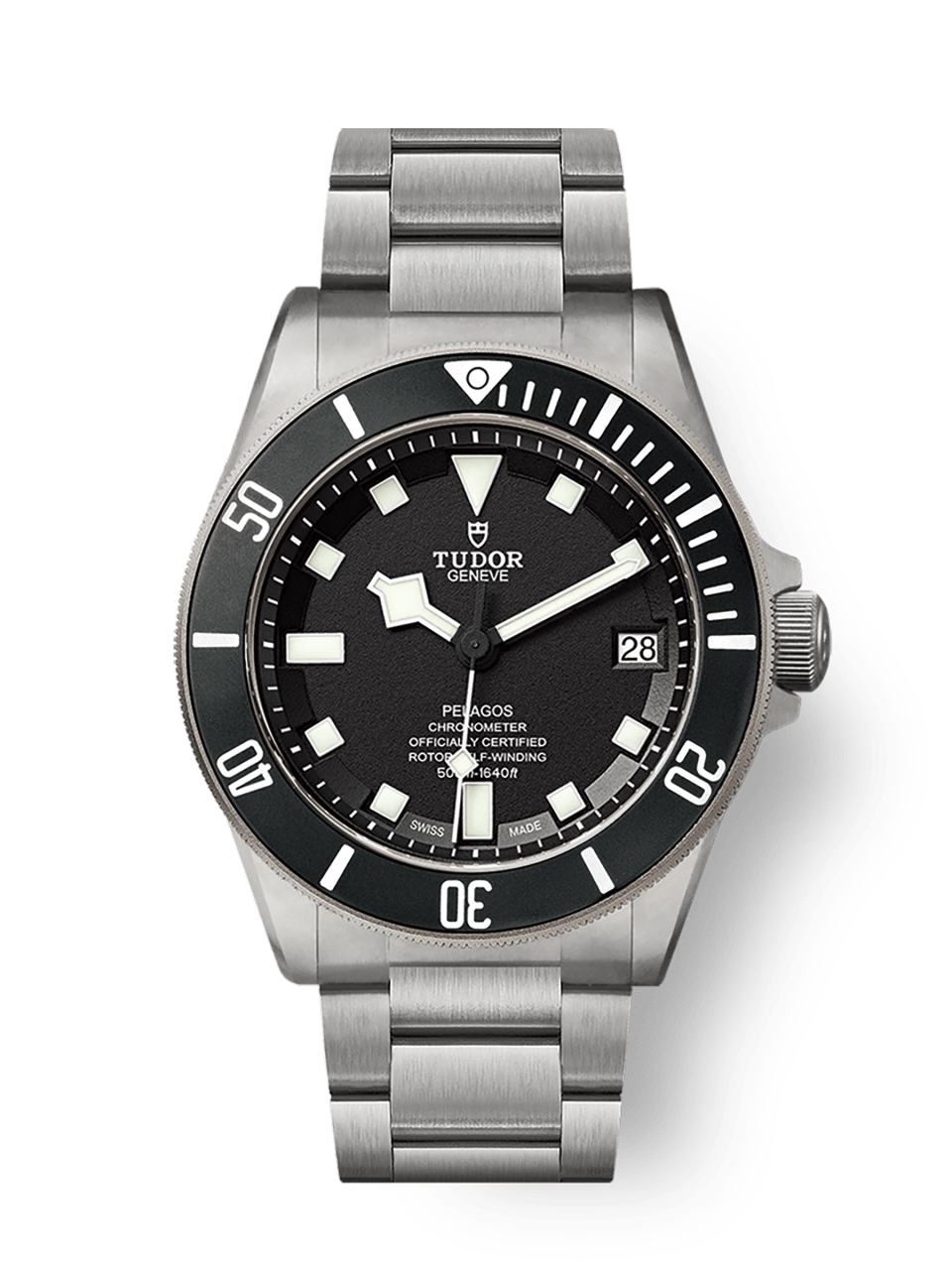
Imagen: Tudor, web oficial
The storyWhy this reference matters
The Pelagos arrived in 2012 as reference 25500TN, with a modified ETA 2824 inside and one very clear idea behind it: build the most literal dive watch possible, no vintage winks, no concessions to prettiness. Titanium, matte dial, not a hint of shine. The second generation, the 25600TN, followed in 2015 with the in-house MT5612 — among the first Tudor movements to carry COSC certification. From the outside it looked like the same watch. Inside it was a different one entirely.
The part of the Pelagos everyone talks about is not on the dial, it is in the clasp. Tudor patented a spring system that lengthens and shortens the bracelet by itself. Underwater, pressure compresses the neoprene and the wrist gets thinner; the spring takes up those few millimetres and gives them back on the ascent. The diver does nothing. It is the kind of solution almost no owner will ever genuinely need, and it explains what the watch was designed for better than any brochure could.
The MT5612 also had a curious second life. In 2017 Tudor and Breitling swapped movements: Breitling handed over its B01 chronograph, which Tudor reworked into the MT5813 of the Black Bay Chrono, and took away this same MT5612, rebadged B20, for the Superocean Heritage II. Two rivals lending each other engines in plain sight — not something that happens often in a trade where these arrangements are usually kept quiet.
SpecificationsThe numbers, in one table
| Brand | Tudor |
|---|---|
| Family | Pelagos |
| Reference | M25600TN-0001 |
| Years made | desde 2015 |
| Calibre | Tudor MT5612 |
| Movement | Automático |
| Frequency | 28.800 alt/h (4 Hz) |
| Power reserve | 70 horas |
| Jewels | 26 |
| Complications | Fecha · Válvula de escape de helio |
| Diameter | 42 mm |
| Thickness | 14.3 mm |
| Lug to lug | 50 mm |
| Lug width | 22 mm |
| Case | Titanio grado 2, con piezas de acero en el cierre |
| Crystal | Zafiro plano |
| Water resistance | 500 m |
IdentificationHow to tell it apart
Nothing else in the catalogue looks like the 42 mm Pelagos. Grade 2 titanium, brushed from end to end, without a single polished surface, and a ceramic bezel insert with luminous numerals rather than the anodised aluminium of a Black Bay. The sapphire is flat, not domed, which pushes it further towards instrument and away from handsome watch.
On the left flank at nine sits the helium escape valve, labelled as such. That is the giveaway that this one was built for saturation diving and rated to 500 metres rather than the 200 the brand usually settles for. Date at three, a snowflake hour hand, and a smaller snowflake on the seconds. The lume glows blue.
The clasp separates the 42 from the Pelagos 39: this one gets the self-adjusting spring, the 39 a conventional T-fit with eight millimetres of travel. Telling a 25600TN from the original 25500TN takes nothing more than reading the dial — the second generation added the certified chronometer line the first never had. The box should also hold a rubber strap with its dive extension.
CollectingWhat collectors check
Grade 2 titanium is softer than steel. It scratches if you look at it, the bracelet worst of all, and no home polish will fix that without eating the edges. A Pelagos with fine marks spread across it is simply a Pelagos. One that looks too immaculate for its age is worth a question about the polisher, because on titanium that treatment changes both the colour and the texture of the surface.
Work the spring clasp properly before you commit. It should open and return with authority, no grit and no sticky spots. It is the most unusual part of the watch and the most awkward to sort out if it goes wrong. Check too that the helium valve is screwed down and does not spin loose, and that the ceramic bezel has no chips along its edge, because ceramic cannot be polished out.
Real money rides on the full set. The rubber strap and the dive extension go missing easily and cost proper sums to replace. And do not muddle the references: 25600TB is the blue, 25600TN the black, and the LHD puts the crown at nine with the date on the left — a different watch with its own following and its own price.
Common questionsWhat people ask us about this reference
Is the Tudor Pelagos entirely titanium?
Case and bracelet are grade 2 titanium; the clasp includes steel components. Titanium is lighter and copes better with corrosion, but it is softer and picks up scratches sooner.
Does the Pelagos scratch easily?
Yes, the bracelet especially. That is the trade-off for grade 2 titanium and part of how the watch ages. Polishing it at home usually makes matters worse.
What is the difference between the Pelagos 42 and the Pelagos 39?
The 42 is rated to 500 metres and has a date, a helium valve and the self-adjusting spring clasp. The 39 measures 39 mm, stops at 200 metres, drops the date and uses a T-fit clasp.
What is the helium escape valve for?
Saturation diving. During decompression in a chamber, helium that has worked its way into the case needs a way out before it pushes the crystal off. In recreational diving it never does anything at all.
Keep readingWhere to go from here
Close relativesThe ones it gets confused with
Confidence: media — this page was checked against the sources below. If a detail looks wrong to you, write to us and we will fix it.