Imagen: Tudor, web oficial
The storyWhy this reference matters
In February 1926 a Swiss watch house called "Veuve de Philippe Hüther" registered the trademark "The Tudor". Not for itself, but on the instructions of Hans Wilsdorf, who had spent some time turning over the idea of a watch his agents could sell for less than a Rolex without lowering the bar on reliability. It took Wilsdorf 10 years to put that name in his own: the transfer was signed in October 1936. Montres Tudor S.A. didn't exist until March 1946. So the collection celebrates the year in which Tudor was nothing more than an idea parked in a register.
The watch arrived at Basel 2018 in four sizes — 28, 36, 39 and 41 mm — with a clear brief: be the way into the brand. Which is why it doesn't take an in-house calibre like its sporting siblings, but the T601, a supplied ETA-based automatic with 38 hours of reserve and no chronometer certification. That isn't an oversight: somebody has to occupy the slot below the Black Bay, and Tudor chose to spend the money on finishing rather than on a movement of its own.
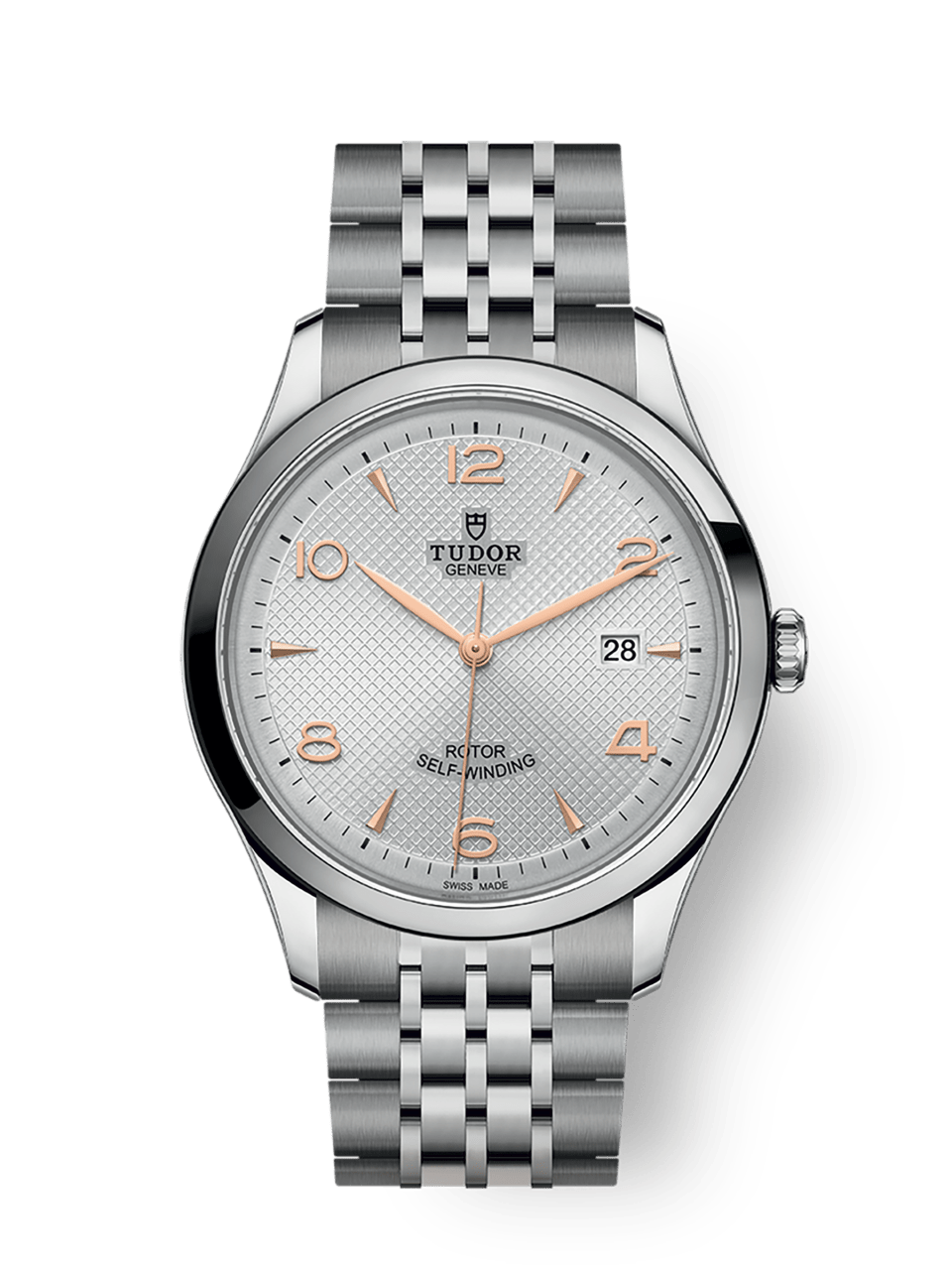
What holds the collection up is the dial. The embossed waffle pattern across the centre isn't a 2018 designer's whim: Tudor took it back off its own watches from the forties and fifties, when those textures were common and almost nobody makes them now. On the M91650-0001 it comes in silver, on a domed dial, with Arabic numerals, applied indices and sword hands. At 41 mm with a smooth polished bezel, the result is a large dress watch, which was exactly the empty slot.
SpecificationsThe numbers, in one table
| Brand | Tudor |
|---|---|
| Family | 1926 |
| Reference | M91650-0001 |
| Years made | desde 2018 |
| Calibre | Tudor T601 |
| Movement | Automático |
| Frequency | 28.800 alt/h (4 Hz) |
| Power reserve | 38 horas |
| Complications | Fecha |
| Diameter | 41 mm |
| Case | Acero inoxidable |
| Crystal | Zafiro |
| Water resistance | 100 m |
IdentificationHow to tell it apart
The number block decides it: 91650 is always the 41 mm case, and the smaller sizes in the collection use different blocks. If the reference in a listing doesn't start with 91650, you aren't looking at the 41, however much the photograph suggests otherwise. The final suffix, -0001, is the silver waffle-embossed dial on steel with a seven-row bracelet and folding clasp.
Within the same size there are black, opaline and silver dials, versions with diamond indices and steel-and-rose-gold combinations, and all of them change only the suffix. Watch the dial: the plain and the embossed versions are two different products in the same case, and in small or badly lit photographs the texture vanishes. Ask for a shot at an angle with the light from the side; either the waffle shows or it doesn't, there's no halfway.
Three quick checks: solid case back — the 1926 has no display back — screw-down crown and a date window at three. That combination goes with the T601, which is the version with a date; Tudor's T600 is the same movement without a calendar and isn't fitted here. And if anyone sells you this watch as having an "in-house Tudor calibre", correct them: the 1926 doesn't have one, and that is precisely its job in the catalogue.
CollectingWhat collectors check
The movement is an unglamorous but real advantage: being a supplied ETA base, any competent watchmaker can open it, clean it and regulate it without going through the brand, and parts are easy to come by. The trade-off is those 38 hours of reserve, and you feel them: take it off on Friday night and it has stopped by Sunday. That's not a defect, it's the arithmetic of a calibre from that generation.
The dial is the asset. Embossed waffle doesn't get restored: if it has damp staining, hand marks or the classic speckling around the centre post, that dial is gone for good, and replacing it costs more than anyone wants to pay. Look too at the smooth polished bezel, which is a magnet for case-opener marks and for over-enthusiastic polishing; a bezel thinned by the cloth shows up in the profile seen from above.
Tudor gives five years of transferable warranty with no registration required, so on a second-hand purchase the date on the card is worth real money: an example from two or three years ago may still be covered in your name. Ask for a photograph of the card with the stamp legible, and check the printed reference matches the watch before you commit to anything.
Common questionsWhat people ask us about this reference
Why is it called the Tudor 1926?
Because in February 1926 the trademark "The Tudor" was registered in Switzerland on Hans Wilsdorf's behalf. Montres Tudor S.A. wasn't founded until 1946, so the name marks the registration, not the watch.
Does the Tudor 1926 have an in-house calibre?
No. It carries the T601, a supplied ETA-based automatic with 38 hours of reserve. The in-house MT calibres are reserved for the Black Bay, Ranger, Pelagos and, since 2026, the Royal.
What size is the Tudor 1926 M91650?
Forty-one millimetres, the largest in the collection. The family was also offered in 39, 36 and 28 mm, each with its own reference block.
Can I shower or swim in a Tudor 1926?
It's water resistant to 100 metres and has a screw-down crown, so water is no drama as long as the crown is properly closed. Worth having the gaskets checked every few years, especially if you take it in the sea.
Keep readingWhere to go from here
Close relativesThe ones it gets confused with
Confidence: media — this page was checked against the sources below. If a detail looks wrong to you, write to us and we will fix it.