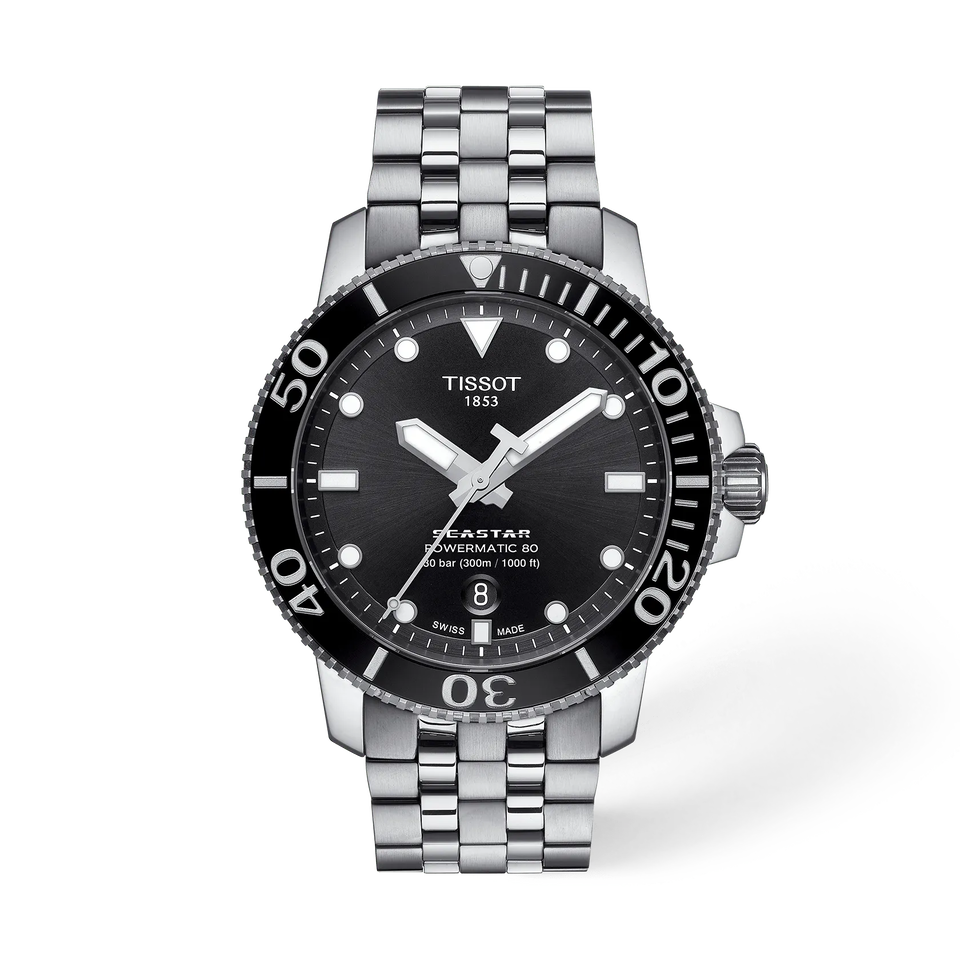
Imagen: Tissot, web oficial
The storyWhy this reference matters
The Seastar name goes back to the fifties, when Tissot split its water-resistant watches off from the rest of the catalogue. The Five Star series made its case on antimagnetism and standing up to knocks; the Seastar added the hermetic sealing that let you put the watch in water without crossing your fingers, and the name followed from there. Seventy years on the label is still in use, and the joke is that the number attached to it was never measured in metres at all: the thousand is feet, about 300 metres.
The interesting part is under the dial. The Powermatic 80 is the ETA C07.111, a 2824-2 whose beat rate Swatch Group dropped from four hertz to three and whose mainspring it lengthened. Fewer beats per second means less energy spent, so the same wind lasts twice as long: roughly 40 hours becomes 80. On the wrist, that means you leave it on the bedside table on Friday and it's still on time come Monday. With that one argument Tissot disarmed half the entry-level market.
The 43 mm case is a diver by the book, and here that's a compliment: screw-down crown between guards, unidirectional 60-minute bezel with a ceramic insert, luminous pip at twelve, sapphire and a screwed case back. The date sits at six, on a black background, where it doesn't break the run of indices. 12.7 mm thick and 49.6 mm lug to lug: it wears better than the diameter suggests, because the lugs turn down towards the wrist early.
SpecificationsThe numbers, in one table
| Brand | Tissot |
|---|---|
| Family | Seastar |
| Reference | T120.407.11.051.00 |
| Calibre | Powermatic 80 (ETA C07.111) |
| Movement | Automático |
| Frequency | 21.600 alt/h (3 Hz) |
| Power reserve | 80 horas |
| Jewels | 23 |
| Complications | Fecha |
| Diameter | 43 mm |
| Thickness | 12.7 mm |
| Lug to lug | 49.6 mm |
| Lug width | 21 mm |
| Case | Acero inoxidable 316L con bisel de cerámica |
| Crystal | Zafiro |
| Water resistance | 300 m (30 bar) |
IdentificationHow to tell it apart
There are 43 mm and 40 mm Seastars, and there are quartz ones. This reference is the 43 with the Powermatic 80, black sunray dial and steel bracelet. In the reference codes Tissot publishes, the 407 block is this 43 mm case and 807 is the 40; and if the seconds hand ticks in one-second steps, you're looking at a quartz, not this watch.
Look closely at the bezel. Here the insert is ceramic with the graduations engraved, but not every Seastar has one: other versions use a mineral glass ring with the scale printed in colour, recognisable by a flatter shine and by how badly it shows scuffs. It's the detail that separates one version from another when the seller only photographs the dial.
The bracelet is a five-link, polished centres and brushed outers, with a folding clasp with safety catch and a wetsuit extension. Lug width is 21 mm, an awkward size that makes decent replacement straps hard to find; check the quick-release system is complete before you count on it.
CollectingWhat collectors check
The Powermatic 80 is regulated at the factory by laser, not with the old index regulator. That means a watchmaker can't fine-tune the rate the way they would on a classic 2824, and that if the watch drifts out of range the usual route runs through official service. It isn't a fault, it's a different way of working, but worth knowing before you start dreaming of pinning it to two seconds a day.
On the used market it's the ceramic insert and the bracelet that decide things. Ceramic doesn't scratch, but it chips at the edges if the watch has taken knocks: hold it up to the light and look into the notches of the bezel. Then turn the bezel, which should feel dry and crisp with no side play, and open and close the wetsuit extension a few times, because that's the part that gets abused most and replaces worst.
Being a catalogue model with plenty of dial variants, the case and crown are usually in better shape than the gaskets: if you plan to swim with it, put it through a pressure test first. And don't pay for the box and papers as though they were relics; on a watch this recent the value is in unpolished case edges and a bezel still aligned with twelve.
Common questionsWhat people ask us about this reference
How deep can the Tissot Seastar 1000 actually go?
Three hundred metres, 30 bar, with a screw-down crown and unidirectional bezel. That's more than any recreational dive needs. The practical limit comes from the gaskets and their maintenance, not from the spec sheet.
What's the difference between the Seastar 1000 and the Seastar 2000?
The 1000 is rated to 300 metres and measures 43 mm. The 2000 Professional doubles that to 600, adds a helium escape valve at nine and meets ISO 6425, but it's noticeably bigger and heavier.
Which movement does the Seastar 1000 Powermatic 80 use?
The Powermatic 80, which is the ETA C07.111 derived from the 2824-2. It beats at three hertz instead of four and gives 80 hours of reserve with an antimagnetic Nivachron hairspring.
Is the 43 mm Seastar 1000 too big?
It's 12.7 mm thick and 49.6 mm lug to lug, so it settles on a medium wrist better than the diameter suggests. If you want something more contained, the same recipe exists in 40 mm.
Keep readingWhere to go from here
Close relativesThe ones it gets confused with
Confidence: media — this page was checked against the sources below. If a detail looks wrong to you, write to us and we will fix it.