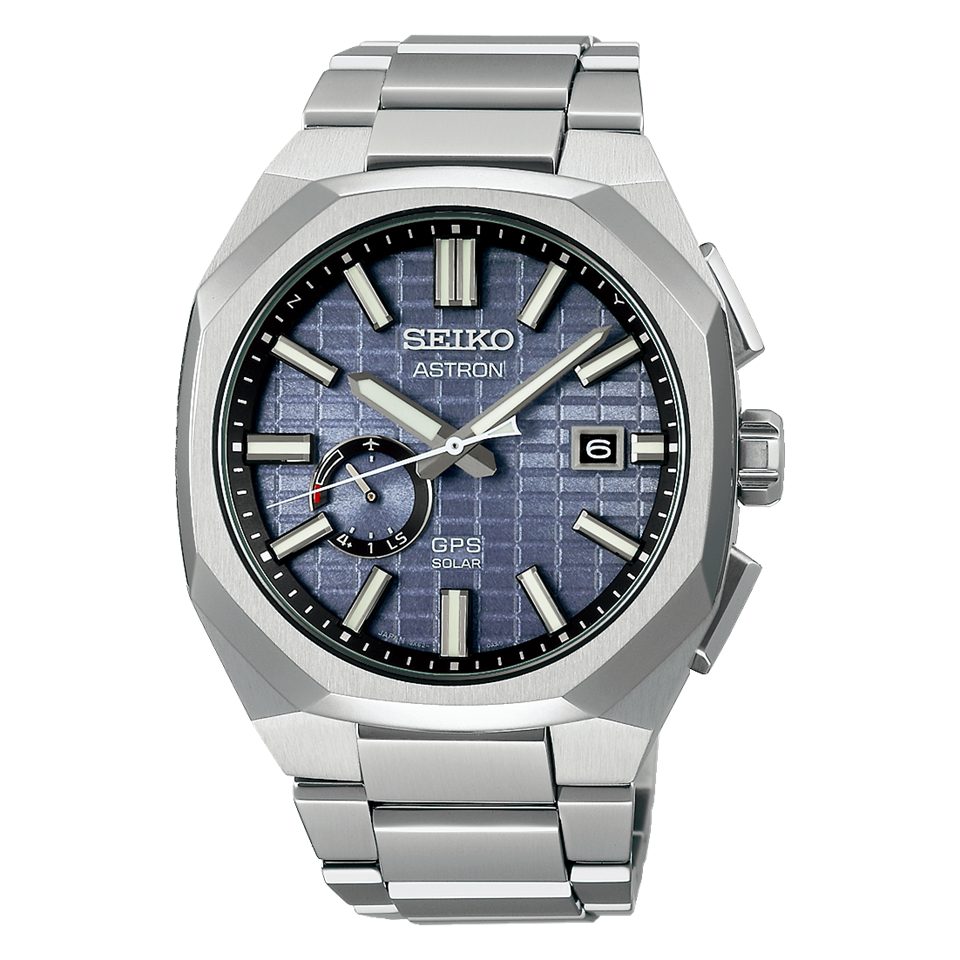
Imagen: Seiko, web oficial
The storyWhy this reference matters
The Astron 35SQ was unveiled in Tokyo on 25 December 1969, after ten years' work at Suwa Seikosha. Inside was a quartz oscillator, a hybrid integrated circuit and a stepping micromotor; outside, eighteen-carat gold. The first hundred sold out in a week. The name was picked for its space-age ring, which was the language of those years, and from that point the mechanical watch stopped being the only business in watches.
Seiko parked the name for more than four decades and brought it back in 2012 for another first: the first mass-produced wristwatch that set itself by reading GPS satellites and ran on nothing but light. The underlying idea is the one from 1969 — put the most accurate time reference available on a wrist — and what changes is where that reference comes from. The trouble with those early GPS models was bulk, and that became the work of the following decade.
The SSJ013J1 belongs to the 2023 redesign, the one that introduced the 3X62 calibre and brought the family down to twelve millimetres tall. The titanium case gave up its round shapes for an irregular octagonal bezel — the sides are not the same length — and the bracelet became integrated. Three independent motors drive hours, minutes and seconds, which is why the watch changes time zone in about three seconds instead of dragging the hands half way round the dial.
SpecificationsThe numbers, in one table
| Brand | Seiko |
|---|---|
| Family | Astron |
| Reference | SSJ013J1 |
| Years made | desde 2023 |
| Calibre | Seiko 3X62 |
| Movement | Cuarzo |
| Power reserve | Aprox. 6 meses a plena carga; hasta unos 2 años en modo de ahorro |
| Jewels | 10 |
| Complications | Sincronización horaria por GPS · 39 husos horarios · Calendario perpetuo hasta 2100 · Indicador de reserva de energía · Modo avión |
| Diameter | 41.2 mm |
| Thickness | 12 mm |
| Lug to lug | 48.5 mm |
| Lug width | 14 mm |
| Case | Titanio con revestimiento súper duro |
| Crystal | Zafiro con tratamiento super clear |
| Water resistance | 10 bar (100 m) |
IdentificationHow to tell it apart
The quickest tell is the bezel: eight faces, none of them alike, brushed on top and polished on the flanks. Below it, an integrated titanium bracelet with a fourteen-millimetre attachment, so there is no strap swapping here. The blue dial carries a pressed relief that evokes quartz crystals, a nod to the original Astron, and a multifunction subdial at eight.
Within the series, the SSJ013 is the one in natural titanium with a blue dial; the SSJ014 has a rose-gold-coloured bezel coating and a grey dial, and the SSJ015 goes all black. If the watch in front of you measures 41.2 mm across, 12.0 tall and 48.5 lug to lug, you are in the 3X62 generation and not one of the thicker earlier ones.
The case back screws down and the calibre is marked 3X62: ten jewels, a perpetual calendar programmed to 28 February 2100, aeroplane mode and accuracy of ±15 seconds a month when it goes a while without seeing a satellite. Water resistance of 10 bar, sapphire with a super-clear treatment, and a folding clasp with quick adjustment.
CollectingWhat collectors check
A solar watch has no battery to change, but it does have a rechargeable cell that ages, and that is the part a service centre ends up replacing after enough years. Buying used, leave the watch in the light for a while and check the reserve indicator climbs. If it stays stuck on low in direct sun, price in a repair.
The fourteen-millimetre lugs and integrated bracelet are a decision for life: there are no practical replacement straps and loose links are hard to track down. Count the links and ask for the maximum wrist size before you buy, because lengthening an integrated titanium bracelet is not a problem you solve with a spare NATO.
The titanium carries a super-hard coating, which handles rubbing far better than bare titanium but, once marked, will not polish out without eating through the layer. Favour examples with a clean bezel, since that is the area that gets hit first. And check that manual signal reception works next to a window: without GPS the watch still runs, but you lose half the argument for owning it.
Common questionsWhat people ask us about this reference
Does the Seiko Astron SSJ013J1 need a battery change?
No. It charges on light and holds about six months on a full charge, up to roughly two years in power-save mode. What can be replaced over the years is the rechargeable cell.
How many time zones does the 3X62 calibre cover?
Thirty-nine. It identifies the zone by GPS and switches in about three seconds, thanks to three independent motors for hours, minutes and seconds.
How accurate is it without a GPS signal?
±15 seconds a month, measured between 5 and 35 °C. As soon as it picks up a satellite it sets itself.
Can you change the bracelet on the SSJ013J1?
In practice, no. It is integrated and meets the case at 14 mm, so conventional straps do not fit.
Keep readingWhere to go from here
Close relativesThe ones it gets confused with
Confidence: alta — this page was checked against the sources below. If a detail looks wrong to you, write to us and we will fix it.