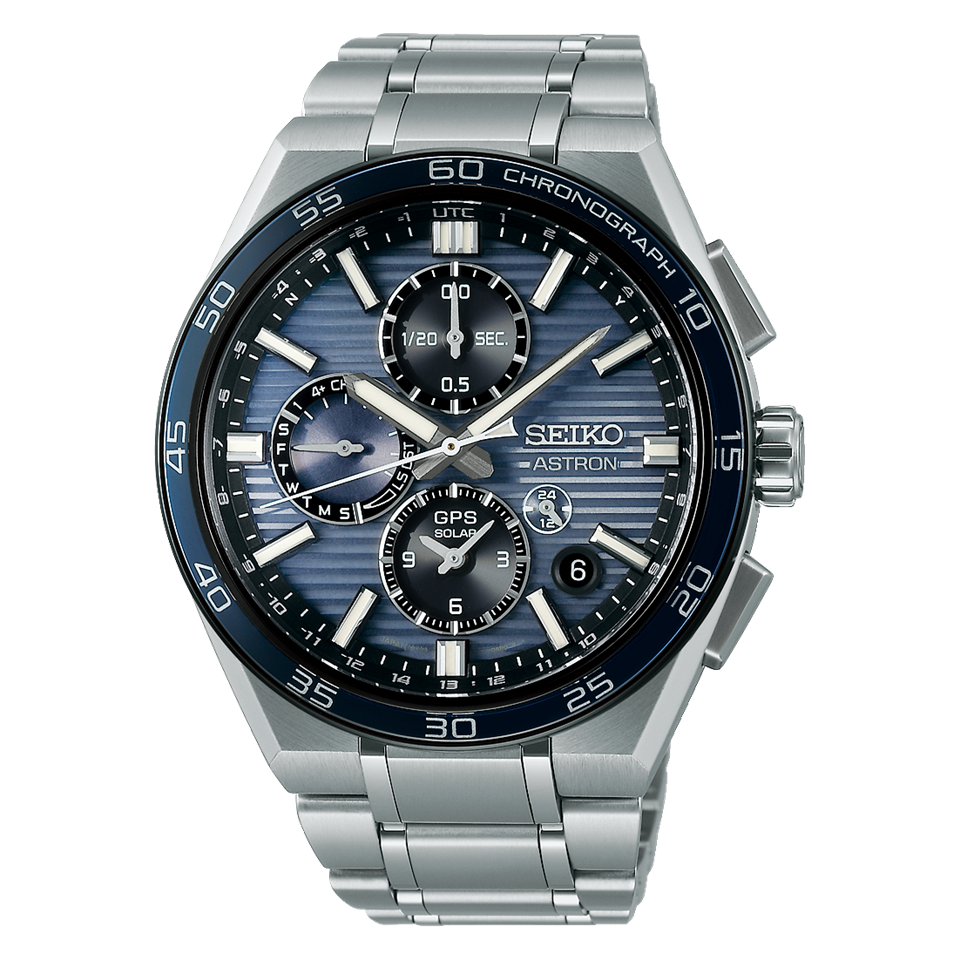
Imagen: Seiko, web oficial
The storyWhy this reference matters
Astron is the word Seiko keeps for whatever arrives before anyone else. In 1969 it was the world's first quartz wristwatch; in 2012, the first mass-produced wristwatch that set itself from GPS signals and ran on light alone. The second feat was harder than it sounds: a GPS receiver draws a lot of power, and the whole point was feeding it from a solar cell hidden under the dial.
The 5X83 calibre appeared in 2024, the first GPS Solar Astron to combine a second time zone with a chronograph. That looks like simple addition and it is not. Motors and hands have to be shared out between local time, home time, the twentieth-of-a-second counter and the twelve-hour counter, without any one function eating the power reserve. Seiko introduced it as the highest-performing movement in the history of the line.
The SSH175J1 comes from the 2025 batch, which left the calibre alone and worked on the finishing instead. The titanium case gained mirror polishing on its flat surfaces, the bezel got a sapphire insert over titanium, and the subdial rings were diamond-cut. It arrived in May that year alongside the grey-dialled SSH177, the black-coated SSH179 and the SSH180, limited to 1,500 pieces.
SpecificationsThe numbers, in one table
| Brand | Seiko |
|---|---|
| Family | Astron |
| Reference | SSH175J1 |
| Years made | desde 2025 |
| Calibre | Seiko 5X83 |
| Movement | Cuarzo |
| Power reserve | Aprox. 6 meses a plena carga; unos 2 años en modo de ahorro |
| Jewels | 14 |
| Complications | Cronógrafo con contador de 1/20 de segundo y contador de 12 horas · Segundo huso horario con indicación AM/PM · Hora mundial (38 zonas) · Calendario perpetuo hasta 2100 · Sincronización horaria por GPS · Ajuste automático del horario de verano · Modo avión |
| Diameter | 44.1 mm |
| Thickness | 14.4 mm |
| Lug to lug | 50 mm |
| Lug width | 14 mm |
| Case | Titanio con revestimiento súper duro |
| Crystal | Zafiro de doble curvatura con tratamiento super clear |
| Water resistance | 10 bar (100 m) |
IdentificationHow to tell it apart
A twentieth-of-a-second counter at twelve and a twelve-hour counter at six: that layout belongs to the 5X83 and will not be confused with a three-hand Astron. The SSH175 dial is greyish blue; the SSH177 is grey, the SSH179 goes all black with a hard coating, and the SSH180 mixes navy with rose-gold accents.
The bezel is titanium with a sapphire insert, and that detail places the watch in the 2025 generation: the first run of the 5X83, from 2024, used a two-piece bezel with ceramic. The measurements do not lie either — 44.1 mm across, 14.4 tall, 50 lug to lug.
Case and bracelet are titanium with a super-hard coating, and the whole thing weighs 110 grams, which is little for the size of it. The bracelet is integrated, meeting the case at fourteen millimetres. Double-domed sapphire with a super-clear treatment and 10 bar of water resistance.
CollectingWhat collectors check
This is a big watch and you need to try it on first: 44.1 mm with 50 lug to lug asks for a real wrist. Titanium makes up for the volume on the scales, not in the way it looks. Coming from a 40 mm automatic, the difference under a shirt cuff is obvious from day one.
Like every GPS solar it depends on two things, light and a clear sky. When buying, check the reserve indicator climbs in direct light and that manual signal reception completes its cycle next to a window. Running the chronograph daily eats far more power than leaving it stopped, so an example that has lived in a drawer may need a few hours of sun before it behaves normally.
The perpetual calendar runs to 2100 and the summer-time change is automatic, so the watch asks nothing of its owner beyond light. What does age is the rechargeable cell, replaceable at a service centre. Check the sapphire bezel insert: it barely scratches, but a chip in it is visible from the other side of the table.
Common questionsWhat people ask us about this reference
What does the Seiko 5X83 calibre do?
GPS time synchronisation, dual time with an AM/PM indicator, a chronograph with 1/20-second and 12-hour counters, world time across 38 zones, a perpetual calendar to 2100, automatic summer-time adjustment and aeroplane mode.
How long does a charge last on the SSH175J1?
About six months on a full charge and around two years in power-save mode. There is no battery to change.
How accurate is it without a GPS signal?
±15 seconds a month between 5 and 35 °C. The moment it picks up a satellite it corrects itself.
Is the Seiko SSH175J1 very large?
It measures 44.1 mm across by 14.4 thick, with 50 mm lug to lug. Titanium keeps it to 110 grams, but you still feel the size.
Keep readingWhere to go from here
Close relativesThe ones it gets confused with
Confidence: alta — this page was checked against the sources below. If a detail looks wrong to you, write to us and we will fix it.