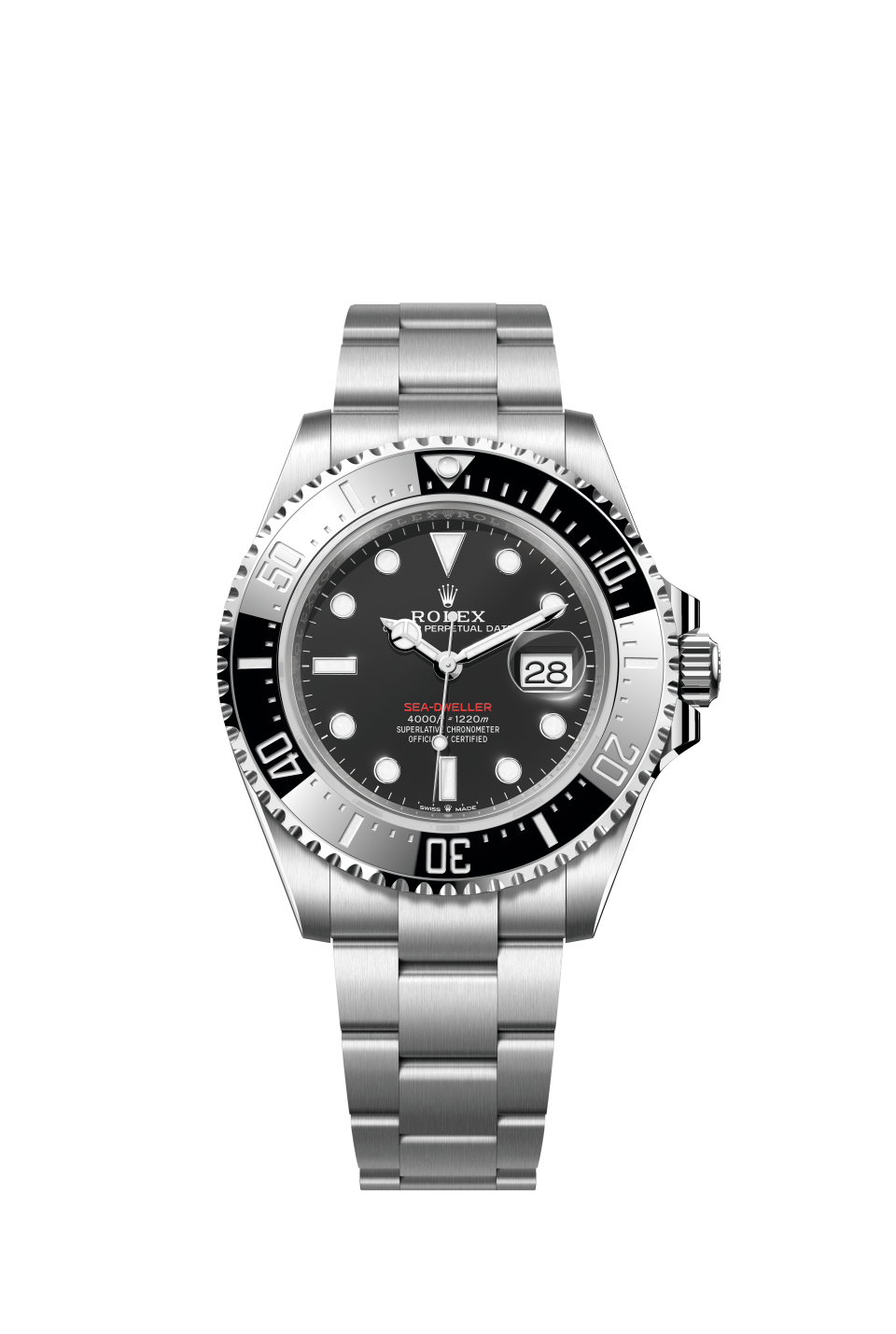
Imagen: Rolex, web oficial
The storyWhy this reference matters
Saturation diving means living for weeks inside a pressurised bell breathing helium and oxygen. Helium molecules are tiny and eventually get into any case, however well sealed. When the pressure comes off, that trapped pressure looks for a way out, and it finds the crystal. Rolex answered with a one-way valve in the side of the case, patented in Switzerland under number CH492246 and tested with COMEX, the Marseille industrial diving firm. Out of that came the Sea-Dweller in 1967: a Submariner whose script the professionals had rewritten.
The reference 1665 opened the run at 610 metres, with the two red lines collectors christened the Double Red; then came the Great White, all the text in white and the last plexiglass crystal in the family. In 1978 the 16660, the Triple Six, brought sapphire, the Triplock crown and the 1,220 metres still printed on the dial today. The 16600 ran for two decades barely touched. And the 116600, 40 mm with a ceramic bezel, lasted all of three years: 2014 to 2017.
That 2017 was the fiftieth anniversary, and Rolex marked it with a heresy. The 126600 grew to 43 mm, moved to a 22 mm bracelet and, the part that really stung, put a magnifier over the date. For half a century the Sea-Dweller had been the only Rolex with a date and no Cyclops. In exchange it gave the dial back a red line, singular this time, a nod to the 1967 prototypes, and introduced the calibre 3235 with 70 hours of reserve against the previous generation's 48.
SpecificationsThe numbers, in one table
| Brand | Rolex |
|---|---|
| Family | Sea-Dweller |
| Reference | 126600 |
| Years made | desde 2017 |
| Calibre | Rolex 3235 |
| Movement | Automático |
| Frequency | 28.800 alt/h (4 Hz) |
| Power reserve | 70 horas |
| Jewels | 31 |
| Complications | Fecha |
| Diameter | 43 mm |
| Thickness | 15 mm |
| Lug width | 22 mm |
| Case | Acero Oystersteel |
| Crystal | Zafiro con lupa Cyclops |
| Water resistance | 1.220 m |
IdentificationHow to tell it apart
Forty-three millimetres across and about fifteen tall: the 126600 is a thick case and your wrist knows it. If the one in front of you measures 40 and has no magnifier over the date, it is the earlier 116600, not this. Another quick tell, and a hard one to fake: the bracelet. The 43 mm starts at 22 mm between the lugs; the 40 mm starts at 20.
On the dial, look for a single red line, SEA-DWELLER, above the 1220m = 4000ft printed in white. Two red lines belong to the 1665 of the seventies and have not come back. The case back is solid, with no sapphire; the helium valve sticks out as a small cylinder on the flank at nine o'clock; and the Cerachrom bezel turns one way only, through 120 dry clicks.
The Oysterlock clasp hides two systems worth telling apart. Glidelock extends the bracelet in 2 mm steps up to 20, no tools needed. The Fliplock extension is a separate link that folds out for another 26 mm to clear a diving suit. If either one is missing or does not work, the bracelet has been through someone else's hands.
CollectingWhat collectors check
The argument about the modern Sea-Dweller comes down to three millimetres. Some will not forgive the jump to 43 and go hunting for the discontinued 116600; others reckon a saturation watch ought to make its presence felt. Try one on before you take a side: here the thickness weighs more on the wrist than the diameter does.
What to check in hand: that the helium valve is not seized, that the bezel gives its 120 clicks with no side play, and that the polished bevels on the lugs still have their edge. Heavy polishing rounds the lugs off and that does not come back. And on a watch rated to 1,220 metres, a case opened by an unauthorised workshop without new gaskets is reason enough to get up from the table.
Papers, card and spare links all add, as ever. Check that the serial engraved on the rehaut at six o'clock matches the one on the card, and look at the repeated crown-ROLEX engraving around that same inner ring: it should be hair-fine and perfectly centred under the crystal.
Common questionsWhat people ask us about this reference
Why did the Sea-Dweller have no Cyclops over the date?
For fifty years it was the only Rolex with a date and no magnifier. The Cyclops did not arrive until the 126600 in 2017, and it remains the most argued-over change in the model's history.
What is the difference between a Submariner and a Sea-Dweller?
The Sea-Dweller was built for saturation diving: it has a helium escape valve, it is rated to 1,220 metres against the Submariner's 300, and its case is considerably thicker. One is the diver's watch; the other is the watch for the pressurised bell.
What does the helium escape valve do?
It lets out the helium that has seeped into the case over days of breathing heliox. Without it, the internal pressure would push the crystal outwards during decompression until it popped off.
How big is the Sea-Dweller 126600?
Forty-three millimetres across and around fifteen thick, with 22 mm between the lugs. It is noticeably bigger than the previous 116600, which measured 40 mm and took a 20 mm bracelet.
Keep readingWhere to go from here
Close relativesThe ones it gets confused with
Confidence: alta — this page was checked against the sources below. If a detail looks wrong to you, write to us and we will fix it.