Imagen: Rolex, web oficial
The storyWhy this reference matters
In 2008 Rolex pulled a disproportionate number out of the hat — 3,900 metres — and a new way of reaching it. The Ringlock system inverts the logic of a dive watch: instead of thickening the case, it puts a compression ring of nitrogen-alloyed steel inside to take the load. The domed sapphire crystal, 5.5 millimetres thick, bears on that ring from above; the titanium case back bears on it from below and gives just enough to spread the force. The outer steel barely works at all.
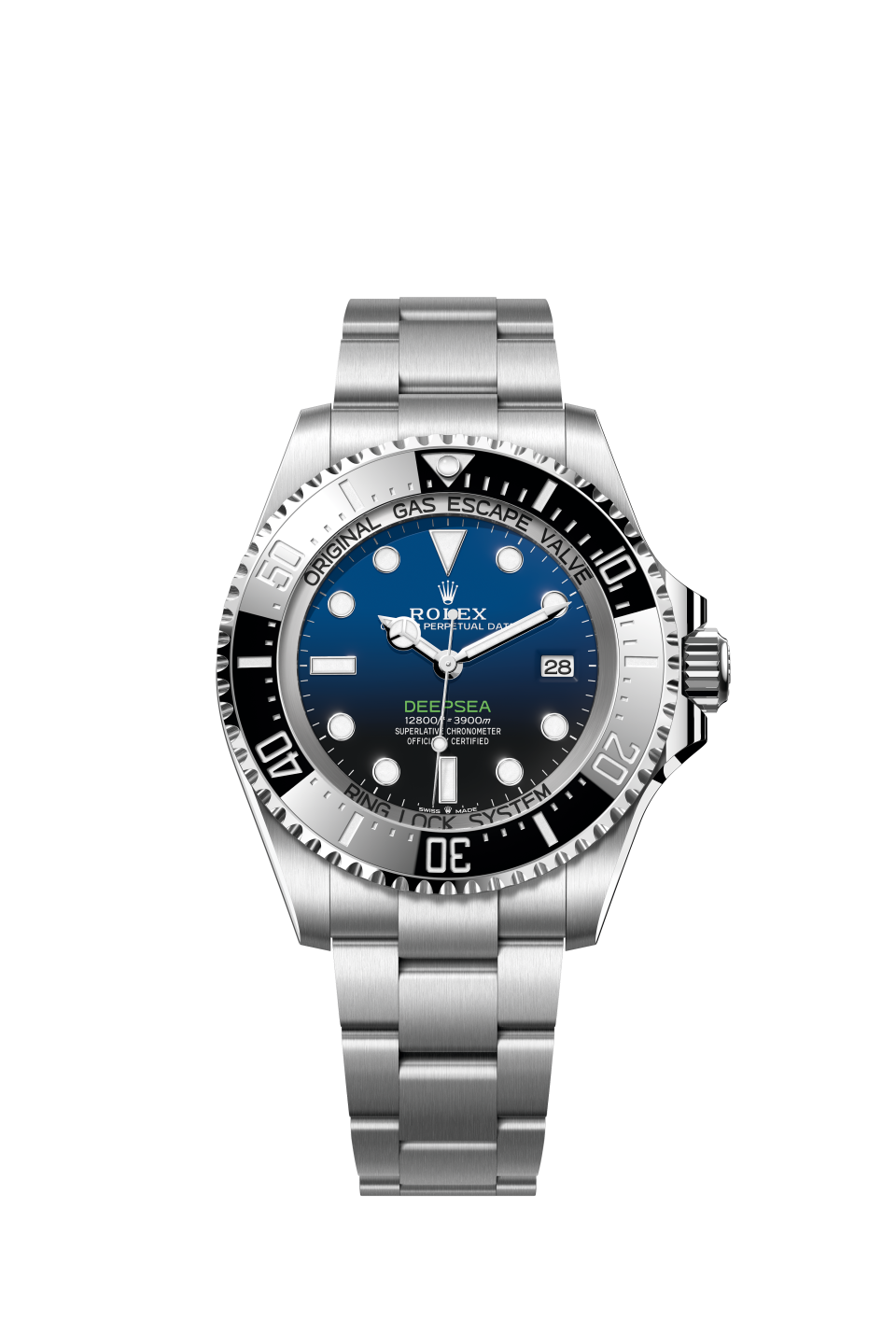
In March 2012 James Cameron went down alone to the Mariana Trench, 10,908 metres, with a Deepsea Challenge prototype bolted to the submersible's arm. Two years later Rolex returned the favour with a dial: deep blue at the top, black at the bottom, the exact gradient of light dying away as you descend. That is the D-Blue dial, and it carries DEEPSEA printed in green after the colour of the Deepsea Challenger submersible.
The reference 136660 arrived in 2022 and is an exercise in millimetres. A narrower bezel, a slightly bigger date window, a case back now explicitly identified as RLX titanium, and one absence divers spotted at once: the Fliplock extension has gone from the bracelet. The calibre stayed the 3235, with its 70 hours and its Chronergy escapement, inherited from the 126660 of 2018.
SpecificationsThe numbers, in one table
| Brand | Rolex |
|---|---|
| Family | Deepsea |
| Reference | 136660 |
| Years made | desde 2022 |
| Calibre | Rolex 3235 |
| Movement | Automático |
| Frequency | 28.800 alt/h (4 Hz) |
| Power reserve | 70 horas |
| Jewels | 31 |
| Complications | Fecha |
| Diameter | 44 mm |
| Thickness | 17.7 mm |
| Lug width | 22 mm |
| Case | Acero Oystersteel con fondo de titanio RLX |
| Crystal | Zafiro abombado de 5,5 mm con lupa Cyclops |
| Water resistance | 3.900 m |
IdentificationHow to tell it apart
Forty-four millimetres across and nearly eighteen tall. That is not a number to read, it is a number to try on: it will not go under a shirt cuff. The bracelet starts at 22 mm and tapers fast, which is the only thing that makes the whole business habitable.
Against the earlier 126660, look at the bezel: the one on the 136660 is thinner, so the dial looks bigger without having grown a millimetre. The date window is also slightly larger. And there is no folding Fliplock link on the bracelet: all that is left is the Glidelock in the clasp.
The D-Blue runs from blue to black with DEEPSEA in green; the black-dial version has that text in white. On the flank at nine, the helium escape valve. And the case back is engraved RLX titanium: if the back is steel, you are not looking at a Deepsea.
CollectingWhat collectors check
Here the condition matters less than the wrist. It is the hardest Rolex in the catalogue to wear every day, and a fair number of second-hand examples come up with very little use for exactly that reason: the seller got tired of the thickness, not of the watch. Before you negotiate, wear it for a whole afternoon.
What to check: the edge of the ceramic bezel, where the chips appear; that the Glidelock runs cleanly through all its positions; and that the titanium back shows no marks from being opened with a generic tool. The proper one is required, and a badly seated gasket on a 3,900-metre watch is a ruined watch.
The D-Blue is in more demand than the black, and the market asks for it by nickname even though inside it is the same watch. If you are after one, ask for photographs in daylight rather than flash: the blue-to-black gradient flatters itself with suspicious ease in listing photos.
Common questionsWhat people ask us about this reference
How big is the Rolex Deepsea?
Forty-four millimetres across by almost eighteen thick, with 22 mm between the lugs. It is the bulkiest watch in the Rolex catalogue behind the 50 mm Deepsea Challenge.
What is the difference between the Deepsea and the Sea-Dweller?
The Sea-Dweller reaches 1,220 metres with a conventional case. The Deepsea gets to 3,900 thanks to the Ringlock system, with its internal compression ring and titanium case back, and that is why it measures 44 mm and nearly eighteen tall.
What does the D-Blue dial mean?
It reproduces the gradient of light as you descend: blue at the top, black at the bottom. Rolex created it in 2014 to mark James Cameron's solo dive to the Mariana Trench in 2012.
What changed on the 136660 against the 126660?
A narrower bezel, a bigger date window, a case back identified as RLX titanium, and the removal of the Fliplock extension from the bracelet. The calibre 3235 carried over unchanged.
Keep readingWhere to go from here
Close relativesThe ones it gets confused with
Confidence: media — this page was checked against the sources below. If a detail looks wrong to you, write to us and we will fix it.