Imagen: Grand Seiko, web oficial
The storyWhy this reference matters
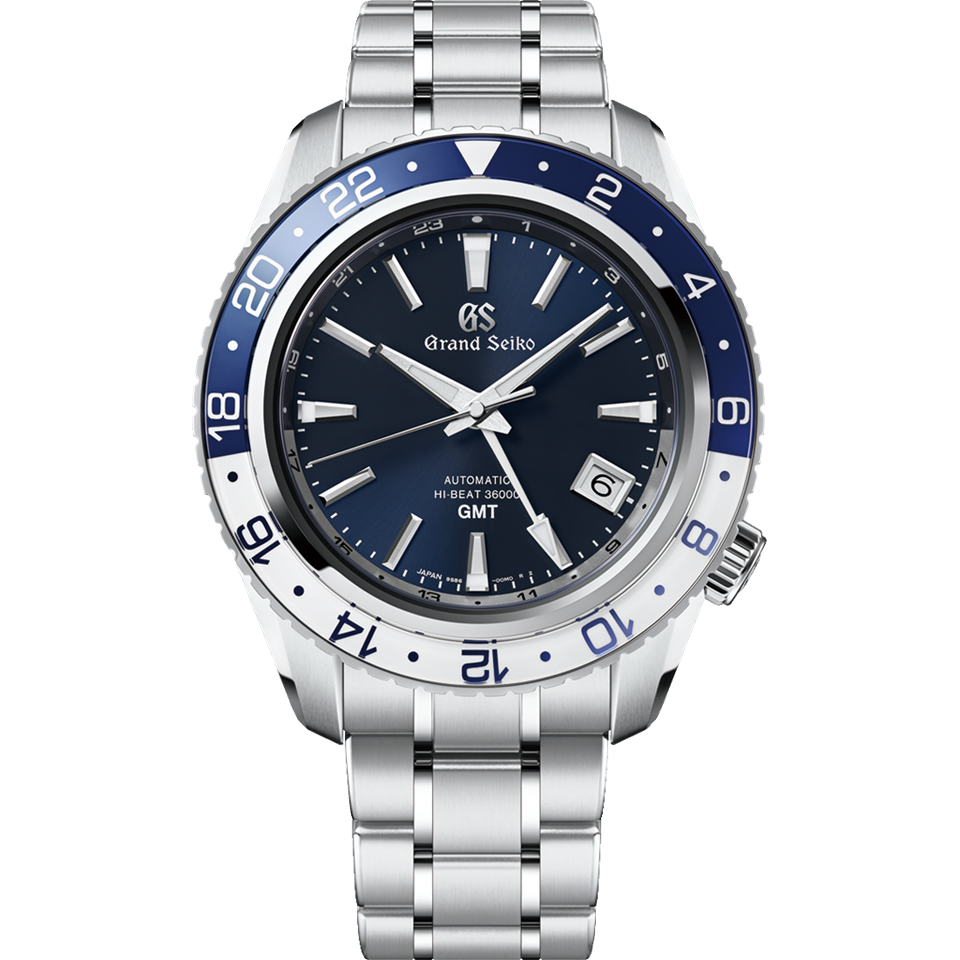
July 2020. Grand Seiko widened its Sport collection with a pair of twin Hi-Beat GMTs: the SBGJ237, blue and on a steel bracelet, and the SBGJ239, green and on leather. The news was not inside but on top, in the bezel. Instead of aluminium or ceramic, a sapphire plate with the 24-hour scale printed on its underside. The numerals appear to float beneath the crystal, much as the old bakelite bezels of the fifties did, without their habit of shattering.
The engine is the 9S86, the mechanical line Grand Seiko runs in parallel with its own Spring Drive. It beats at 36,000 vibrations per hour, is regulated to plus five and minus three seconds a day, holds around 55 hours and carries 37 jewels. And it is a true GMT: the hour hand jumps hour by hour without touching the minutes, dragging the date along with it, while the 24-hour hand stays pinned to home time. You land, give it three clicks and still know what time it is in your kitchen.
The Sport case puts the crown at four, and that is no styling whim. It moves the tube away from the back of your hand and leaves the right flank clean. With a screw-down crown, a screwed case back and two hundred metres of water resistance, the SBGJ237 is one of the few Grand Seikos you can wear without treading carefully. The midnight blue dial, says the brand, comes from the sky seen out of an aeroplane window. It reads like brochure copy, but the colour carries the line.
SpecificationsThe numbers, in one table
| Brand | Grand Seiko |
|---|---|
| Family | Sport |
| Reference | SBGJ237 |
| Years made | desde 2020 |
| Calibre | Grand Seiko 9S86 |
| Movement | Automático |
| Frequency | 36.000 alternancias por hora (10 Hz) |
| Power reserve | Aprox. 55 horas |
| Jewels | 37 |
| Complications | GMT (segundo huso horario) · Fecha · Bisel giratorio de 24 horas |
| Diameter | 44.2 mm |
| Thickness | 14.4 mm |
| Lug to lug | 50.6 mm |
| Lug width | 21 mm |
| Case | Acero inoxidable |
| Crystal | Zafiro de doble curvatura con tratamiento antirreflejos; bisel con placa de zafiro |
| Water resistance | 200 m (20 bar) |
IdentificationHow to tell it apart
Start with the bezel. The blue half does not stop exactly at 6 and 18: it runs on a little further so as not to cut those numerals in two, which leaves the day-night boundary slightly off-centre. That is the detail that identifies the model even in a small photograph. Every white section of the bezel carries Lumibrite and glows green; the blue ones do not.
The twin SBGJ239 shares the case and the calibre but has a green sunray dial, a red GMT hand and a leather strap. The 237 always comes with the midnight blue dial, a white GMT hand and a three-link steel bracelet. Nor should you mistake it for the Sport Spring Drive GMTs. They share the silhouette and the crown at four, but the Spring Drive seconds hand glides without a single step, while the 9S86 advances in tiny jerks, ten a second.
On paper it is 44.2 mm across, 50.6 mm lug to lug and 14.4 mm thick, with 21 mm lugs, an awkward width if you ever want to change the strap. It weighs 188 g on the bracelet. On the wrist it deceives: the lugs drop steeply and the bezel is wide, so you see less watch than the numbers suggest.
CollectingWhat collectors check
First, the Zaratsu polish. The flanks should be mirrors with not the slightest distortion, and the edges should stay clean. A going-over by a workshop that does not understand what it has rounds those edges off, and the watch loses exactly what you paid for. If the edges look blunt, or a straight line ripples as it reflects off a flank, it has been near a polishing wheel.
Sapphire will not scratch, but it can chip from a sharp knock on the rim, so hold it up to the light and turn it slowly. Check that the bezel turns both ways with firm clicks, that the crown screws down with no odd resistance, and that with the watch reading twelve noon the 24-hour hand points exactly at its marker.
As a catalogue model rather than a limited edition, condition rules here. Box and papers add to the price, and so does a bracelet with all its links, because loose Grand Seiko links are neither cheap nor easy to find when you need them. If the rate has wandered, look for a watchmaker with experience of 9S calibres: a Hi-Beat running at ten beats a second is not handled like an ETA.
Common questionsWhat people ask us about this reference
What is the difference between the SBGJ237 and the SBGJ239?
Same case, same 9S86 calibre. The SBGJ237 has a midnight blue dial, a white GMT hand and a steel bracelet; the SBGJ239 has a green sunray dial, a red GMT hand and a leather strap.
Does the sapphire bezel scratch?
Not in normal use. Synthetic sapphire is far harder at the surface than steel or ceramic. What can happen is a chip, if it takes a sharp knock right on the edge.
How much power reserve does it have?
Around 55 hours. Leave it in a drawer on Friday night and it will be stopped by Monday morning.
Is the SBGJ237 very big?
It measures 44.2 mm across and 50.6 mm lug to lug, but the lugs drop a long way and the wide bezel eats into its visual presence. It wears better than the specification suggests, though it is still a big watch.
Keep readingWhere to go from here
Close relativesThe ones it gets confused with
Confidence: alta — this page was checked against the sources below. If a detail looks wrong to you, write to us and we will fix it.