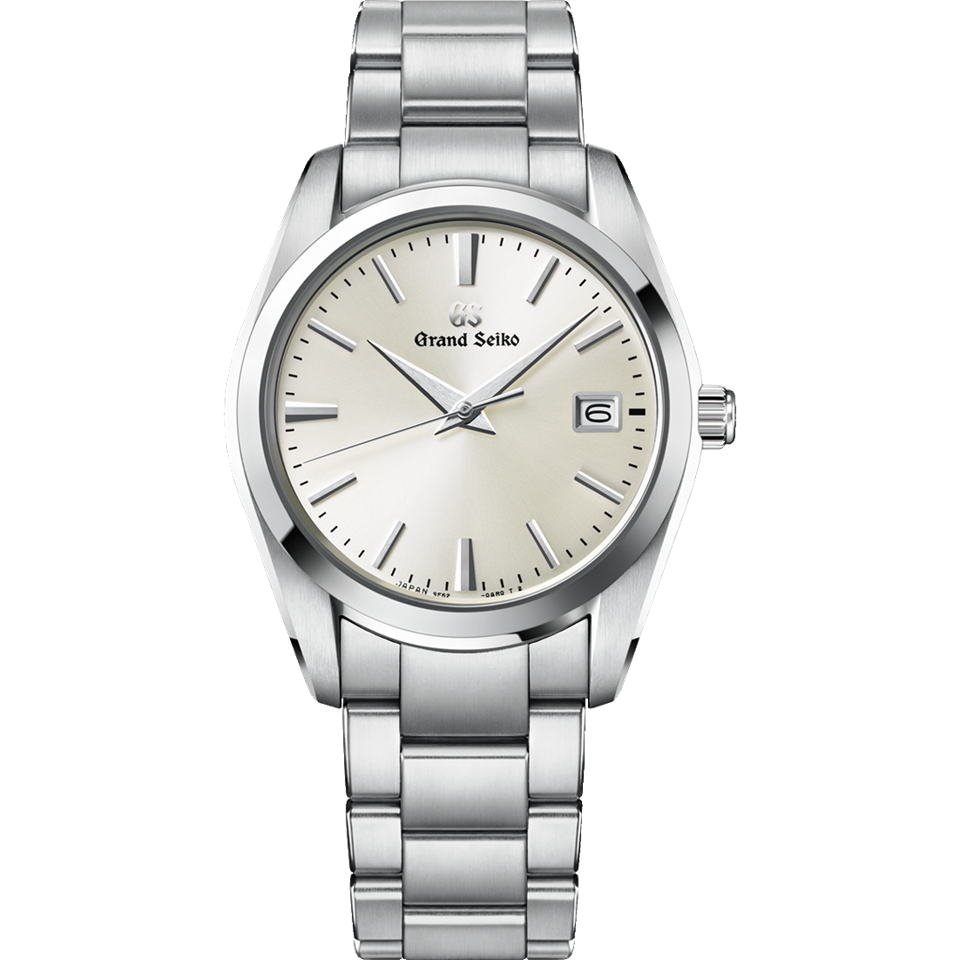
Imagen: Grand Seiko, web oficial
The storyWhy this reference matters
The first quartz Grand Seiko arrived in 1988, and accuracy was never the problem. Torque was. An ordinary quartz motor could not shift the big, heavy hands the brand regards as its own. In 1993 Kuniharu Natori's team at the Shinshu Watch Studio answered with the 9F and its twin-pulse motor, which fires two impulses a second instead of one. More torque, no extra drain on the battery, and hands that at last reach the edge of the dial.
The 9F is full of answers to questions nobody asks of a quartz watch. A hairspring, a plain old piece of mechanical watchmaking, keeps the seconds wheel under tension so the hand does not nod as it settles on the marker. A cam and lever store energy for hours and release it in one go, so the date snaps over instead of creeping; a technician sets that by hand until it happens inside the five minutes before midnight. And a shutter inside the case seals off the gear train from dust while the battery is being changed.
Ten seconds a year does not come out of an off-the-shelf crystal. Grand Seiko grows its own and ages them for ninety days under controlled temperature, humidity and voltage, then marries each crystal to its own integrated circuit, because no two react to heat in quite the same way. Once the watch is together, a sensor reads the internal temperature 540 times a day and trims the frequency as it goes. Every movement is assembled by hand in Shiojiri. It is quartz, treated as though it were a complication.
SpecificationsThe numbers, in one table
| Brand | Grand Seiko |
|---|---|
| Family | Heritage |
| Reference | SBGX263 |
| Calibre | Grand Seiko 9F62 |
| Movement | Cuarzo |
| Frequency | 32.768 Hz |
| Power reserve | Pila de unos 3 años |
| Complications | Fecha |
| Diameter | 37 mm |
| Thickness | 10 mm |
| Lug to lug | 44.6 mm |
| Lug width | 19 mm |
| Case | Acero inoxidable |
| Crystal | Zafiro con antirreflejos en la cara interior |
| Water resistance | 10 bar (100 m) |
IdentificationHow to tell it apart
A steel case 37.0 mm across, 10.0 mm high and 44.6 mm lug to lug, on 19 mm lugs: you identify this reference by its proportions, not by decoration. Champagne dial, date window at three, sapphire crystal with anti-reflective coating on the inner face, and a solid screwed case back with no window onto the movement. On the scales, 134 g on the bracelet.
Its catalogue sisters share the case and the calibre and differ only in dial colour: there is a black and there is a blue. The champagne of the 263 gives the least contrast of the three. Indoors the faceted markers sink into the background and only fire up when the light comes in from the side.
Two checks give away a real 9F with the watch in your hand. The seconds hand drops dead on each marker, with none of the shuffle you get from ordinary quartz, and the date snaps over at midnight rather than dragging itself across for half an hour.
CollectingWhat collectors check
The first thing anyone with an eye goes to is the zaratsu polishing. The mirrored surfaces should read flat, with no ripple, and the edges of the lugs should still be sharp. A back-street repolish rounds those edges off for good, and on a Grand Seiko that takes more off the value than a scratch does.
The battery is good for about three years. Have it changed by an official service centre: the 9F carries that dust shutter precisely for this job, and prising the case open in a hurry is the silliest way to get grit into the gear train. While you are there, check the bracelet for slop and make sure the folding clasp does not rattle.
Secondhand, Grand Seiko's quartz sits well below its mechanical watches. That makes it the cheapest door into the house and the hardest thing to sell on again. Box, papers and the spare links all count, particularly at 37 mm, a size people are now actively hunting.
Common questionsWhat people ask us about this reference
Is a quartz Grand Seiko worth buying?
If you want accuracy and no fuss, yes: the 9F62 runs to within ten seconds a year and is assembled by hand in Shiojiri. If you want to watch a movement through the back, look elsewhere. The case back here is solid.
How long does the 9F calibre's battery last?
Grand Seiko quotes around three years. The movement has an internal shutter that seals the gear train off during the change, so have it done by an official service centre.
How accurate is the 9F62 calibre?
Ten seconds a year. That comes from quartz crystals aged for ninety days and paired with their own integrated circuit, plus a sensor that reads the internal temperature 540 times a day.
How does the SBGX263 wear?
37 mm across, 10 mm high and 44.6 mm lug to lug, on 19 mm lugs. It is one of the smallest Grand Seikos in the current catalogue and slips under any shirt cuff.
Keep readingWhere to go from here
Close relativesThe ones it gets confused with
Confidence: alta — this page was checked against the sources below. If a detail looks wrong to you, write to us and we will fix it.