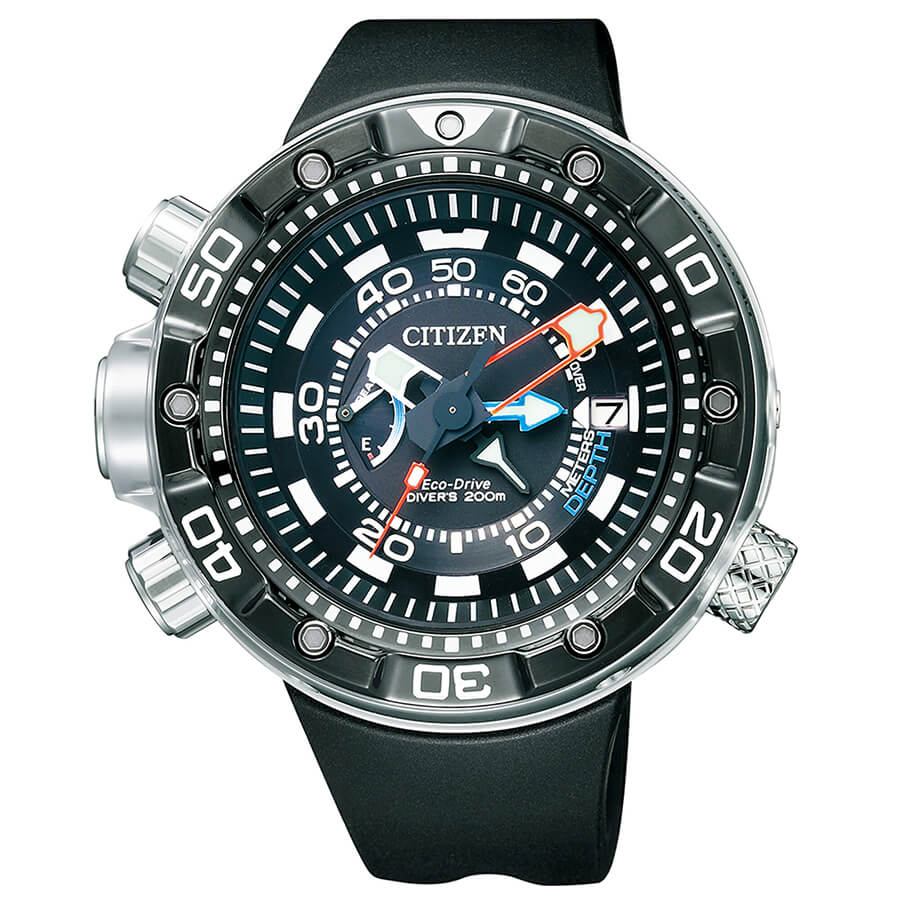
Imagen: Citizen, web oficial
The storyWhy this reference matters
The original Aqualand, reference C0023 of 1985, was the first dive watch with an electronic depth gauge built in. Citizen filed US patent 4611923 on 27 November that year: watch circuit, display and water pressure sensor all in one case, reading down to eighty metres with an error margin of around three per cent. Until then the amateur diver went down with a watch on one wrist and a needle depth gauge on the other. The C0023 swallowed both instruments in a single bite, and logged the dive while it was at it.
Getting from there to this BN2024 is the odd part. The family spent decades wedded to the LCD: the JP2000 of 1992 cut the original's three batteries down to one and added the rapid-ascent alarm, and a titanium Aqualand in black PVD, reference C029, ended up on screen in The Big Blue. Then the model Citizen showed at Basel 2014 did the opposite of what anyone expected and threw the display away. Depth here is read off hands, the way it was read before electronics turned up.
It isn't a decorative wink, either. The BN2024 meets ISO 6425, the standard that decides what may call itself a dive watch, and under the retro costume it is still an instrument: it reads to seventy metres, stores the deepest point of the dive, sounds off when you ascend too fast and carries a humidity sensor that spots water where water shouldn't be. All of it run on light, with no battery to change and eleven months of running time from a full charge. A dive computer wearing the face of an eighties watch.
SpecificationsThe numbers, in one table
| Brand | Citizen |
|---|---|
| Family | Promaster |
| Reference | BN2024-05E |
| Years made | desde 2014 |
| Calibre | Citizen Eco-Drive J250 |
| Movement | Eco-Drive |
| Power reserve | 11 meses a plena carga |
| Complications | Profundímetro hasta 70 m · Memoria de profundidad máxima · Alarma de ascenso rápido · Sensor de humedad · Indicador de reserva de carga (4 niveles) · Bisel giratorio unidireccional |
| Diameter | 52.5 mm |
| Thickness | 18.4 mm |
| Lug width | 24 mm |
| Case | Acero inoxidable con bisel tratado en DLC |
| Crystal | Cristal mineral con tratamiento antirreflejos |
| Water resistance | 200 m (20 bar), certificación Diver's ISO 6425 |
IdentificationHow to tell it apart
Start with the size: 52.5 mm across, 18.4 mm tall and 177 grams on the strap. If the watch in front of you is somewhere near 46 mm, it isn't a BN2024 but one of the mid-case Aqualands, which the classifieds happily sell under the same name. This one has a two-piece clamshell case, a screw-down crown at four and a screwed case back.
The giveaway is the gold-rimmed sensor port at three o'clock, and the depth scale starting from exactly that point: the surface reading sits at that height and the scale runs downwards, with the first forty metres spread wide enough to read through a mask. There are two depth hands, one for current depth and one for the deepest point reached; at rest the second parks somewhere near sixty metres. The lume tells you the reference too, green on the time side and blue on the depth scale.
Mind the crystal: it is mineral with an anti-reflective coating, not sapphire, and on the big Aqualands that was a deliberate call, because mineral absorbs a hard knock better even if it picks up scratches sooner. A seller who advertises sapphire deserves a question. Lug width is 24 mm and the strap is polyurethane.
CollectingWhat collectors check
The first thing to look at isn't the case, it's the power. Eco-Drive runs on a secondary cell that degrades over the years, and this model carries a four-step charge indicator: if several days of bright light leave it stuck on the first step, the cell is asking to be relieved. That is a service part rather than a fault, but you want to know before you pay.
Second, the sensor. A depth gauge is, literally, a controlled hole in a sealed case, and that hole comes with maintenance of its own: on a watch that has genuinely been diving, ask when it was last pressure tested. The internal humidity sensor helps, because if water ever got in, the watch knows about it. Check the unidirectional bezel and its DLC coating while you're there, because DLC doesn't polish out. It flakes off and stays flaked.
On variants, the BN2024-05E is the big case with the black dial. Siblings from the same generation share the market with other dials and straps, plus smaller Aqualands that the listings mix in without mercy. The original polyurethane strap adds value, so does the box with the manual, and the manual genuinely matters here: the functions are not intuitive and working them out unaided costs you an afternoon. Marks against are a generic crystal badly fitted, stiff pushers, and a bezel with the DLC eaten off it.
Common questionsWhat people ask us about this reference
How deep does the Citizen Aqualand BN2024 measure?
The depth gauge works down to seventy metres and stores the deepest point reached on the dive. The case water resistance is a separate matter: 200 metres, Diver's ISO 6425 certified. One figure is the measuring range, the other is the limit of the watch.
Does the Citizen Aqualand take a battery?
No. It is an Eco-Drive: the dial lets light through to a photovoltaic cell that charges an internal accumulator. Fully charged it runs for about eleven months in total darkness. What does get replaced, after many years, is that accumulator.
Can you actually dive with the BN2024?
Yes. It meets ISO 6425 and has a unidirectional bezel, a rapid-ascent alarm and a humidity sensor. It doesn't replace a decompression computer, but it works as a dive watch with a depth gauge and asks nobody's permission.
How big does the Citizen Aqualand BN2024-05E wear?
52.5 mm across by 18.4 mm tall, 177 grams all in. It is an enormous watch, designed to sit over neoprene; on a bare, narrow wrist it overhangs without apology.
Keep readingWhere to go from here
Close relativesThe ones it gets confused with
Confidence: media — this page was checked against the sources below. If a detail looks wrong to you, write to us and we will fix it.