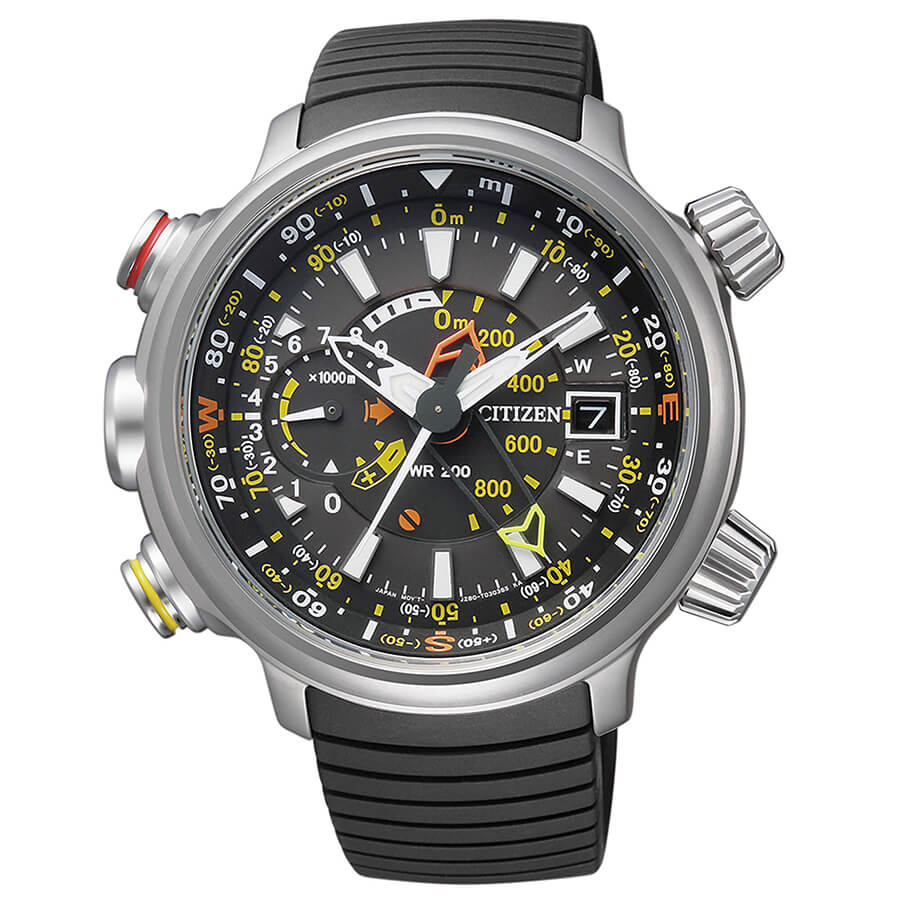
Imagen: Citizen, web oficial
The storyWhy this reference matters
The Altichron was born as the Aqualand's dry-land brother. Citizen had already solved the hard problem — putting a pressure sensor inside a sealed case — and had been selling it to divers for years; taking it up a mountain was the logical next step, because a barometric altimeter does exactly what a depth gauge does, only reading a column of air instead of water. The first generations were digital, with a little screen and a menu. This one, shown at Baselworld 2013, went the other way and moved it all onto hands.
That is where the merit lies, and the vertigo. Four concentric scales share the BN4021's dial along with several hands that, depending on which button you press, stop telling the time and start counting metres or degrees. The altimeter covers three hundred metres below sea level to ten thousand above — Everest with eleven hundred metres to spare — and it manages that by splitting the reading three ways: in steps of a thousand metres, a hundred, and two and a half.
Its behaviour in use is its own too. Switched on, the altimeter measures continuously for five minutes and then takes a reading every three minutes over twelve hours, so as not to drain the cell halfway up a long climb. The electronic compass wakes on its own pusher and needs the watch held level to orient itself. And the whole thing is rated to work at twenty degrees below zero, which in a quartz watch with sensors is no small detail.
SpecificationsThe numbers, in one table
| Brand | Citizen |
|---|---|
| Family | Promaster |
| Reference | BN4021-02E |
| Years made | desde 2013 |
| Calibre | Citizen Eco-Drive J280 |
| Movement | Eco-Drive |
| Power reserve | Indicador de autonomía graduado en días en el subdial de las nueve |
| Complications | Altímetro (-300 a 10.000 m) · Brújula electrónica · Calendario · Indicador de reserva de carga · Bisel giratorio interno |
| Diameter | 49.5 mm |
| Case | Super Titanium con recubrimiento DLC negro |
| Crystal | Cristal mineral con tratamiento antirreflejos |
| Water resistance | 200 m (20 bar) |
IdentificationHow to tell it apart
It is hard to mistake for anything else: a 49.5 millimetre case, Super Titanium with black DLC coating, screw-down crown and 98.8 grams with the strap. That weight is the first clue, because a watch of nearly fifty millimetres that comes in under a hundred grams is only possible in titanium. The strap is Liquid Rubber polyurethane and water resistance is 200 metres, far more than any mountaineer will ever need but consistent with the Promaster name.
The controls: the pusher at eight o'clock opens the altimeter, the one at ten wakes the compass, and there is an internal rotating bezel worked from the case. The subdial at nine holds the power reserve indicator, and on this calibre it is graduated in days of autonomy rather than in levels — one of the few dials where you can read how much energy is left with an actual number in front of you.
The crystal is mineral with anti-reflective coating, not sapphire, something shop listings get wrong very often. And look at the DLC on the bezel and the case sides in raking light, because on the dark references that is exactly where wear shows before anywhere else.
CollectingWhat collectors check
You buy a second-hand Altichron for the sensor, so test it first. Ask them to switch on the altimeter in front of you and compare the reading against the real altitude where you are standing: a large but stable deviation may be no more than calibration, while an erratic reading, or one that does not respond at all, points to a damaged sensor, and that is not a three-euro repair.
Second is the power. Being an Eco-Drive with sensors that draw current when they work, the cell suffers more than in a three-hander, and the indicator graduated in days tells you so without ambiguity. If the watch has spent years in a drawer, give it a full week of light before judging it; if it still does not come back, budget for a new cell in the price.
Several generations of Altichron with near-identical names circulate on the market, including later versions with different cases and new calibres, and listings mix them up cheerfully. The BN4021-02E is specifically the 49.5 millimetre black DLC shown in 2013. Add for the original box, a strap with no cracks where the lugs begin and intact DLC; subtract for polishing, chipped DLC and a lazy sensor.
Common questionsWhat people ask us about this reference
How high does the Citizen Altichron measure?
From three hundred metres below sea level to ten thousand above, reading in steps of a thousand, a hundred and two and a half metres spread across several hands. It is a barometric altimeter, so sharp changes in the weather move the reading too.
How does the Citizen Altichron's compass work?
It is activated by the pusher at ten o'clock and needs the watch held level to orient itself. The hands swing round to point at magnetic north and, when you are done, the same pusher sends them back to the time.
Does the Citizen Altichron BN4021 take a battery?
No. It is a light-powered Eco-Drive, with the quirk that its autonomy indicator is graduated in days on the subdial at nine. What does get replaced over the years is the internal cell.
Is the Citizen Altichron BN4021-02E very big?
It is 49.5 millimetres across, yes, but it weighs 98.8 grams because the case is Super Titanium and the strap is rubber. It wears better than the spec sheet suggests: the problem is not the weight, it is the width under a sleeve.
Keep readingWhere to go from here
Close relativesThe ones it gets confused with
Confidence: media — this page was checked against the sources below. If a detail looks wrong to you, write to us and we will fix it.