
In one line
Three sub-dials, a column wheel and 18,000 vph. Between 1938 and 1974 half of Switzerland bought it as an ébauche, and every hand-wound Daytona runs on one, whatever the mainplate is signed.
First things first: nothing inside a Daytona says Valjoux
This is the number one confusion. Rolex bought the 72 raw, finished it its own way and gave it its own numbering. Open a Cosmograph expecting to read Valjoux 72 on the bridge and you will not find it.
722-1 — the late-1960s development.
727 — 21,600 vph, from 1969. Still a Valjoux 72.
That last line starts the most arguments. Rolex raised the frequency from 18,000 to 21,600 vph in the 727 to sharpen the chronograph's resolution, so a late Daytona beats faster than the Valjoux 72 of the textbooks. It has not been tampered with and it is not a different movement: it is the same calibre, run quicker.
Rolex also fitted a free-sprung balance with Microstella screws and a hairspring with a Breguet overcoil, and stamped the plates with its own markings. Saying it is therefore not a Valjoux is a step too far: the architecture, the column wheel and the going train all come from the Vallée de Joux, not from Geneva.
Valjoux 72 against Valjoux 23: the same machine with one more counter
The two get mixed up constantly, because they are very nearly the same movement. The whole difference fits into one sub-dial.
| Valjoux 72 | Valjoux 23 | |
|---|---|---|
| Sub-dials | Three — tricompax | Two — bicompax |
| 12-hour counter | Yes | No |
| Diameter | 13''' (29.5 mm) | 13''' (29.5 mm) |
| Frequency | 18,000 vph | 18,000 vph |
| Jewels | 17 | 17 |
| Origin | 1938, built on the 23 | From the Valjoux 22 of 1914 |
| Where it ended up | Daytona, Autavia, Carrera | Patek Philippe 2499, among others |
The last row deserves a moment. Patek Philippe's most revered perpetual calendar chronograph, the reference 2499, was built on a Valjoux 23 VZ. The same base as in a Heuer made for racing.
That is the moral of the whole page: in the 1950s and 1960s, buying your movement in signified nothing at all. What set a brand apart was what it did with it afterwards.
A valley and two brothers
Valjoux is a contraction of Vallée de Joux, and the firm was founded by two brothers, John-Auguste and Charles-Ami Reymond, on 1 July 1901 at Les Bioux. It traded as J. & C. Reymond Frères; the Valjoux trademark was registered in November 1912, and the name did not pass to the company itself until 25 January 1929. Ebauches SA absorbed it in 1944, and in 1992 it ended up inside ETA.
The 72 appeared in 1938 and is, in essence, a Valjoux 23 with one more sub-dial: the twelve-hour counter at six o'clock. Nothing revolutionary, everything well sorted — column wheel, 17 jewels, 18,000 vph, 6.95 mm tall — and that was enough to keep it in production without a break until 1974.
The figures collectors work with put the whole family at some 750,000 movements across those thirty-six years, with close to 59,800 of them going into Rolex Daytonas. Roughly eight per cent of total 72 production went to a single model from a single customer.
Two things that get overlooked
- The family had some very odd members. The 72 spawned the 72C with a triple calendar — the one in the Rolex 6236, the so-called Jean-Claude Killy — the 88, which adds moon phases, the 720 with flyback reset, the 724 with a 24-hour indication, and the 721, which showed the tides. That last one was built for people who fished, not for people who raced.
- The Navitimer everybody thinks has a 72 does not have one. Breitling did fit Valjoux 72s to the earliest Navitimers, in the mid-1950s, but the reference 806 of 1956 — the one that has come down to us as the classic Navitimer — shipped with a Venus 178, and stayed with it until the end of the 1960s. If a listing for an 806 says Valjoux 72, check it twice.
Technical data
| Type | Hand-wound chronograph, tricompax |
|---|---|
| Chronograph control | Column wheel |
| Frequency | 18,000 vph (2.5 Hz) |
| Jewels | 17 |
| Power reserve | ~48 hours |
| Diameter | 13''' — 29.5 mm |
| Thickness | 6.95 mm |
| Lift angle | 52° |
| Shock protection | Incabloc |
| Counters | Small seconds, 30 minutes and 12 hours |
| Base | Valjoux 23, itself derived from the 22 |
| Production | 1938 – 1974 · around 750,000 movements across the family |
What a watchmaker checks before buying one
The twelve-hour counter, because nobody tests it. People start the chronograph, stop it after thirty seconds and pronounce the watch sound. Let it run for a good hour instead, and watch the hour counter jump cleanly and stay put: it is the most neglected train in the movement and the most expensive to put right.
Frequency, before you panic. If the timegrapher reads 21,600 vph on a movement you took for a 72, the odds are you are looking at a 726, a 727 or a late Daytona. Nobody has defrauded you.
And the underlying problem: production stopped in 1974 and nobody has restarted it. There are no new spares. A worn column wheel or a cracked chronograph bridge means hunting down a donor movement, which is what has pushed up the price of loose 72s. On a Rolex, check as well that the movement is the calibre that belongs to the reference: a Cosmograph with a generic, unsigned Valjoux 72 inside is, at best, a service replacement.
Watches that used it
- Rolex Cosmograph Daytona 6239, 6241, 6262, 6264, 6263 and 6265 — as cal. 72B, 722, 722-1 and 727
- Rolex pre-Daytona 6234 and 6238
- Rolex 6236 Jean-Claude Killy — with the triple-calendar 72C
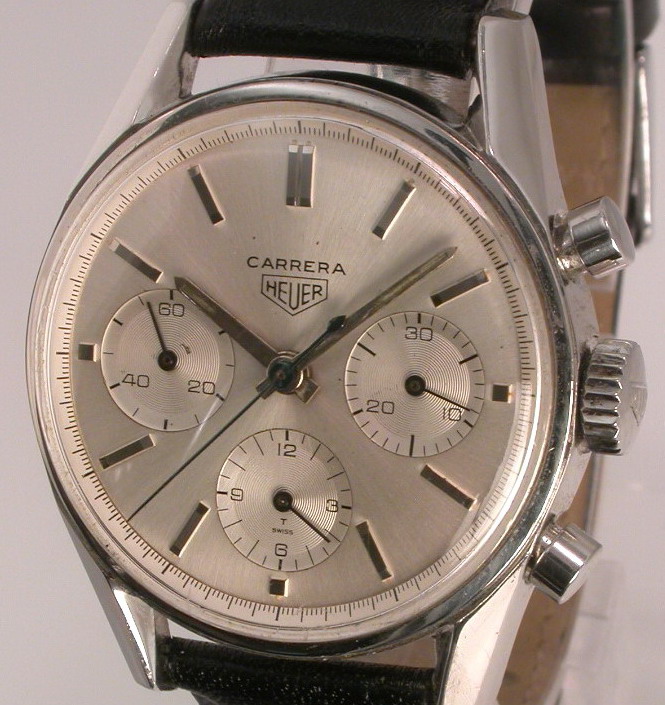
- Heuer Autavia 2446 and Carrera 2447
- Gallet, Wittnauer, Enicar, Zodiac, Girard-Perregaux — Valjoux sold to anyone who asked
The Daytona left the Valjoux 72 behind in 1988, when Rolex moved to an automatic chronograph: a heavily reworked version of Zenith's El Primero. And the bicompax base all of this grew out of is the Valjoux 23.