In one line
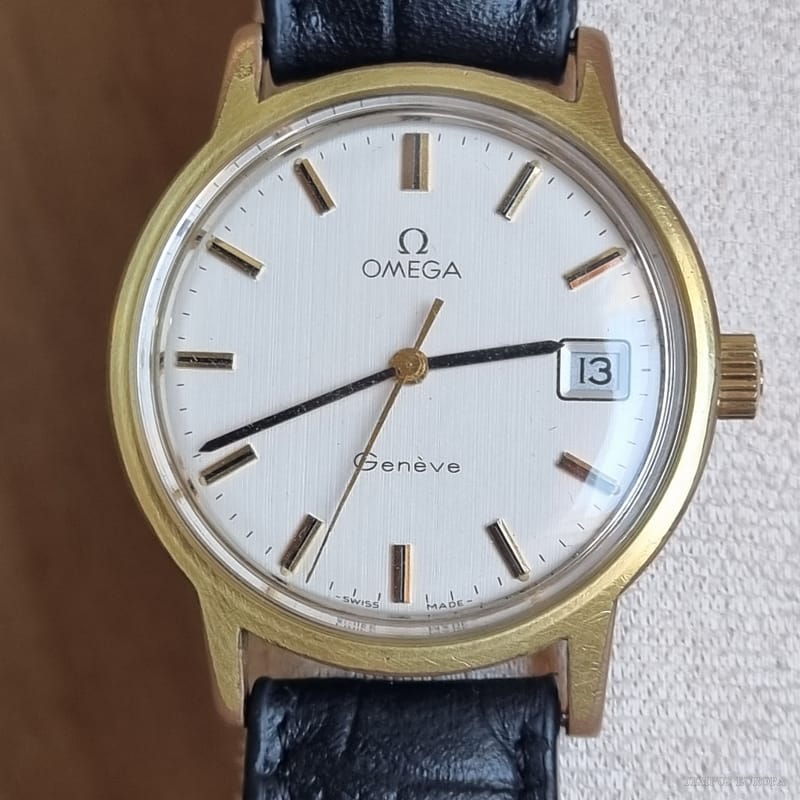
Omega's own automatic with the oscillating weight taken out: 17 jewels, date, 28,800 vph, and a bridge that covers the rotor's empty space without holding anything down.
First things first: this is not the Rolex 1030
Two calibres carry the number 1030 and they have nothing in common. The Rolex is the centre-rotor automatic of the 1950s, 25 jewels at 18,000 vph, the movement inside the Explorer 6610. The Omega dates from 1974: hand-wound, 17 jewels, 28,800 vph.
The confusion is not theoretical. Listings for the Omega Genève turn up on the sales sites offering an 'automatic calibre 1030', which cannot exist. No rotor, no automatic, whatever the seller's description says.
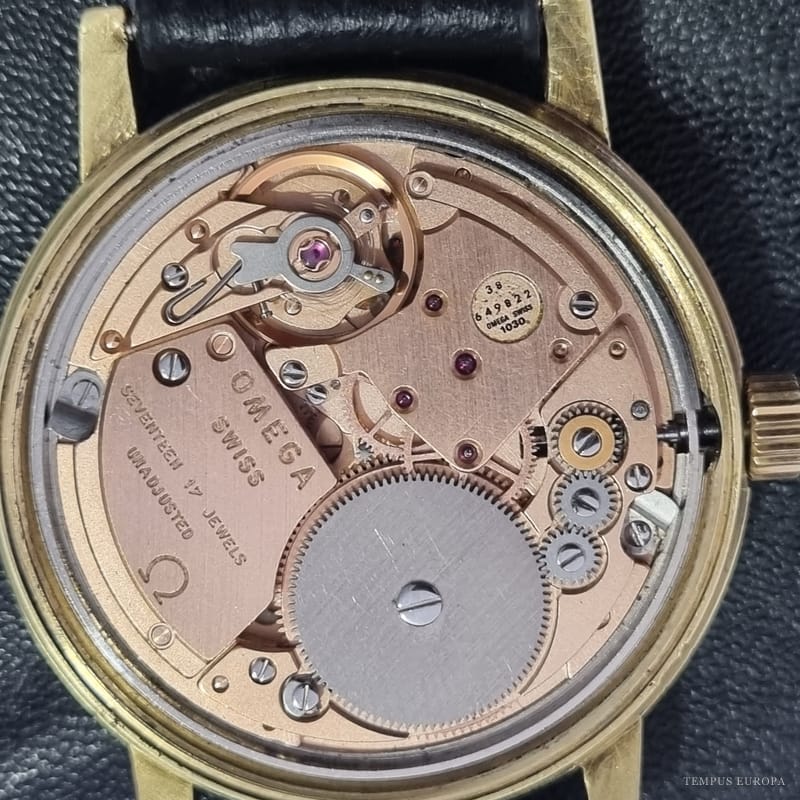
One more thing that throws people: the mainplate is engraved UNADJUSTED. That is neither a fault nor a stripped-back version of anything — Omega simply did not have these regulated in positions. You will never see the word on a chronometer.
1030 versus 1022
Same escapement, same frequency, same family resemblance. The difference is what sits on top.
| 1030 | ||
|---|---|---|
| Winding | Hand-wound | Automatic |
| Jewels | 17 | 23 |
| Calendar | Date | Day and date |
| Frequency | 28,800 vph | 28,800 vph |
| Over the rotor space | A dummy bridge | The automatic module |
The 1022 is the calibre Omega wanted to sell. The 1030 is the same project trimmed to hit a price, at a moment when hitting a price was the whole game.
On the wrist, the practical difference is that one needs winding every morning and the other does not.
How to make a hand-wound movement out of an automatic
Omega had been building the 1000 series since 1968: automatics with date running at 28,800 vph, in 17, 20 and 23-jewel versions. In 1974 it brought out two hand-wound derivatives on the same base, the 1030 with a date and the 1035 without.
The operation was exactly that literal. Take out the automatic module, leave the space, cover it with a decorative bridge. Everything else — escapement, going train, frequency, calendar — comes straight across from the automatic. Ranfft puts it without diplomacy: an obvious derivative of the automatic design, with the empty space hidden under a dummy bridge.
Production ran to 1984 and reached some 314,000 pieces. Ten years is a long run, but these were the ten years in which quartz was eating the market. The 1030 nearly always ended up in mid-range dress watches: slim-cased Genève models, most of them gold-plated and a few in solid gold.
Two oddities from the factory
- A bridge that holds nothing down Open a 1030 and you find an empty space shaped exactly like the automatic module it does not carry. Omega covered it with a bridge that has no mechanical function at all: it is there so the movement does not look unfinished when the caseback comes off.
- An indirect minute and seconds train, for no reason In the automatic, the indirect minute and seconds train existed to clear the centre of the movement so a decent rotor bearing could go there. The 1030 has no rotor, so the complication buys nothing. Ranfft dismisses it as 'rather useless', and it is hard to argue.
Technical data
| Diameter | 25.94 mm (11½ lignes) |
|---|---|
| Height | 3.70 mm |
| Frequency | 28,800 vph (4 Hz) |
| Lift angle | 52° |
| Shock protection | Incabloc |
| Jewels | 17 |
| Power reserve | 45 hours |
| Functions | Centre seconds with hacking, quickset date |
| Adjustment | None (UNADJUSTED on the mainplate) |
| Base | Omega 1000-1035 series |
On the bench
Lift angle 52°, the same as the rest of the family.
Mainspring Omega 1030-1208, 0.950 × 11.500 × 0.120 × 480 mm. Balance staff Ronda 5997. Because it shares its architecture with ten other calibres, from the 1000 to the 1035, hunting for spares is one of the easier jobs in 1970s Omega.
The dummy bridge comes off like any other. There is nothing underneath it to lose.
Watches that used it
- Omega Genève with date, refs. 136.0099, 136.0102 and 136.0104
- Gold-plated and 9-carat gold Omega dress watches from the mid-1970s