Imagen: Longines, web oficial
The storyWhy this reference matters
The Master Collection arrived in 2005 with an uncomfortable brief: be the line where Longines proves it can do proper classical watchmaking and not just watches that are pleasant to wear. That's where the house complications went — moon phase, retrograde calendar, monopusher chronograph — and where the codes that still define it were set: a round case with no hard edges, blued leaf hands, barleycorn guilloché, and a date that doesn't raise its voice. Twenty years on it's still the collection Longines measures itself by.
Inside runs the L888, a calibre ETA builds exclusively for Longines, and it hides an odd decision: instead of turning at the usual 28,800 vibrations per hour it drops to 25,200. Lower frequency, yes, but seventy-two hours of reserve in return — and that's the part you actually notice when you leave the watch in a drawer on Friday and it's still going on Monday without asking for anything. The sapphire back shows the oscillating weight at work, which is no trivial piece of decoration: it obliges the movement to be finished with some decency.
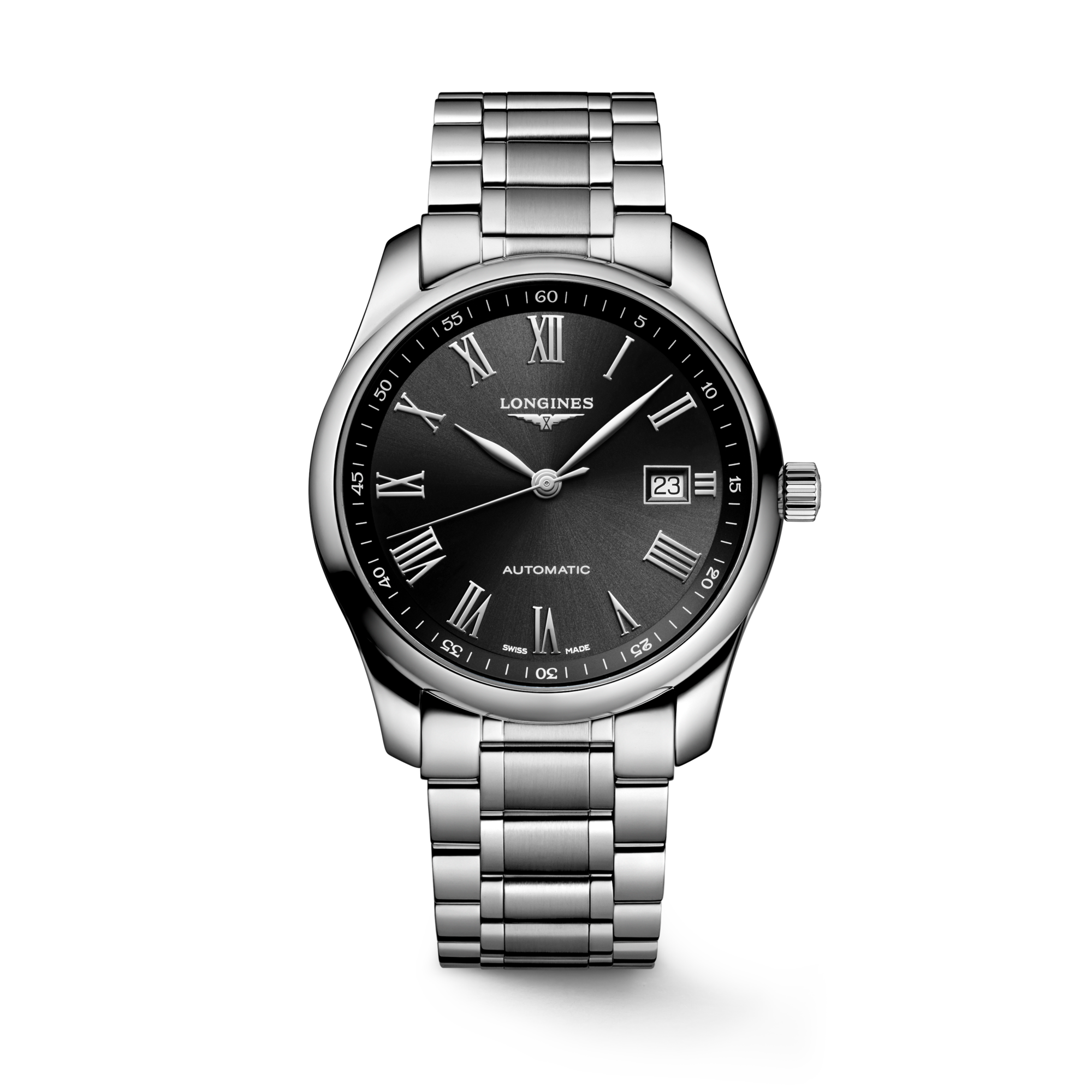
In 2026 Longines redid the collection from top to bottom. The 40 and 42 mm gave way to 39 and 41 mm cases, flatter at 9.05 and 9.50 mm, with a far more pronounced stamped barleycorn and sharper leaf hands. This reference, the L2.793.4.59.6, belongs to the batch before: a round forty millimetres, black dial, applied Roman numerals. You can still find it in shops, but it belongs to the chapter that's closing.
SpecificationsThe numbers, in one table
| Brand | Longines |
|---|---|
| Family | Master Collection |
| Reference | L2.793.4.59.6 |
| Calibre | Longines L888 |
| Movement | Automático |
| Frequency | 25.200 alt/h (3,5 Hz) |
| Power reserve | 72 horas |
| Complications | Fecha |
| Diameter | 40 mm |
| Thickness | 9.35 mm |
| Case | Acero inoxidable |
| Crystal | Zafiro con antirreflejos en ambas caras; fondo de zafiro |
| Water resistance | 3 bar (30 m) |
IdentificationHow to tell it apart
Forty millimetres on the nose, 9.35 tall, black dial with applied Roman numerals, date at three, polished hands. The tail of the code does the work: .59 is the black dial, and the final 6 is the steel bracelet with a triple-safety folding clasp and push-button release. The same dial on leather carries a different number.
Longines doesn't use the word barleycorn for this dial — that name is kept for the silvered grained ones — so if the photograph shows a heavily marked guilloché and the case is listed as 39 or 41 mm, you're looking at the 2026 generation and not this. The new one is flatter as well, with sharper leaf hands.
At the back, a screwed sapphire case back. And watch the number that causes the most grief: 3 bar. That's a dress watch that survives rain and not much else — no pool, no shower, no beach. If the example in front of you has moisture marks under the crystal, you know where it's been.
CollectingWhat collectors check
The first thing anyone with hours behind a counter looks at is the bracelet: Master links work loose over the years, and the triple-safety clasp should shut with a snap rather than need escorting home. Then the polished flanks of the case, which mark if you look at them too hard and which a heavy polish thins for good.
On the movement, check the date snaps over cleanly near midnight and that the reserve gets where it should. If it starts losing time the day after a full wind, the barrel or the service schedule wants attention. The L888 is a well-understood ETA base, so there's no drama over parts or over finding a watchmaker who'll open it — and ten years out, that counts for more than it looks.
A market thought: with the collection redesigned in 2026, this 40 mm with Romans becomes the last version of a format that suited a lot of people better than the new 39 and 41 do. Nobody is going to speculate on it, but it is one of those watches people miss once it's gone from the catalogue.
Common questionsWhat people ask us about this reference
Which calibre is in the 40 mm Longines Master Collection?
The L888, an automatic ETA builds exclusively for Longines. It runs at 25,200 vibrations per hour and gives around 72 hours of power reserve.
Can the Longines Master Collection get wet?
Splashes only. It's rated 3 bar, a nominal thirty metres, which in practice means washing your hands without worrying. No pool, no shower, no sea.
Does the Master Collection have a display back?
Yes, a sapphire back showing the rotor and the finishing of the calibre. It has been one of the collection's signatures since it launched in 2005.
How does it differ from the new 41 mm Master Collection?
In 2026 Longines redid the collection: 39 and 41 mm cases, flatter at 9.05 and 9.50 mm, with heavily stamped barleycorn dials. This 40 mm is the earlier generation.
Keep readingWhere to go from here
Close relativesThe ones it gets confused with
Confidence: media — this page was checked against the sources below. If a detail looks wrong to you, write to us and we will fix it.