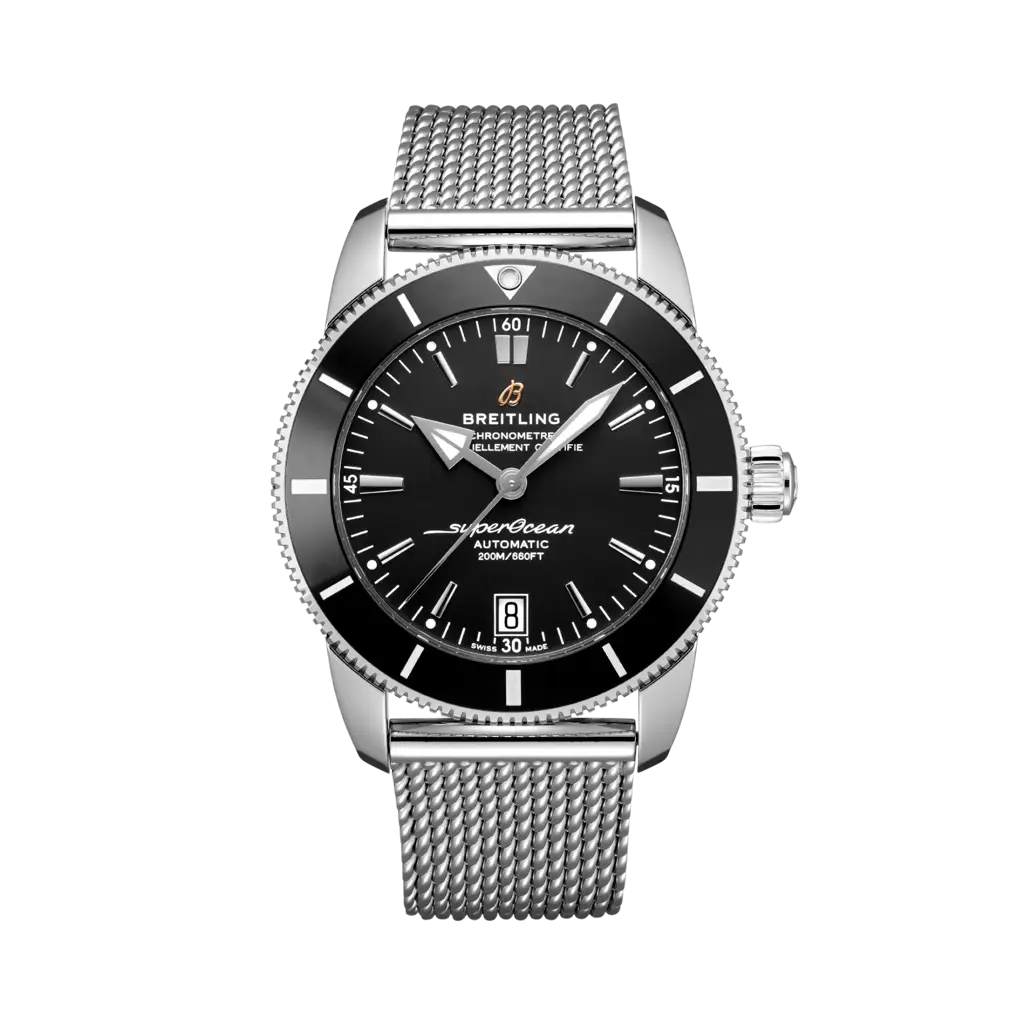
Imagen: Breitling, web oficial
The storyWhy this reference matters
The original Superocean is from 1957 and arrived in two flavours: reference 1004, a three-hander, and reference 807, a dive chronograph that was the first of its kind and, incidentally, the first reverse panda dial anyone had made — silver registers on black. Both were rated to two hundred metres, a serious number for the time. Breitling came late to diving and made up the ground with engineering rather than advertising.
In 2007, for the collection's fiftieth, the Heritage line appeared. The modern Superocean had been filling up with contemporary sizes and contemporary dials, and this branch went back to the fifties: triangular hands, clean bezel, proportions kept in check. What makes the B20 genuinely interesting, though, is not the drawing. It is the mechanics. At Baselworld 2017, Breitling and Tudor announced a swap of movements — an unusual thing for two firms competing for the same shelf space in the same shop.
The trade was symmetrical. Tudor took Breitling's in-house chronograph, fitted its own regulating organ and badged it MT5813 for the Black Bay Chrono. Breitling took Tudor's MT5612, dressed it in Côtes de Genève with gilt engraving, and called it the B20. That single move almost doubled the running time against the ETA-based calibres the collection had used — thirty-eight hours to seventy — and threw in a silicon hairspring and a COSC certificate.
SpecificationsThe numbers, in one table
| Brand | Breitling |
|---|---|
| Family | Superocean Heritage |
| Reference | AB2010 |
| Years made | desde 2017 |
| Calibre | Breitling B20 (manufactura, sobre base Tudor MT5612) |
| Movement | Automatico |
| Frequency | 28.800 alt/h (4 Hz) |
| Power reserve | Aprox. 70 horas |
| Jewels | 26 |
| Complications | Fecha · Bisel giratorio unidireccional |
| Diameter | 42 mm |
| Thickness | 14.35 mm |
| Lug width | 22 mm |
| Case | Acero inoxidable |
| Crystal | Zafiro abombado con tratamiento antirreflejos en ambas caras |
| Water resistance | 20 bar (200 m) |
IdentificationHow to tell it apart
The AB2010 is the 42 mm size in the family. You know it by the unidirectional bezel with its polished ceramic ring — glossy, not matte — and by the triangular hands lifted from the fifties Superocean. Steel case, 42 mm by 14.35 mm, screwed case back, screw-down crown on two gaskets, twenty bar. The lugs are 22 mm, tapering to 20 at the clasp.
Watch the name, because it changed along the way. This exact watch was first sold as the Superocean Héritage II B20 Automatic 42, and later, when Breitling tidied up its naming, it became simply the Superocean Heritage B20 Automatic 42. The reference AB2010 did not shift a single digit. If you find both names attached to the same code in a listing, nothing is wrong.
The case back is solid, so the way to confirm a B20 is the paperwork and the year. The previous Heritage generation ran ETA-based calibres good for thirty-eight hours, and since the collection's 2025 relaunch the 42 mm Heritage has moved on to the B31. The B20 occupies the middle stretch, opening in 2017: a chapter with a start and a finish.
CollectingWhat collectors check
The whole reason to buy this watch is the movement, so start there. A healthy B20 should give you seventy hours and mean it: wind it right up, leave it off for a full weekend, see whether it is still running on Monday morning. If it stops somewhere in the forties, the barrel or the regulation needs a bench. The hairspring is silicon, which means magnets are irrelevant to it, and also means that part is never coaxed back into shape. It is replaced.
Then the ceramic bezel. It is polished, so it records every knock it has ever taken: hold it to the light and hunt for chips along the edge, particularly between twelve and three, which is the arc that meets door frames. A chipped ceramic ring does not get polished out. It gets replaced. The bracelet should close with no side-to-side play, and on the Milanese mesh version check that the adjustment runs smoothly and that the weave has not gone oval with wear.
On variants, the AB2010 came in black, blue and green, on a steel bracelet, mesh or rubber. The limited editions built for a particular country or city hold interest better than the standard catalogue pieces. And one daft check that everybody forgets: turn the bezel a full revolution and listen. If it skips a click, or if it turns both ways, the part is damaged — and on a dive watch that is not a cosmetic complaint.
Common questionsWhat people ask us about this reference
Which movement does the Breitling Superocean Heritage B20 use?
The B20 calibre, which is Tudor's MT5612 redecorated by Breitling. It gives around seventy hours of reserve, runs a silicon hairspring and is COSC-certified. It arrived through the movement swap the two brands announced in 2017.
Are the Superocean Héritage II B20 and the Superocean Heritage B20 the same watch?
Yes. One watch, two commercial names in sequence; Breitling dropped the II when it reorganised its naming. The AB2010 reference never changed, so that number is the one that counts.
How deep can it go?
Twenty bar, two hundred metres, with a two-gasket screw-down crown and a unidirectional bezel. Fine for swimming and for recreational diving, provided the gaskets are in good order and get checked at intervals.
How much power reserve does it have?
About seventy hours, against the thirty-eight of the ETA-based calibres in the previous Heritage generation. That jump is precisely what the Tudor deal bought.
Keep readingWhere to go from here
Close relativesThe ones it gets confused with
Confidence: alta — this page was checked against the sources below. If a detail looks wrong to you, write to us and we will fix it.