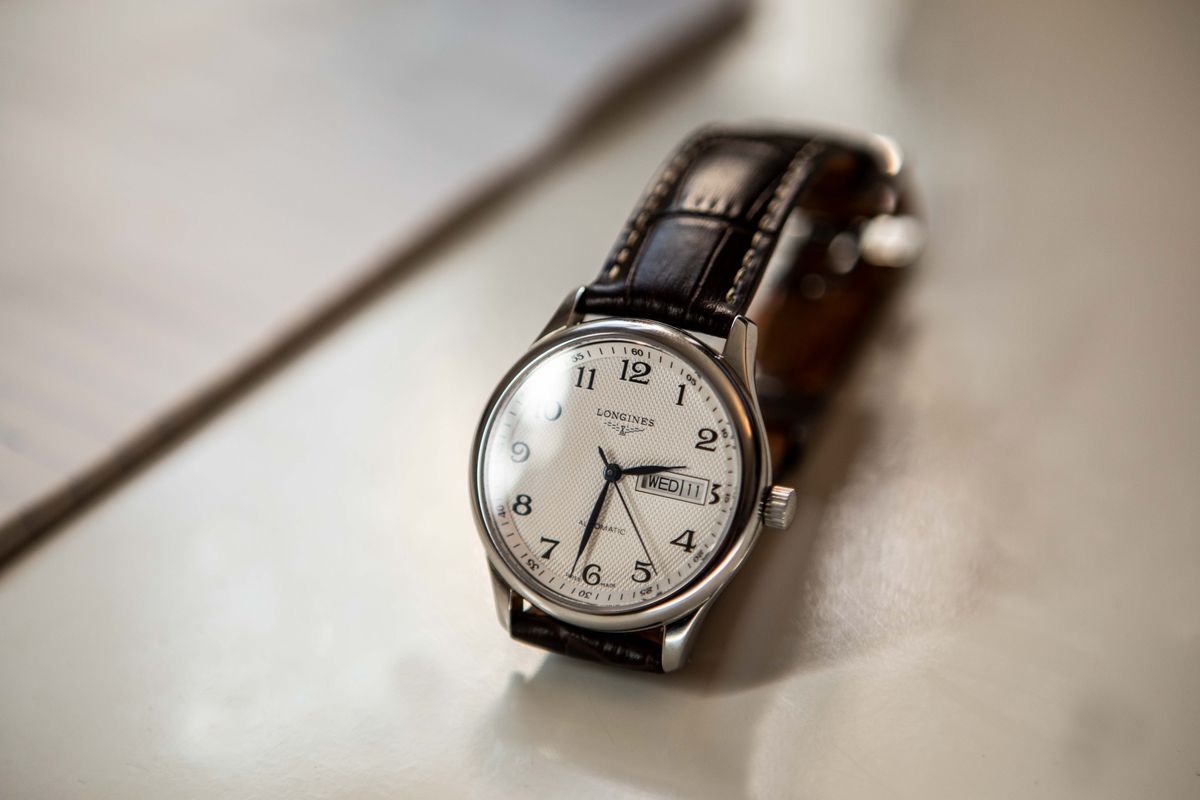
Explorers, aviators and international sporting bodies all took their timing from Longines, and for most of the twentieth century the firm sat among the most respected manufactures in Switzerland. Seven calibres here cover that stretch: the 13ZN flyback chronograph built for the cockpit at one end, the modern L.688 automatic chronograph at the other. Click a calibre number to open its page.
| Calibre | Type | Jewels | Frequency | Years | Key note |
|---|---|---|---|---|---|
| 13ZN | Hand-wound chronograph, flyback | 17 | 18,000 vph | 1930 – 1940 | The aviation chronograph that made the name |
| 12.68Z | Hand-wound | 17 | 18,000 vph | Mid-20th century | Classic manual winding, nothing exotic |
| 30L | Hand-wound | 17 | 18,000 vph | Mid-20th century | The benchmark inside the Flagship and the Conquest |
| 340 | Automatic | 24 | 18,000 vph | Mid-20th century | First Longines automatic with a centre rotor |
| 290 | Automatic | 24 | 21,600 vph | After the 340 | The automatic generation that stepped up to a faster beat |
| 490 | Hand-wound | 17 | 21,600 vph | From 1969 | A bought-in ébauche, finished by Longines |
| L.688 | Automatic chronograph | 27 | 28,800 vph | Modern | The automatic chronograph of the modern era |
How to identify a vintage Longines
The calibre number is engraved on the movement bridge and shows as soon as the caseback comes off. On the aviation models such as the 13ZN, check the case reference against the calibre as well — the two agreeing is what tells you the watch is what it claims to be.